Make Do With Your God-Given EVIL! “Bad Biology” reviewed! (Severin Films / 4K UHD – Blu-ray)

“Bad Biology” on 4KUHD and Blu-ray Combo Set. Purchase Here!

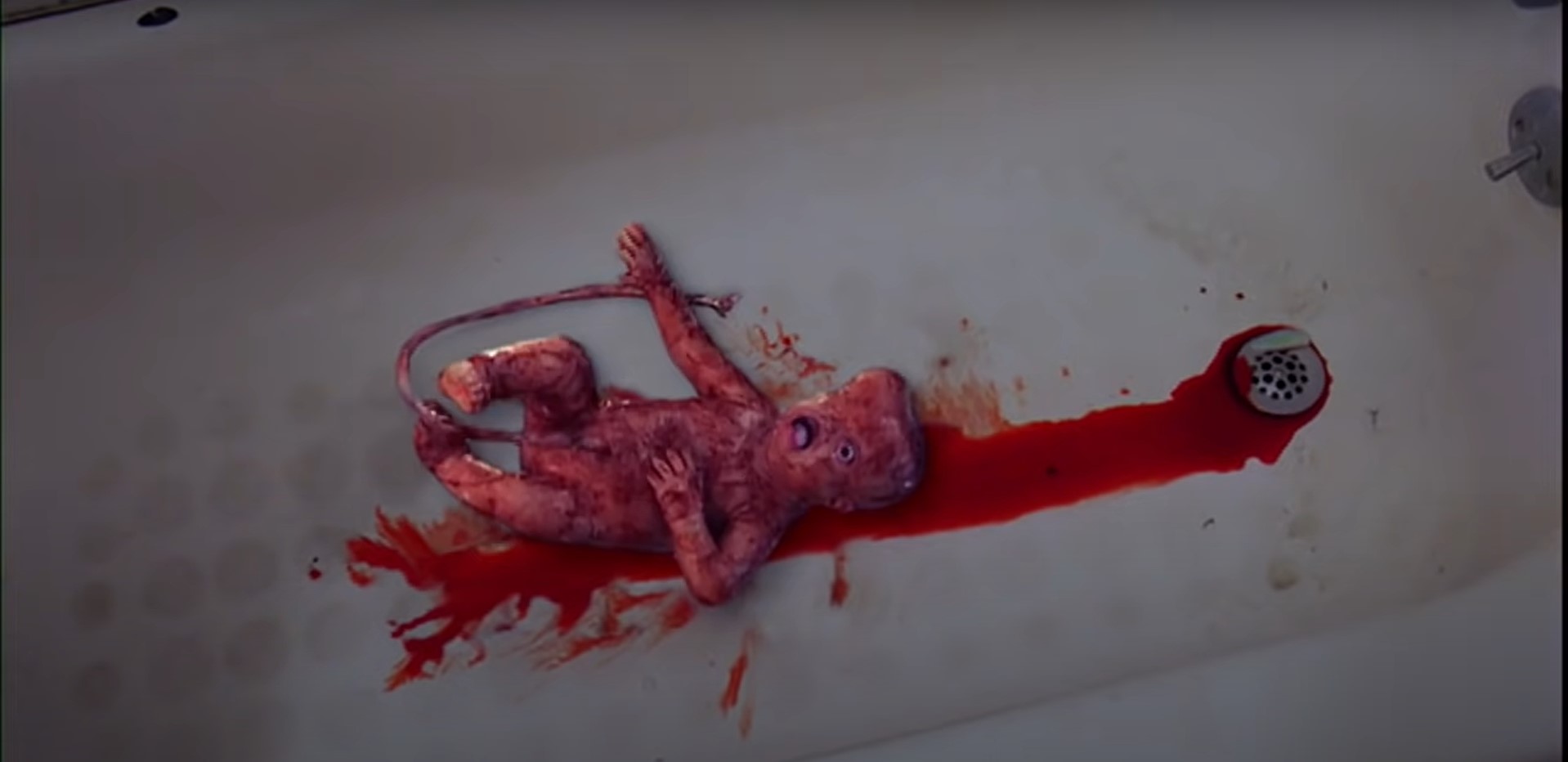
Jennifer and Batz don’t know each other and live two totally different lives but they have one thing in common, they are enslaved by their abnormal sexual organs.  Jennifer, a young provocative photographer, embraces her vagina’s biological differences and immensely magnified hormones whereas Batz suffers monstrously from his radical rehabilitation of a once limp manhood.  The contrasts continue as Jennifer must scratch the inflamed itch to be penetrated, luring men with her insatiable lust that ultimately end in their demise with an irrepressible emotional sway, whereas the botted-up Batz’s love life is virtually bankrupt due in fear of his conscious and uncontrollable enlarged penis.  When Jennifer happens upon Batz in her peripheral during a photoshoot, she finds him intriguing enough to break into his home and watch him with a prostitute.  The experience left the prostitute with a continuous orgasm long after penetration was over and left Jennifer with an impression that her vagina has finally found it’s match in life. 

Seventeen years.  That’s how long the inactivity span was between Frank Henenlotter’s last directed film and his next.  Not since 1991 did Henenlotter, the madcap mastermind behind some of the more than unusual creature-esque concepts surrounding sexuality, addiction, and childbirth in a way that sheds light on society’s blatant distaste for the odd and grotesque,  profess his creative talents with his trademark dark humor and unabashed practical effects that campy the content toward much to our enjoyment again until returning to the director’s chair with the 2008 shlock-sleazy horror-comedy “Bad Biology,” cowritten alongside American rapper R.A. “The Rugged Man” Thorburn as the musicians first taste of the film industry.  Shot in and around the New York metropolitan area, “Bad Biology” is also produced by Thorburn alongside associate producers Dario Correale, Nicholas Deeg, Antonia Napoli, Vinnie Paz, and star Anthony Sneed under the LLC created for Bad Biology. 

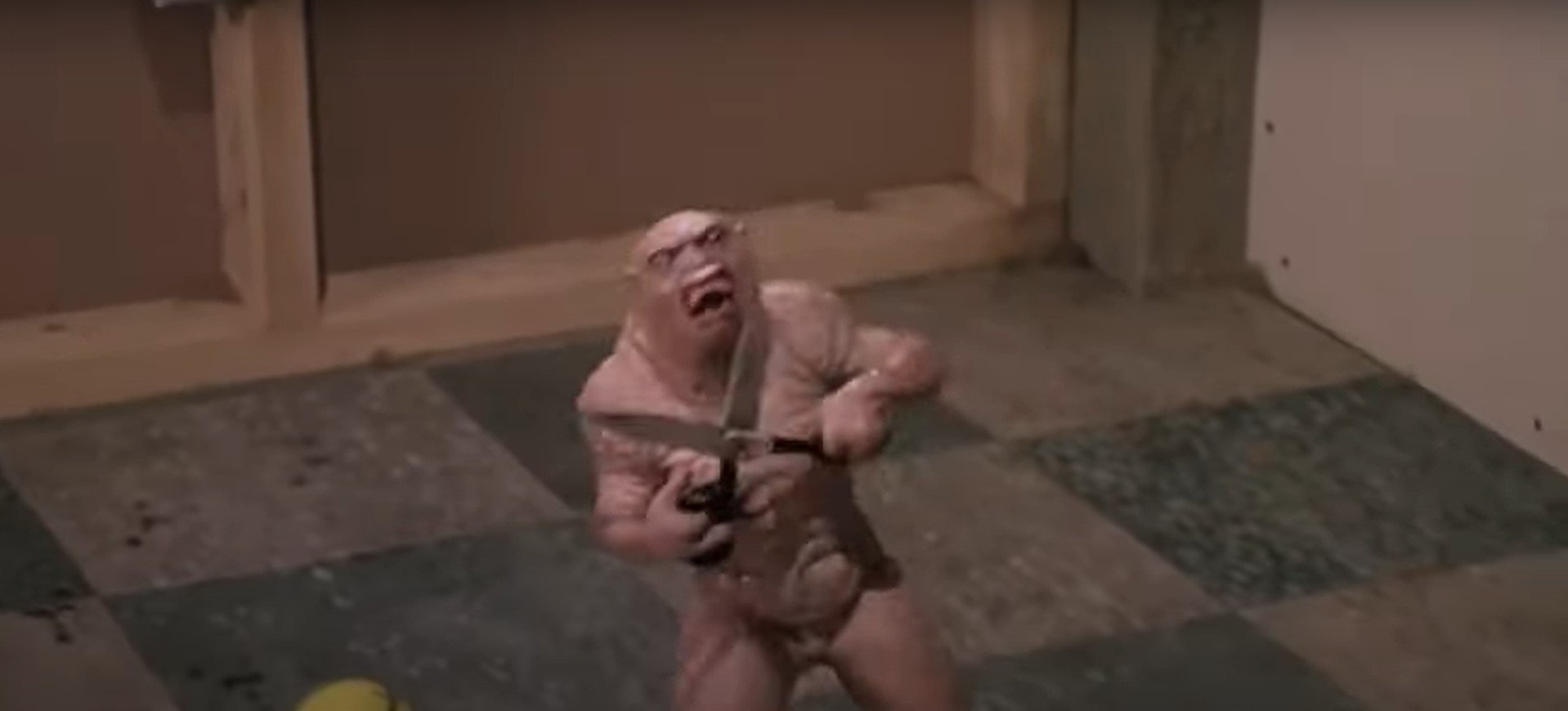
Not many would take on a role with heightened sexual absurdity, especially one with a puppeteered penis on the hunt for feminine pelvic regions or where a numerous clitorises ramp up sexual drive into murderous overdrive.  Yet, first time actors Charlee Danielson and Anthony Sneed seem game for the roles as lonely sexual misfits Jennifer and Batz.  To debut right out the gate as a character proclaiming to have 7 clits in the very first scene can’t be easy and I’m sure a deluge of thoughts questioning just what in the ridiculous Hell did I get myself into accelerated through her thoughts but Charlee Danielson doesn’t pull punches or need a second to rethink life choices in the feed the need role of lust, sex, kill, labor, birth and repeat.  Same can be said about Anthony Sneed’s slinking and desperate peculiarities for Batz and Sneed’s willingness to browbeat his own anaconda trouser snake to assert back in being control.  Danielson and Sneeds have tough jobs but pull off Henenlotter and Thorburn’s grotesquely envisioned gallows humor and body horror.  While the confidence is there, the experience is not resulting in a stiff, monotone performances in nearly every scene and that can dampen the story’s eccentrical principals who are just delivering the lines instead of taking the lines to heart.  Being that “The Rugged Man” is a rapper, the cast is comprised of other likeminded musical artists, mostly rappers as well, with Remedy, J-Zone, Vinnie Paz, and Reef the Lost Cause along with cameos from other artists and music producers.  And being a film mostly about sex, “Bad Biology” fills out the cast with models and actors very comfortable showing their skin in Vivian Sanchez, Carolyn Thompson, Brittany Moyer, Vicky Wiese, Ginger Starr, Vladislav S., and well-verse indie horror scream queen Tina Krause (“Crimson Nights”, “The Fappening”).

Outrageous with bad taste, “Bad Biology” prides itself with point-blank profaneness and kitschy special effects, a resounding typical Frank Henenlotter production as the director hasn’t seemingly lost a step in 17 years between films.  Yet, the story’s infiltrated by the need to incorporate strong personality cameos and is uneven in a way that hyper focuses on Jennifer’s quest, with inner monologuing, flashbacks, and direct camera speaking surrounding her spiritual search of a satiable schlong for her specialized snatch, becomes subverted by Batz’s less significantly told story quickly summed up in introspection while being pleasured by a homemade, industrial-sized masturbator.  Doesn’t quite feel Batz receives the same valued introduction in contrast to his female counterpart, but he quickly forges a more interesting path having a roid-raging, self-aware, monster cock that’s addicted to large animal anabolic steroids and is isolated from the rest of the world.  As polar opposite in the way Jennifer and Batz view and handle their sexual anomalies, the pair make the perfect odd couple, like “Ghostbusters’ Key Master and Gatekeeper, but at the cost of their own stories and their inevitable hookup that becomes flattened by a steamrolling climatic slasher-esque moment that doesn’t really involve them at all, segregating the leads momentarily from their own catalytic arc that deflates the finale into a flaccidity.  Most of the comedy also falls flat but the dialogue is well bulbous in the skilled rhapsody and written dialogue that shocks and awes with every depraved bluster.

Scanned in 4K from the camera negative, “Bad Biology” receives a UHD plus Blu-ray 2-disc set from Severin Films. The HEVC encoded, ultra high-definition 2160p, BD100 and the AVC encoded, high-definition 1080p, BD50 are both presented in a widescreen 1.78:1 aspect ratio. The 4K scan fills in the gaps of next stage video evolution though the gaps filled are minuscule at best. What makes the real difference is Henenlotter shooting in Super 35mm that provides a gritty grain overlay and similar, if not identical, saturation as film stock. Finer details more in the setting aspects, around darker areas, that are more illuminated by the pixel increase. Skin tones and grading are naturally set without much of a stylistic presence other than the gels used for the giant penis vision and the peering from inside-out Jennifer’s Uterine cavity. I do think facial details are not as firm, possibly smoothed too much during the restoration. The English language audio options include a lossless DTS-HD 5.1 Master Audio and a 2.0 stereo. Presenting flawless dialogue within the heavy soapboxing monologues and philosophical diatribes, “Bad Biology” promenades dialogue as an important part to the film’s machination. This doesn’t mean everything is flounders with a range of outrageous sound effects, including the gushings of childbirth, the whooshing whips of a conscious monster male member, and the squishy ins-and-outs of copulation. Spatial depths have finite proportions that relinquishes true depth to keep audiences near the action audibly. Closed caption English subtitles are optionally available. The 4K disc might have a capacity of 100 gigabytes but the format’s space on this release is quickly depleted for the feature and two audio commentary tracks – one with director Frank Henenlotter, director of photography Nick Deeg, and actor Anthony Sneed while the second commentary also includes Henenlotter and cowriter/producer R.A. The Rugged Man Thorburn. Both commentaries are also on the Blu-ray, housing over 5+ hours of special features which includes interviews with a Spook House entitled segment featuring interviews with Henenlotter, Thorburn, Deeg, production coordinator Michael Shershenovich, production manager Chaz Kangas, and David Henenlotter, an unorthodox interview between a basketball and actress Charlee Danielson In the Basement with Charlee Danielson, a lengthy back and forth question and answer between actor Anothy Sneed and cinematographer Nicholas Deeg, an interview with special effects artist Gabe Bartalos (“Frankenhooker,” “Basket Case 3”) Swollen Agenda, a behind the scenes of the film, photographer Clay Patrick McBride snapping cast and crew O-faces around Henenlotter’s apartment in F*ck Face, short film “Suck” directed by Anthony Sneed, R.A. The Rugged Man Thorburn music video for “Legendary Loser,” an imagine gallery, behind-the-scenes shots, and video covers and death stills. The standard 4K UHD release comes in the traditional black Amary case with an O-face compilation compositional cover art and has a lock-tabbed disc on each side. The release does not come with a reversible covert art or insert. Both idiosyncratic disc arts have whimsically crude caricatures of the main characters. The region free release has a runtime of 84 minutes and unrated.

Last Rites: “Bad Biology” marks a return to ungovernable psychotronic cinema for filmmaker Frank Henenlotter with new blood, a new story, and the same old objectionable orifices and organs of monstrous body horror.

“Bad Biology” on 4KUHD and Blu-ray Combo Set. Purchase Here!

Backyard is Spacious, Green, and has an EVIL Portal to the Underworld! “The Gate” and “The Gate II” reviewed! (Via Vision / Blu-ray)

Better Hurry! Amazon Has a 20% Coupon for This Very Release! Limited to 1500 Copies.

The Gate

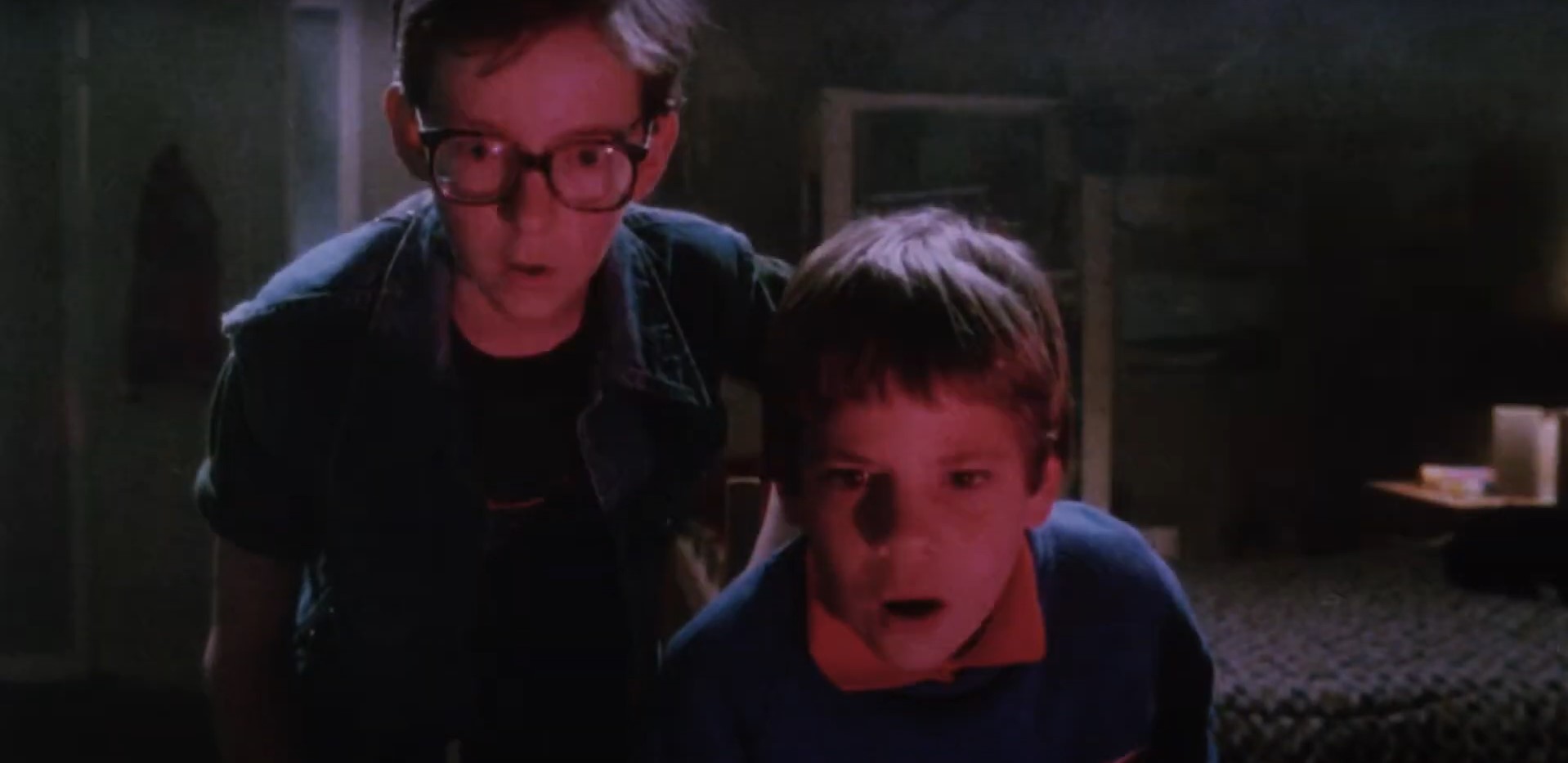
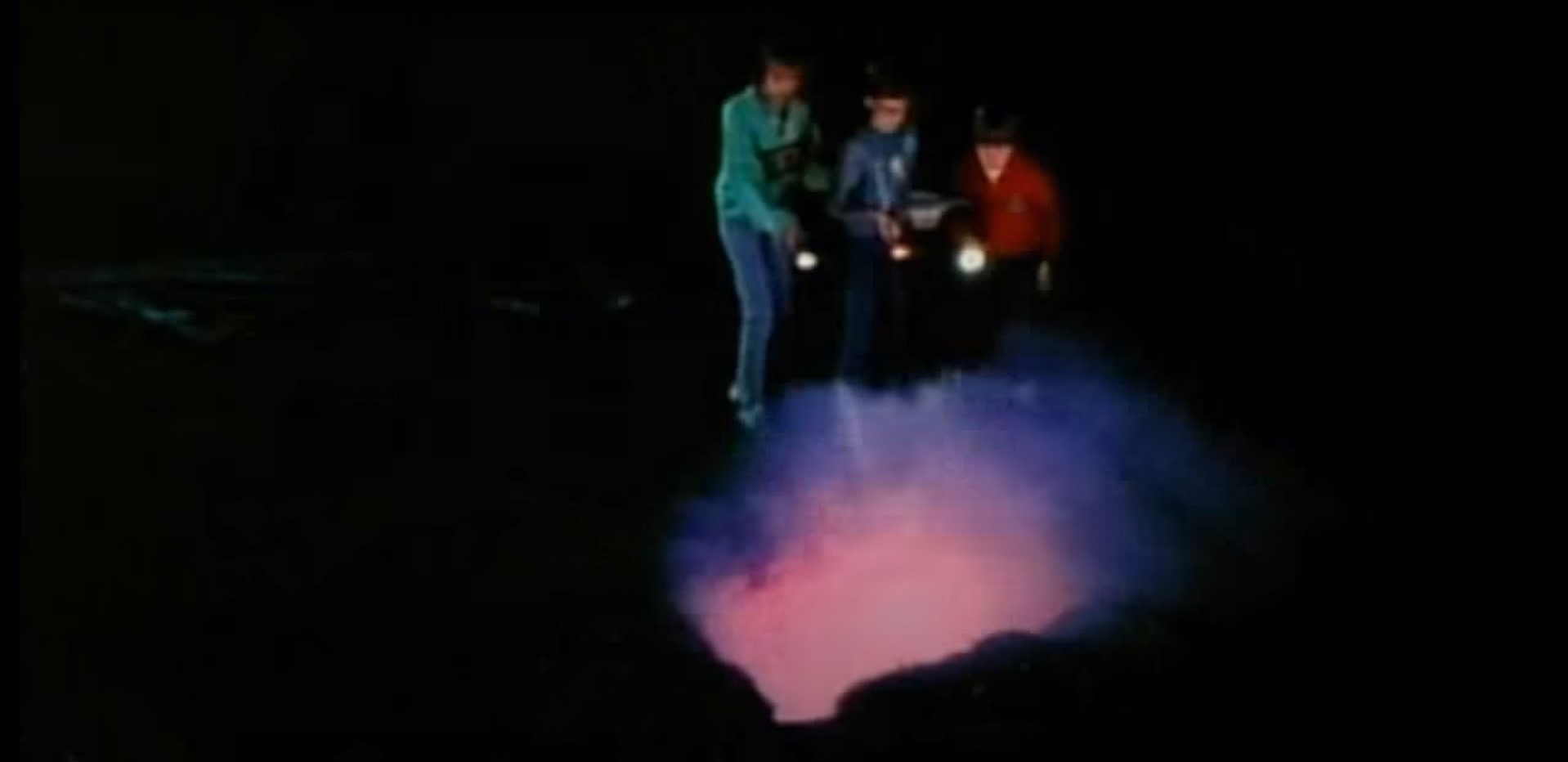
A severe storm brings down Glen’s treehouse, leaving a giant hole in his background.  Discovering what looks to be precious geode rocks, Glen and his friend Terry continue to dig hoping to strike larger, more valuable, geodes.  When they come upon a sizable rock, breaking it open unveils a crystalized liner of colorful minerals as well as a strange gas that unearths an incantation to open a gate to the underworld.  With Glen’s parents gone for the weekend, he, his teenage older sister Al, and Terry must somehow reverse the opening of the gate but demonic-serving, pint-sized minions hunt down a pair of human sacrifices in order to unleash their powerful demon master, an old God reemerging from being locked away from Earth for billions of years.  Serving the night is a fight for their very lives as the minions use their cunning tricks and supernatural powers to deceive the home alone kids into traps in order for there to be Hell on Earth. 

Created in mind to appeal to children with the limitless possibilities of a child’s imagination, “The Gate” caters to a wide audience of all ages.  Hungarian-born Director Tibor Takács and American-born writer Michael Nankin bring out of the shadows the scary corners of a young mind into the light with a demonic tale, a portal from another plane of existence, and a theme of growing up and being accountable in a context of taking head on a doomsday event without mommy and daddy.  The 1987 released Canadian production, shot mostly around Ontario, is the first of two “The Gate” films under the studio flag of Alliance Entertainment.  Presented by New Century Entertainment, as one of the company’s limited credits, “The Gate” is produced by fellow Hungarians in Andras Hamori, who went on to produce fellow Canadian filmmaker David Cronenberg’s “eXistenZ,” and “Quest for Fire” and “The Wraith’s” John Kemeny.

The Gate II:  The Trespassers

Five years after narrowly surviving near Hell of Earth, Terry’s obsession to return to Glen’s abandoned and dilapidated home and resurrect the demonic powers of wish granting stems from his jobless father’s dwindling livelihood, drinking himself into a stupor every night at the bottom of a bottle.  With equipment powered to project his incantations and protect him from evil, Terry is about to begin his summoning when interrupted by three teens led by bad boy John who mostly ridicules his fixation until one of the pint-sized minions comes out of the shadows and is quickly gunned down by John.  The injured minion self-heals and is captured for wish granting exploitation but when the wishes turn into a disastrous chimera, Terry soon realizes that his summoning has not just been answered for selfish motives, but it also re-opened the portal for three power demons to transmogrify from within him and his friends. 

The success of “The Gate” sought the fast tracking of a follow-up story produced within two years’ time after that spoke a different tone and came in a different approach to the nightmarish content and the age of the kids.  Takács and Nankin reteam for “The Gate II:  The Trespassers” who, at the authoritative behest of executive powers, had to take the fantastical lining of a child’s imagination to more extreme measures that evolved the original film’s grotesquely saturated PG-13 rating into a lighter, water downed R rating, removing a good chunk of the viewer base from a theatrical run.  The 1990 released venture was also shot at some of the same sets in Ontario Canada as the first film with Alliance Entertainment returning as producing studio and Vision International presenting to the world.  Andras Hamori and John Kemeny also return as producers.

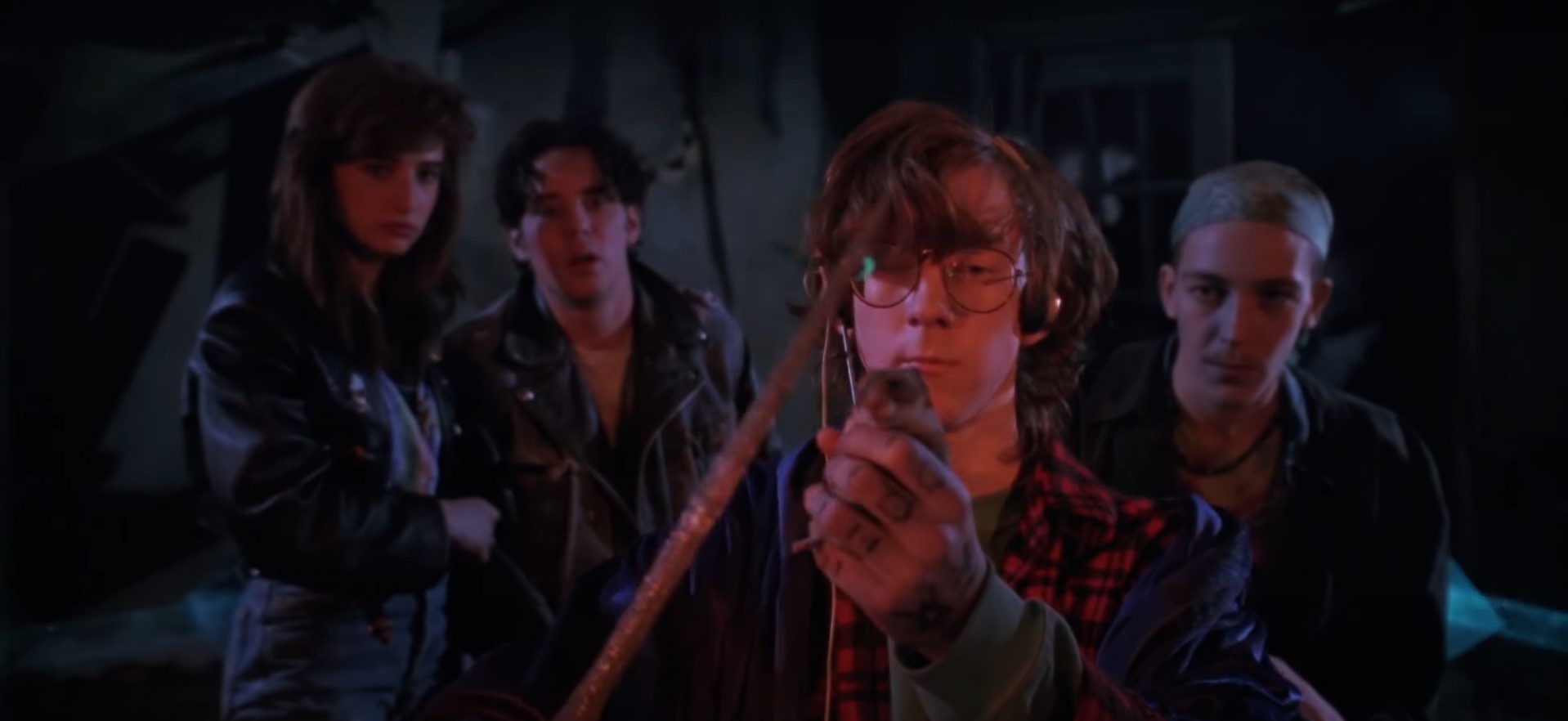
Doesn’t take the understanding mechanisms of rocket science to discern “The Gate’s” cinematic victory.  Demons were all the rage in 80’s from Italian eurotrash to American grindhouse and why shouldn’t the Canadians get into the action?  Special and makeup effects, in themselves, are tremendously impressive, as aspect we’ll go thoroughly more into later in the review.  Yet, the one golden ticket area that deems “The Gate” as an unsullied hero of PG-13 horror is the unaccompanied children misadventure narrative coupled with, or maybe elevated by, good dialogue sanctioned by even better performances.  The 80’s saw scads of children in danger storylines that either had no responsible adult in sight or the adult party was the adversarial danger.  “Explorers,” “Adventures in Babysitting,” “E.T.,” and, one of the biggest examples of all, “The Goonies,” caddied the action-adventure and thrills-and-chills long game for the better part of the 80s decade and “The Gate” teed up on the opportunity, bringing together a trio of varying degrees of adolescents to go toe-to-toe with an ancient evil in what would have been seen as a no-win situation.  In his feature film debut, the barely teenage Stephen Dorff (“Blade”) lead the trio as the highly impressionable and model rocket enthusiast Glen, the youngest of the cast to be the one to save them all, including big sister Al, played by Christa Denton, and best friend Terry, played by Louis Tripp.  Tripp would go on to be principal lead in the sequel that veered away from the fantastically supernatural misadventures of innocence into a more older teen intrinsic narrative that no longer saw the world warp through youthful eyes.  While Tripp segues seamlessly in his role, he finds himself in new territory as the heavy metal and demonology aficionado sparks potential romantic interest in Liz (prolific voice actress Pamela Adlon, “Vampire Hunter D:  Bloodlust”) and is seized by arrogant bullies with two pot smoking hooligans Moe (Simon Reynolds, “P2”) and John (James Villemaire, “Zombie 5:  Killing Birds”), both instances a premiere example of the raw rite through to adulthood.  Again, “The Gate II” keeps adults at an arm’s length away, forsaking youth the challenge of cleaning up their own mess.  Both films fill out their respective performances from Kelly Rowan (“Candyman:  Farewell to the Flesh”), Jennifer Irwin (“Another Evil”), Deborah Grover (“Rated X”), Scot Denton (“Murder in Space”), Carl Kraines (“The Slayer”), and Neil Munro (“Murder by Phone”).

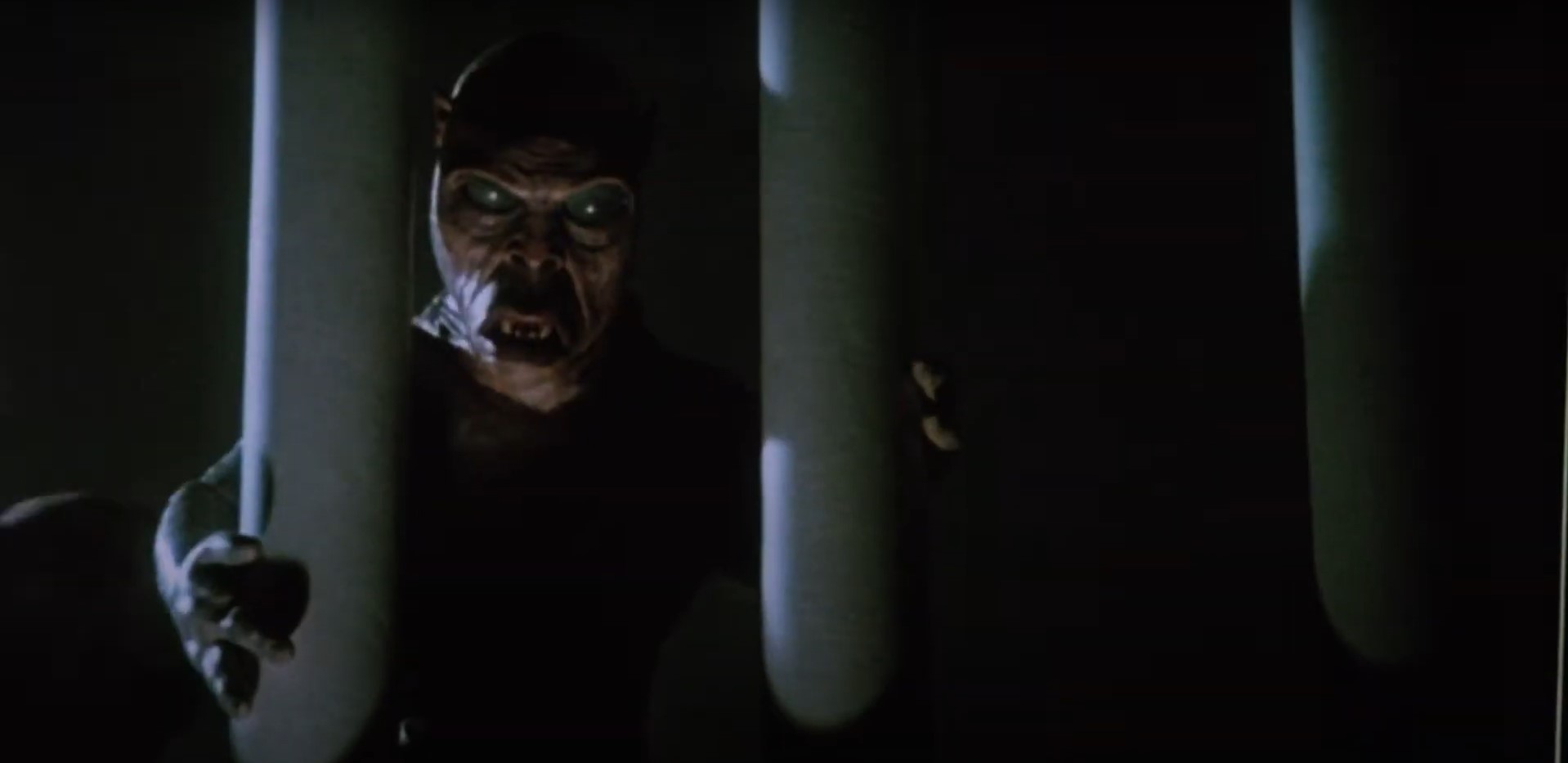
Special effects by the team of Randall William Cook, Craig Reardon, and Frank Carere couldn’t have pulled off an ambitiously suburban horror hyper focused inside Glen’s home any better.  Fashioning mind-bending illusions that are still marveled at to this day, Cook’s forced perceptions eliminates mostly the use of stop motion tactics for the miniature sized minions, replacing the rigid effect with a more lively physical man-in-suit option that smooths out the actions, attributing the creatures idiosyncratically with not only depth of perception to contrast sizes but also shot in a faster camera speed compared to which the seemingly normal sized actors would have to slow down their performances to become level with the creature.  The whole process is crazily multifaceted and mind-boggling effective if pulled out in great detail and “The Gate” team does so, twice, in face, between the two films, with Reardon’s fleshy creature designs enhancing the hideous zeal in the bulbously decaying Workman zombie and even in Reardon’s blamelessly slapped together endgame demons for the ordered change of a quickly surmised climax in the sequel.  As a collaborating unit, the special effects crew pulls off seamless transitions in what is captivatingly pure eye-candy of movie magic.  The stories themselves, especially in “The Gate,” are enchanting, full of mysterious and unpredictability, and stretches the imagination beyond the confining limit as we’re led to inevitable showdown only to be pleasantly accosted on the optics.  The sequel has a rougher go with the story as the narrative feels like a wound-up toy twisted tight to the threshold only to be released spinning in all different types of directions that ultimately lead to an exhausted stopping point. The stark contrast between the two films doesn’t offer a lot of subsequential continuity in narrative and even in some areas of the special effects but the silver lining in that last statement can be a sigh of relief in not receiving a rehashed product sought to recap or repeat off the back of the original’s success. Instead, “The Gate II” begs to be separated to be its own entity and does so while being a homage to the practical illusions that sparks awe, joy, and terror!

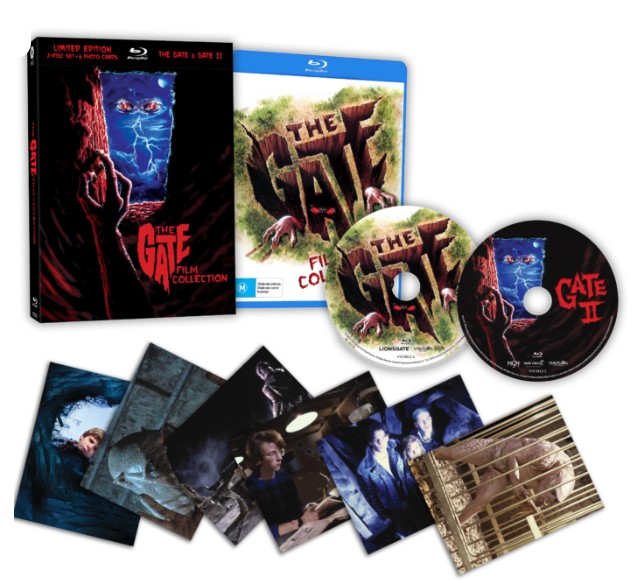
If looking to physically own both “”The Gate” and “The Gate II” in one deluxe package, the Australian based distributor Via Vision has set the bar high with their 2-disc, numbered limited edition, Blu-ray collector’s set. Both films, shown in a widescreen 1.85:1 aspect ratio, are AVC encoded with a high-definition, 1080p resolution on a BD50 (“The Gate”) and BD25 (“The Gate II”) and we’ll come to the reasoning to that split later on. Shot on 35mm and scanned into a 2K print, not many details are noted about what film negative or other print element is scanned to 2K but most of the bonus content on this particular release is Vestron produced, leading to believe the same Vestron print is also used here. Between the two pictures, “The Gate II” has a better saturated image whereas the original film almost seems ungraded with a slight gray concealer that somewhat mutes the hues. The forced perception shots are seamless yet are also delineated nicely that curves into a believable and pleasing symmetry without an inkling of divisional depths. Skin tones are natural looking and textures, such as practical prosthetic masks and molds, score high in all the nooks and crannies of the folds and surface level haptics. The English encoded tracks include a lossy DTS-HD 2.0 stereo codec on “The Gate” and an uncompressed, lossless PCM 2.0 stereo on “The Gate II.” These sole options provide suitable stereophonics without significant compression issues, other than “The Gate’s” minor fidelity data loss, or original source damage or technical gaffs, such as hissing or popping. Dialogue design sees the “The Gate” come out on top over the course of layering and projecting atmospheric augmenting. I don’t get that same sense from “The Gate II” that modulates the dialogue with a redounding heavy-handed echo effect in locations it does not make sense for reverberations. “The Gate” has English and Spanish subtitles with the sequel reduced to just English subs available. “The Gate’s” greater format capacity holds most of the special feature cards with a number of duplicated Vestron produced bonus content, including two audio commentaries: commentary one with director Tibor Takács, screenwriter Michael Nankin, and special effects designer/supervisor Randal William Cook and second commentary with Cook again along with his f/x crew Graig Reardon, Frank Carere, and Bill Taylor. Composer Michael Hoenig and J. Peter Robinson discuss the score with selected isolated tracks to enjoy, a conversation between Takács and Cook in The Gate: Unlocked, Craig Readon in an interview about creating the pint-sized creatures in Minion Maker, an interview with co-producer Andras Hamori From Hell it Came, an interview with actor Carl Kraines aka The Workman aka Terry the Demon The Workman Speaks!, an interview compilation from the local Toronto talent involved Made in Canada, a 2009, archival retrospective look and discussion from Reardon and Cook at their monstrous being handiwork From Hell: The Creatures & Demons of The Gate with Randall William Cook and Craig Readon, a 2009, archival retrospective look and discussion with director and writer Tibor Takács and Michael Nankin The Gatekeepers, a vintage making-of featurette, teaser and theatrical trailers, TV spots, and storyboard and behind-the-scenes galleries. In what is a David and Goliath size imbalance, “The Gate II” special features ultimately will not trump with smaller disc capacity and the lack thereof content but the second disc sequel does contain a new, 2023 audio commentary by Tibor Takács and film historian Jarret Gahan as well as a documentary with Takács, Nankin, and Cook Return to the Nightmare: A Look Back at The Gate II that discusses how and where the film strayed off the intended course, an interview with make-up effects artist Craig Reardon From the Depths, the theatrical trailer, and retain video promo. Via Vision’s limited-edition packaging is another world chic and cool with a rigid sleeve box and a lenticular “The Gate II” front cover art. Slipped inside from the right is a single Amary Blu-ray case with a center stationed second disc attachment. While the front cover on the sleeve box showcases the sequel cover, the Amaray’s reversible cover sports the original “The Gate” cover art with a Glen still image and film cast/crew credits on the other side. Also inside the sleeve box are six fully colored glossy photo cards! Both films are Australia certified Mature for moderate violence and moderate course language and have a runtime of 84 minutes (“The Gate”) and 93 minutes (“The Gate II”). The Via Vision release is region B locked (note: the release did play on my region A setting).

Last Rites: Digging a hole to open “The Gate” and the contradistinctive sequel unburies a pair of underrated underworld-creeping-toward-the-surface 80’s phantasmagorias, a regular doomsday fait accompli with children standing between Hell of Earth and saving the world, and what better wait to see the world potentially burn to the ground than with a beautiful new Blu-ray collector’s set from Via Vision!

Better Hurry! Amazon Has a 20% Coupon for This Very Release! Limited to 1500 Copies.

‘Twas the Night Before Christmas, When All Through the EVIL “A Creature Was Stirring” reviewed! (Well Go USA Entertainment / Blu-ray)

Purchase “A Creature Was Stirring” Here at Amazon.com

During the height of a 6-day Christmas blizzard, nurse Faith remains home to care for her mysteriously afflicted daughter Charm.   Faith diligently stays vigilant over her daughter’s inexplicable condition with test after test and maintaining Charm’s constant body temperature between 102 to 104.4 degrees, seemingly stabilizing Charm’s condition.  If the temperature exceeds beyond, Charm transmogrifies into a barbed humanoid creature.  While Faith works on a compound cure, Liz and Kory, a sibling pair of Jesus zealots, break into the house seeking shelter out of the deadly snowstorm.  Faith has no other choice but to let them stay the night until the storm subsides but the appearance of Charm’s at-home care and the young girl’s sudden seizures and erratic behavior sends Liz into savior mode, meddling into more than she can comprehend.  Yet, something else lurks inside the house, between the shadows, and beneath the veil of reality that is way more terrifying. 

Even though Christmas might be long over and all the gaudy and brilliantly lit decorates are stowed away back into Grandma’s attic that doesn’t mean the holiday horror train has to depart the station.  And I’m not talking about no Polar Express with the edging on creepy motion capture animation.  I’m talking about “The Cleansing Hour’s” Damien LeVeck’s Twas the Night Before Christmas-inspired titled “A Creature Was Stirring.”  The equivocal creature feature set in the throes of a raging blizzard and inside a very decked the halls house is penned by debut screenwriter Shannon Wells under the original title of “Good Luck, Nightingale.”   Aimed to be more than what meets the eye, “A Creature Was Stirring” blends the involuntary struggles of drug addiction with potent secretions of supernaturalism.  The U.S. production was shot in Louisville, Kentucky, produced by LeVeck, wife Natalie, as well as “Scare Package” producers Aaron B. Koontz and Cameron Burns with Vladislav Severtsev (“The Bride”) under the production companies Skubalon, 10/09 Films, and Paper Street Pictures. 

Topping the bill as Faith is “This Is Us” star Chrissy Metz, portraying a nurse practitioner and mother desperate on concocting a cure to her daughter’s strange, monstrous manifesting condition.  Metz brings the multifaceted mania between being rock solid and stringent with medical checks and procedures and being able to turn aggressive when the moment calls for it, especially swinging a screwed-spiked baseball bat.  This underlines an underlying secret or hidden predicament viewers will be dipped into and begin processing all the little traces of one-offs that don’t necessary make sense to an already peculiar narrative.  Then, there’s Charm, played by Annalise Basso (“Oculus”), in constant oversight, constantly mutable, and urging to constantly be free from her mother’s impervious iron grip to lighten up.   Basso retains angsty opposition while tossing moments of reflective consideration for her mother and for herself, disquieting the teetering tranquility when Liz and Kory come into play.  Respectively played by “Halloween” ‘07’s Scout Taylor-Compton and “Stake Land’s” Connor Paolo, siblings Liz and Kory stir the pot that’s slowly simmering to a boil as one religious dogmatist and one eager to break the constraints of his sister’s purity with sex and drugs complicate the strained mother-daughter relationship with their intrinsic quirks that expose a deeper, rooted-to-reality problem.  The now generational scream queen Compton dons colorful dreads and a large Messiah back tattoo amongst a high and mighty attitude while Paolo can be praised for the sarcasm brought out from the scripted dialogue.  Each of the four principals are inherently different and clash, in a good way, to provoke complications. 

Drug addiction has infiltrated horror years ago and have been the basis of many notable films such as Abel Ferrara’s “The Addiction,” Larry Fessenden’s “Habit,” and Frank Henelotter’s “Brain Damage” to name a few from the massive lot.  “A Creature Was Stirring” taps into that same vein as LeVeck’s injects and shoots up his own interpretation of horrors with withdrawals.  Long time addicts suffer through agonizing, powerful withdrawals that screenwriter Shannon Wells incorporates symptomatically with a figurative approach and while Wells’ story invokes colorfully rich characters and enigmatic tale of terror, brought to life by LeVeck’s vibrantly warm and glow Christmas adorned and atmospheric house, the finished feature, that really has nothing to do with Christmas oddly enough, feels uneven when revealing the irony of surprise doesn’t become catchall illumination.   The most ambiguous part about the tale is the spiny-signified creature, a mutated, zoomorphic porcupine of sorts, to represent ferocity of the withdrawn drug with its hypodermic needle-like defense mechanism and malevolence nature.  The shadowy man-thing is given such a threadbare association between Charm’s anecdotal encounter with large rodent and its manifestation metamorphosis into the fold that the hostile has hardly any staying power as a villain and, like a rodent, really does feel just like a mouse was stirring as it scurries arbitrarily throughout the house but not all is negative as there are scenes that make you go holy crap when recollecting character and creature interactive moments that suddenly click and make sense, often coinciding and juxtaposed against really neat interior cinematography bathed in mixture of hard light and soft glows. 

Well Go USA Entertainment presents “A Creature Was Stirring” on a high-definition Blu-ray home video.  The AVC encoded, 1080p, BD25 has soft illumination but a grading design that’s befits the ’tis the season paradigm with the primary color warmth radiating out from Christmas lights strung up around the house and the beaming brilliance of white battery-operated light-up decorations. Between the crude adornment lighting, some lighter translucent gels, and with a splash of black-and-white, Alexander Chinnic cinematography, presented in an anamorphic widescreen 1.78:1, resembles a rave clad fitting into the drug theme as an echo of the one character’s pill-popping, molly-dropping past. Details become diffused by the varying, indiscriminate incandescence and shadowy fields that play into the creature’s tenebrific threat, but those same shadows are often deep without posterization. The English 5.1 DTS-HD master audio achieves the goal of the very title of something stirring inside creating rustling movements and spiny-shifting clacking, coursing through the back and side channels and maintaining an even keeled LFE. Space awareness is key for close quartered tension and that’s rendered well in the design. Dialogue comes off without a hitch and is elevated above the rest of the tracks with no issues with compression faults or a fractured recording. English SDH subtitles are available. Like most Well Go USA releases, “A Creature Was Stirring” shoulders only Well Go USA preview trailers with no real bonus features of its own in the semi-static main menu but what we do get is a better than modest laid out standard Amaray Blu-ray package with a lightly titled embossed cardboard O-slipcover and on the back two different texture types, a polaroid slick abutted against the smooth cardboard. Image design is a greatly detailed silhouette of the porcupine creature looming over the house. The same image is also on the Blu-ray cover with a simple red-beaded or red-string light encircling the title on the disc. There is no insert inside. Rated R for violence, bloody images, drug context, language, and some sexual suggestion, the 96-minute Blu-ray comes region A locked. 

Last Rites: Chrissy Metz battling a deformative disease, drug addiction, an angsty teen, two home invasive siblings, and a large porcupine monstrosity all in the name of “A Creature Was Stirring” is the prickly cold turkey suspenser this side of the New Year.  

Purchase “A Creature Was Stirring” Here at Amazon.com

EVIL’s Coaxial Cord Right into Your TV Set! “HeBGB TV” reviewed! (Scream Team Releasing / DVD)

Contact Your Local Cable Provide to Upgrade Your Box for “HeBGB TV” on DVD!

In a world of streaming devices, the cable box era has become nothing but a memory until mysterious HeBGB cable boxes sudden appear on retail shelves and on homeowner doorsteps.  The what looks to be a brain in a box with some wiring quickly self-installs right into the cable jack and manifests a gaudy-dressed tangible host, The Purple Guy, right into your living room.  Promising a guaranteed fun time, The Purple Guy is eager for souls, I mean viewers, to subscribed to the endless commercial content of HeBGB TV, promising nothing but the best entertainment from the other side of the dimension has to offer.  Sordid horror, 90s-inspired carving infomercials, grotesque commercials, monstrous sexy hotlines, demonic feature films, and more provide a source of endless brain-rotting consumerism over the TV broadcast waves.  Eye-glued patrons of senseless horrors become slave to the screens that send their very souls to a machination machine from another world.  Who can stop the evils of doom channel surfing? 

Those who are now in their late 30s, early 40s likely remember how awesome and nearly uninhibited cable television was back in the day.  Money and creative talent were invested in turning the most ordinary retail product into a mini-movie of ostentatiousness, imbued with vividly stark colors and an insanity of pure energy.  Television didn’t coddle, it shaped the very fabric of impressionable children of that era, resulting in imagine and inspiration.  That is what comes to mind when speaking of “HeBGB TV,” a comedy-horror anthology of sorts of shorts written-and-directed by Eric Griffin, Adam Lenhart, and Jake Mcclellan.  The trio’s initial concept, prior to the creation of “HeBGB TV,” was something along the lines of an interactive variety show with short films, standup comedy, and puppetry held in front of a live audience.  When COVID hit in 2020, their idea pivoted toward a movie, eventually a script evolved into a drivable wraparound narrative chalked-full of some of the prefabbed material as well as some other new zany, horror-inspired skits, shorts, and string-pulling puppetries.  Griffin, Lenhart, and Mcclellan produce the feature under their LLC of HeBGB TV productions and PatchTown Films, based right in my regional backyard of Lancaster, PA.

Credited in the film as Knucklehead, Jake Mcclellan may act to the very definition of pseudonym but, in the lack of better words, is the face of “HeBGB TV” by having scores of roles and personalities at his disposable to dress up and become a totally new and grotesquely phantasmagoric character.  Whether be The Purple Guy, PU News’ greasy anchorman, the Blue Monster, or just desperate dieter with a health-hazard late night snacking problem, Mcclellan goes all out with makeup, costuming, and prosthetics in what could be considered a one man drag show and its gorgeously panache and over-the-top but doesn’t stray terribly too far from the outrageous era the horror-comedy emulates.  “HeBGB TV” is full of caricatures of late-night television and oddities of live TV and marketing campaigns, even Eric Griffin and Adam Lenhart get involved in front of camera as a hobo watching a portable antenna TV and as Smokie, the exterminator of potheads with noxious weed, as seen on TV, or rather “HeBGB TV.”  Most of the enthusiasm, and eccentrics, are within film’s faux television programming but the cast of performances flesh out with Ian Sanchez, Curtis Proctor-Artz, Josh Dorsheimer, Zenobia Decoteau, Michael Garland, Mike Madrigall, Ellen Tiberio-Shultz, Kristie Ohlinger, Colleen Madrigall, and Willow and Van Reiner as the kids who The Purple Guy connivingly entertains and Andrew Bowser reprising his most beloved YouTube persona, Onyx the Fortuitous.

Cut from the same cloth as Weird Al’s “UHF, Peter Hyams’s “Stay Tuned,” and Jeff Lieberman’s “Remote Control,” the cable box antics of the 80s-90s TV is quickly fading the analog years into nothing more than static snow of broadcast noise.  However, “HeBGB TV” is the answer, the recollection, and the nostalgia-driven film that delivers better than trying to get a glimpse of the vague outlines of adult actresses in the static noise of premium adult channels.  Directors Griffin, Lenhart, and Mcclellan combine their creative geniuses, incorporate their sentimental love of 90’s media, and integrate their own other interests into a cinematic cannonball of colorful comedy-horror.  While the wraparound stories outside the HeBGB TV box proves able with the inexplicable mass rollout of the brain-in-a-box cable program provider and rotting, killing, and transfiguring viewers into mindless gawkers, overdosed smokers, and malevolent demons, the real star of the feature is flipping through the channels for the go-hard mock-commercials and other putrid programming laced with horror themes and capturing the spirit of television culture of 20-to-30 years ago.  While most of the visual effects reside around the wraparound story, contributing to the alloying of the story, Adam Lenhart’s practical effects more than make up for it a DIY initiative of can-do sculpting, molding, and crafting ingenuity below the embraced realm of unreality.

Don’t touch that dial as Scream Team Releasing delivers cable television like never before with “HeBGB TV” now on DVD! Though the Scream Team Releasing DVD back cover lists the format as a Blu-ray, the data file is actually a MPEG2 encoded, singer-layer DVD5 that has a widescreen 1.78:1 aspect ratio presentation. A combination blend of interlaced and digital video swirl “HeBGB TV” into a time warp of the past and present. The filmmakers captured not only the feel of rambunctious, eccentric, and vividly brilliant 90’s commercials but were also able to capture the look of it too with the interlacing horizontal lines indicative of video frame rates of the time. The wraparound narrative portions are digitally cleaner in juxtaposition, factionalizing present and TV programming with distinction until the culminating plan comes to conclusion. Some of the digital visual effects gags crumble under the practical elements of an analog airing, proving once again that the tangible and practical outstage the digital composition, but the crumbling doesn’t stem from compression issues. The English language Dolby Digital 2.0 mix is a symphony of frenzied chaos, pinpoint advert jingles, and deliciously distasteful horror gags facsimiled perfectly, as if it was plucked straight from the pre-millennium. Dialogue is quick but renders clean and clear in a blend of inset and ADR vocal recording, per the commentary. No issues with depth, range, or any kind of compression side effects. Well scored with a catchy main theme and topnotch sound designed to add to “HeBGB TV’s” romp commercial content. English subtitles are optionally available. Bonus features are aplenty with a retrospective interview with the three directors and short clips going in-depth with behind-the-scenes movie magic, a HeBGB TV video installation guide, a world-premiere pre-show, the first interactive show prior to COVID, and the theatrical trailer in the motion menu option shaped like a retro tube television with right side buttons. Inside the setup option along with the English Subtitle toggle, a directors’ commentary can be selected and played from there. The standard edition encased inside an Amaray comes with faded hues on an illustrated composition cover art of most of the “HeBGB TV’s” wacky pastiches and a disc pressed with the pulsing brain-loaded cable box. The release comes not rated, region free, and has a copasetic runtime of 78 minutes. ”HeBGB TV” is couch potato worthy that syndicates together hilarious travesties and transvestites for timeless television touting, stitched together from previously shot short films, puppetry depravities, and a new sci-fi fiction.

Contact Your Local Cable Provide to Upgrade Your Box for “HeBGB TV” on DVD!

Amusing Little EVIL Enjoying the Carnival Rides! “Ghoulies II” reviewed! (MVD Visual / Blu-ray)

Next Time You Sit On the Can, Check the Bowl First!  “Ghoulies II” on Blu-ray!

The travelling Hardin Family carnival has been on a steady decline through the years.  The Hardin Holdings group, aka Mr. Hardin, dispatches his young senior accountant and son, Philip Hardin, as authoritative proxy to ensure sustainable profit.  One of the longstanding attractions, Satan’s Den, lies headfirst on the chopping block with a dismal profit rate.  Determined to recover and avoid being permanently shut down, Larry, his drunk uncle Ned, and actor Sir Nigel Penneyweight won’t give up so easily despite needing a miracle.  That miracle comes in the form of the Ghoulies who hitch a ride on Satan’s Den’s trailer while escaping persecution.   The pintsized demons bring the slowly withering Satan’s Den back to lucrative life but at the deadly cost of the patrons and carneys who fall victim to the Ghoulies impish behavior.  Larry vows to rid the amusement on their infestation after uncle Ned perishes at the demons’ tiny hands but Philip has glimmering money signs in his eyes. 

They’re back!  The Ghoulies return as masterless nomads after a failed attempt of abduction by a devout crusader aiming to destroy the pagan evocations and wreak mischievous havoc on a two-bit amusement park suffering from low attendance.  The late Albert Band, father of Full Moon’s Charlie Band and director of “Dracula’s Dog” and “I Bury the Living,” took over the reins from first film director Luca Bercovici and helmed “Ghoules II,” a vastly different kind Ghoulies tale of terrorizing totality based off the Charlie Dolan story and a polished script from “Re-Animator’s” and “From Beyond’s” Dennis Paoli.  Filmed entirely in Rome, and mostly in a soundstage, where Empire Pictures headquarters were located, the 1987 sequel was the last Ghoulies venture from executive producer Band and his Empire Productions empire before Vestron oversaw the subsequent sequels.  Albert Band produced the feature with Frank Hildebrand (“Once Bitten,” “Project Metalbeast”) serving as associate producer. 

With the contestable exception of the five prosthetic creatures receiving a dust off and sprucing up paint job, none of the lively characters from the first film return for the sequel in what becomes a principal clean slate.  The story starts off with who appears to be a man of God fleeing on foot with a bag over his shoulder from three cloaked cult acolytes.  There’s never a reference to this escaping man (Anthony Dawson) or the shrouded cultists in torch-in-hand tow but does arouse a bit of enigmatic energy around the Ghoulies misadventures through the human plane and happening upon the likes of two opposite side of the spectrum carneys who are also related between the long-in-the-tooth and drunk Ned by the loveable character actor in Royal Dano (“Killer Klowns from Outer Space,” “Spaced Invaders”) and his big top tenderfoot nephew Larry played by Damon Martin.  Ned’s alcoholism combined with stress over possibly losing Satan’s Den makes causes him complexity within his closest confidants for when he happens upon the Ghoulies after citing an incantation, he’s also in a drunken stupor, and so he words of exciting, or maybe even warning, fall on deaf ears as intoxicated imaginations that result in a pity for his dependency.  As Larry and the Shakespearean line spewing Sir Nigel Pennyweight (Phil Fondacaro, “Willow”) continue with setting up the ragamuffin that is the antiquated Satan’s Den, they let Neg wander despite suspecting his delusions of demons due to the pressures of one carnival hotshot Phil Hardin (J. Downing, “Robot Wars”) who has come to town to clean up his family’s carnival act with threatens of shutdowns and layoffs.  Hardin’s your typical weight-throwing antagonist with a pompous attitude and wandering eye for the most gorgeous girl under the tent, in this case it’s with Larry’s love interest Nicole (Kerry Remsen, “Pumpkinhead”), a once great high-wire performer turned belly dancer for the departmental freakshow act.  Nichole’s hidden talents, buried deep beneath past personal pain, will undoubted be utilized for climatic gain as all chaos breaks loose on carnival grounds with the Ghoulies break free of Satan’s Den menagerie of cardboard and latex-crafted horrors.  “Ghoulies II” rounds out the cast with Jon Pennell, Sasha Jenson, Donnie Jeffcoat, Donald Hodson, Dale Wyatt, Romano Puppo, Ames Morton, Michael Deak, and Full Moon actor-turned-director William Butler (“Night of the Living Dead” ’90, “Baby Oopsie”).

Along with a new set of human characters, “Ghoulies II” also freshens up the trajectory by focusing less on the black magic that saturated the plot of the first film and relying more on the gremlin-like playfulness of the Ghoulies themselves, rightfully giving way into the very creatures of the title. There’s some magic involved but only to the extent that doesn’t have the Ghoulies rely on a master to evocate them from the Netherworld or for the dark powers to be used to perpetuate wickedness upon others.  Instead, the ghoulies are depicted utilizing their skillsets, such as flying, oral expelling sticky-gunk, super-strength, and chomping, which obviously lead to more of a micro-level apocalypse of carnage; however, the print obtained for the MVD Blu-ray release is the edited down version for theatrical circulation so some, not a lot mind you, of the gory bits have been taken out and this makes the storyline stutter with misplaced time with rough segues and an imbalance of edits that aren’t as smooth.  From what I’ve seen, the minuscule timed deleted scenes are not much more violent or gory but add just that tad more context to the next scene instead of our brains working to connect the dots on what should be a brain shutoff, entertaining creature feature.  Yet, you can’t deny the sequel’s appeal that has turned to center around the little demons assiduously but managing to keep the same, steady pace of ferity and gothic skim of mise-en-scene from the first.  Puppetry is retained for that palpable product while also introducing stop-motion, a visual effect that has served Empire/Full Moon well throughout the years and is only used sparingly to wet the limitless capabilities of our miniature monsters to roam free in open spaces. 

“Ghoulies” return with the sequel to MVD’s Rewind Collection as Blu-ray release number 53 on the spine. The AVC encoded, high-definition, 1080p Blu-ray is presented in a widescreen 1.85:1 aspect ratio. A virtual carbon copy of the first film in regard to a well-preserved print, the sequel isn’t noted in having a 4K restoration scan like the antecessor release number 52 but the 2K scan offers an abundancy of positive picture rendering with a seamless color grading that isolates distinction and range as well as a tangible details, especially on characters and the ghoulies alike who are often gleaming and show off every nook and cranny ridge on their dark, hairy bodies. Aforementioned, this print is the theatrical cut, missing some gruesome elements for the sake of a broader audience, and while most of the print is near flawless, there is one dunk tank scene that’s cropped and noticeably marred with horizon creases in the brief airtime. The English LPCM uncompressed 2.0 stereo mix caters to every audible necessity of the “Ghoulies” soundtrack, ambience, Foley, and dialogue. The latter is clean and clear with prominence over the rest of the layers though I wouldn’t label it flawless with some echoey segments, almost a doubling effect, that might be due to the soundstage vibrations at Empire. Ambient track provides a wide range with exact depth with the example being inside Satan’s Den of horrors where doors creak, motorized bats fly overhead, and other models of haunted house spookery, along with an underlining carnivalesque soundtrack by Fuzzbee Morse (“Dolls”), is the epitome of a great sound design suffused together. English, French, and Spanish subtitles are optionally available on this release. Special features include an introduction by screenwriter Dennis Paoli, which is also available as a standalone at the play feature option, More Toilets, More Terror: A Making of Ghoulies 2 is a retrospective lookback with select cast and crew, an interview with Dennis Paoli Under a Magic Moon, the gruesome deleted scenes, a photo gallery, and theatrical trailer. Physical attributes include a VHS retro-esque mockup of the original poster art on a cardboard O-slipcover, fitting for the sub-bannering Rewind Collection. The same image graces the front cover of the clear Blu-ray Amary case, but the cover art is also reversible with one of the film’s most memorable smoochy-kiss moments plus title above. The disc is art pressed similar as the first film, a laser disc veneer on the Blu-ray top. Opposite side is the folded poster insert of the slipcover front image. The region A playback release has a runtime of 90 minutes and is rated PG-13. “Ghoulies II” retains that same diabolical energy as the first film but channels it very differently into the very titular creatures that puts them at the forefront instead of being just an afterthought in a sequel that celebrates their uncontrollable knavery and loving every second of it.

Next Time You Sit On the Can, Check the Bowl First!  “Ghoulies II” on Blu-ray!