The Shaw Brothers Deliver the EVIL Lovers! “Shaw Brothers Horror Collection Volume 2” reviewed! (Imprint Asia / Blu-ray)

Shaw-Shock Horror Collection Volume 2 is Now Avilable for Purchase!

The Qing Dynasty of Imperial China is full of spiritual folklore, mysticisms, and romance.  Three tales of supernatural passion arouse not only enduring amorousness and longing desire but also strikes fear of apparitional ghosts and grudges into naive and honest souls from beyond the grave, crossing existential planes to be with intended suitors no matter the cost.  These stories will send a pining chill down your spine:  a traveling scholar bunks at an abandoned temple to find he’s enchanted by a young woman not of life and protected by a blood thirsty lady-in-waiting, a provincial governor crosses paths with a beautiful virgin while taking shelter at her home.  When he catches her nude, he’s willing to marry her to avoid her shame but little does he know she’s a lonely ghost searching for love and revenge against those who raped and killed her, and, lastly, an arranged marriage is foiled by the sudden death of a young mistress and the late arrival of the master because he was being robbed of a debt he owned the mistress’s family.  Unfulfilled in love and life, the young woman returns to court the young master with the help of her elderly servant who took her own life to make the love between them possible.  Not believing the rumors of her death and discounting the spirit warnings from those close around him, the young master falls in love with his intended bride despite the obstacles put in between them by the master’s servants, Taoist priests, and even a band of bodyguards. 

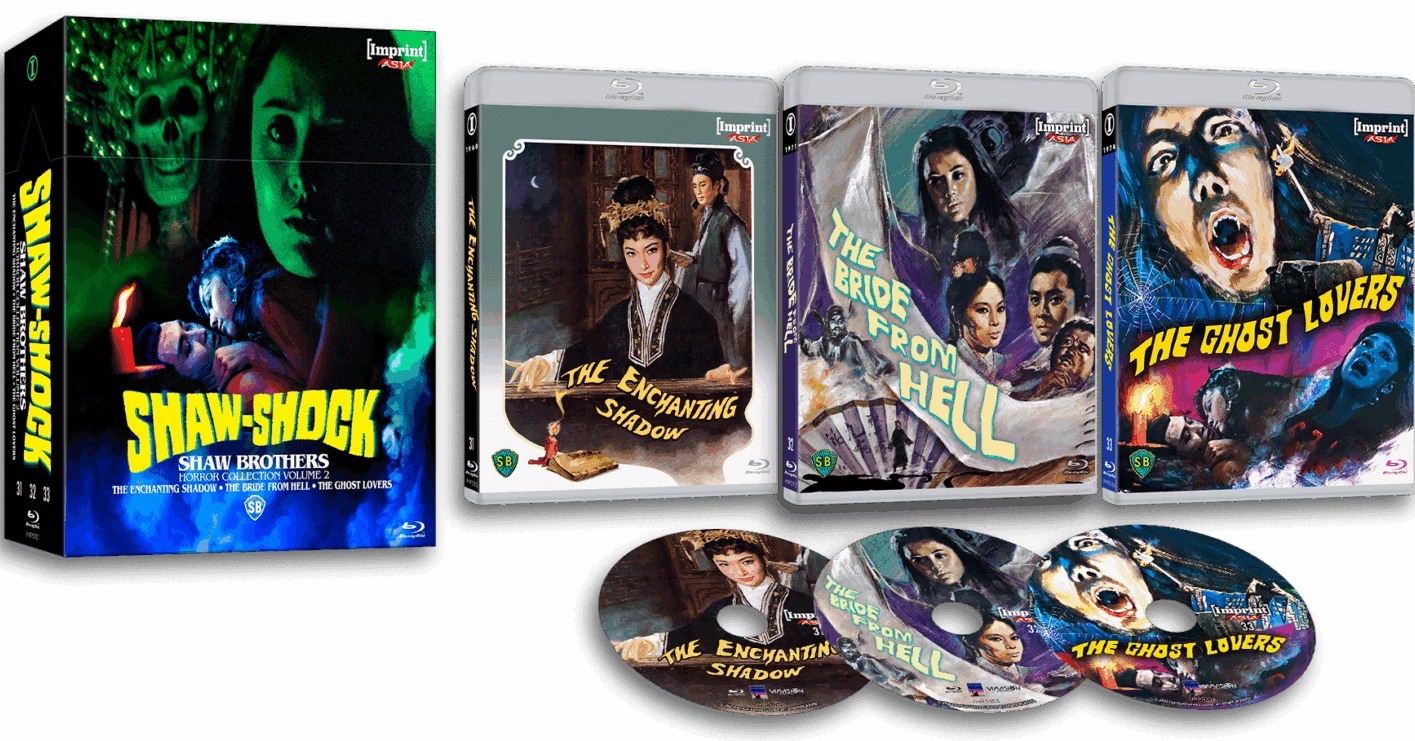
Australian distributor Imprint, under their sublabel Imprint Asia, has released the second volume of the Shaw-Shock:  Show Brothers Horror Collection with three more titles that fall within the release window of 1960 to 1973.  These adapted stories stem from and inspired by Songling Pu’s Liaozhai Zhiyi, aka Strange Tales from a Chinese Studio, which is a collection of classical Chinese ghost narratives, and they include the 1960 “The Enchanting Shadow,” directed by Han Hsiang Li (“The Ghost Story,” “Return of the Dead”) and written by Yue-Ting Wang and Wong Yuet-Ting, the 1972 “The Bride from Hell,” directed Hsu-Chiang Chou (director of “The Enchanting Ghost,” not to be confused “The Enchanting Shadow”) and penned by Tien-Yung Hsu, and 1973’s “The Ghost Lovers,” the only film of the three from Korean-born filmmakers, director Shin Sang-ok (“3 Ninjas Knuckle Up”) and writer Il-ro Kwak (“Ghosts of Chosun”).  Runme Shaw produces all three films in the Shaw Brothers production studio. 

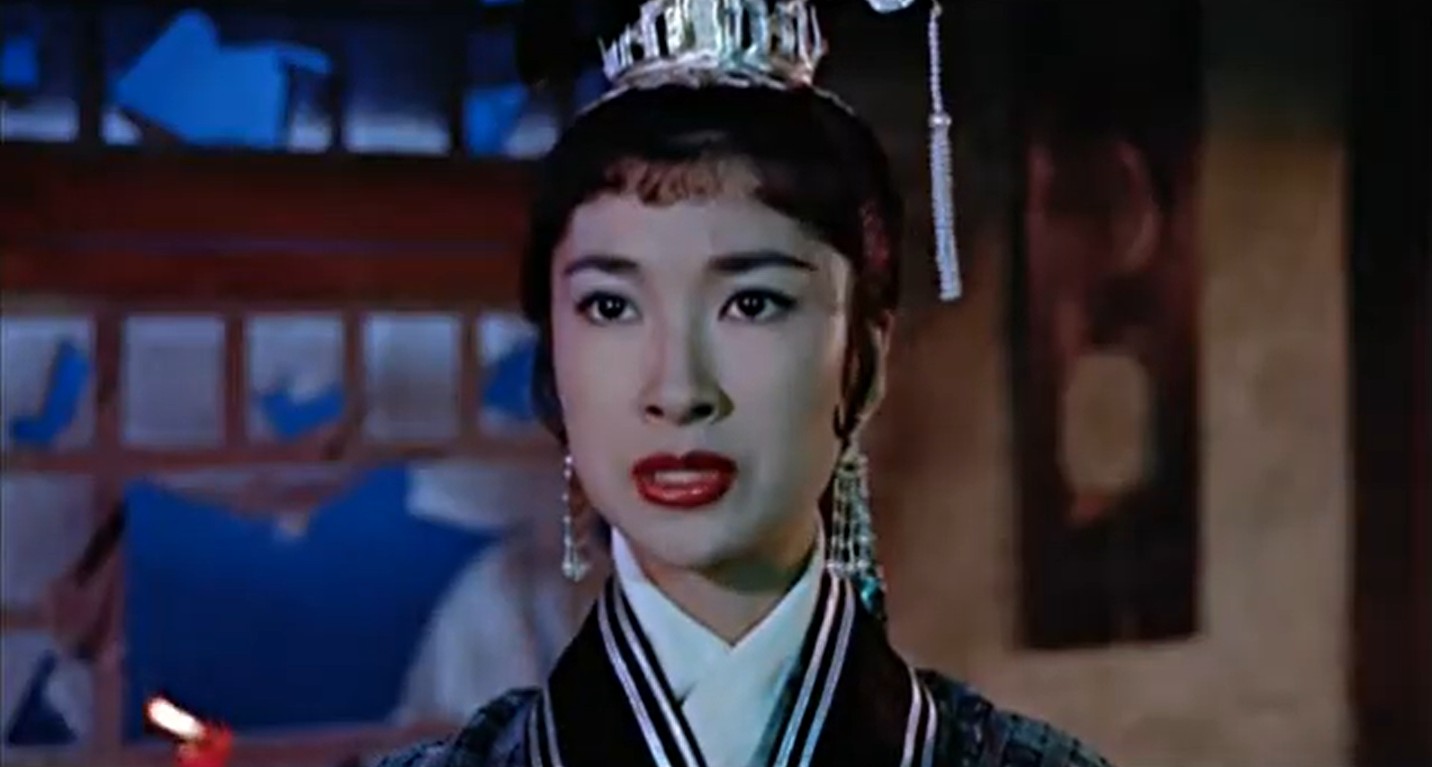
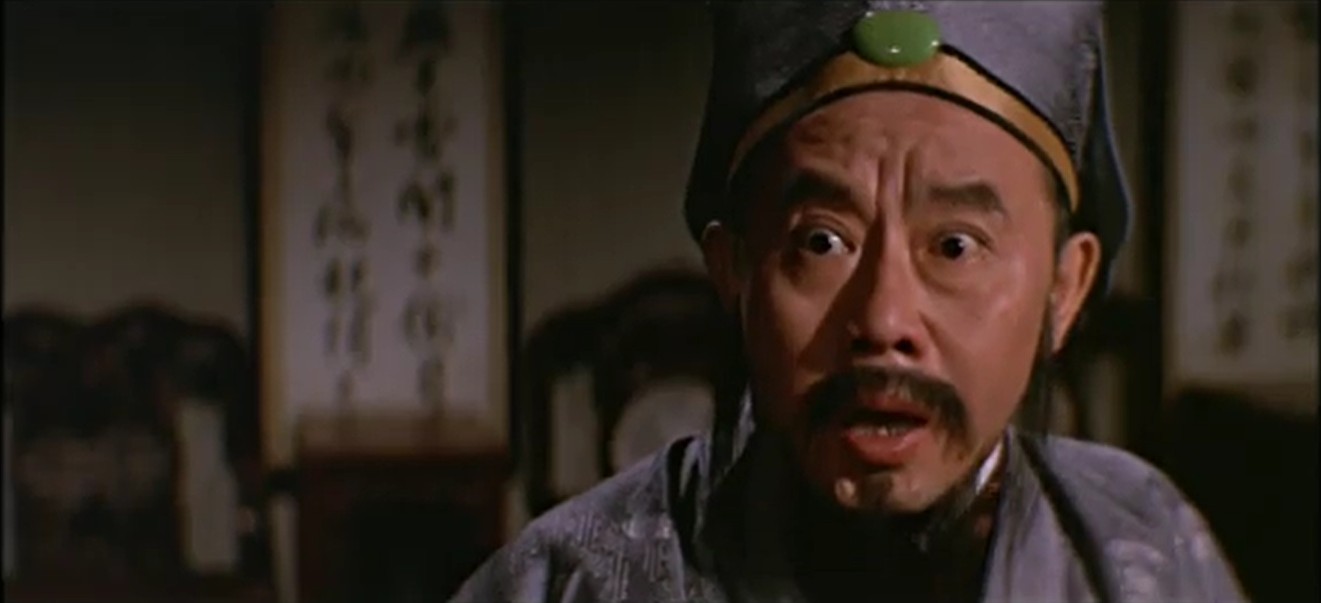
Other than being a Shaw production, each of the three stories are also connected by common elements – travelling male scholars or those high in station, a dead or recently deceased high-born woman in phantomic form, and the two intertwine romantically under false pretenses all the while Taoist priest, servants, or family of the living beg, plead, and even self-interject themselves in between the unnatural love affair to save the man from a wraith’s haunt, whether the affectionate intent by the ghost is malicious or benign, but each also differ in style and substance.  Lei Zhao (“Succubare”) plays a servant-less travelling scholar, Ning Tsai-Chen, unphased by the foreboding warning of ghosts and death of a dilapidated temple where those who stay the night don’t live the next morning.  Ning falls for adjacent neighbor maiden in Nie Xiaoqian (Betty Loh Ti) and between the actors there is a show of palpable and touching natural coquet that’s honorable to their period and to their characters’ hearts but their being from two different worlds puts up a marital blockade unlike in  “The Bride of Hell” that has generally has the same amorous bond between Yang Fang (Nie Yun Peng) and Anu (Margaret Hsing Hui) that eventually leads to marriage, but the Anu guileful portraying of a living is more deceitful to use Yang Fang despite also actually loving him in this more revenge based spookery involving Fang’s unscrupulous family members.  “The Ghost Lovers” also uses ghostly deceit to trick the master into a coitus cemented bond revolving and complicated around Han His-lung’s (Wei-Tu Lin, “Corpse Mania”) honor and shame and the affluent Sung Lien-hua’s (Ching Lee, “Sexy Girls of Denmark”) unfulfilled life and love before an untimely death.  There are of course the conflicts that get in the middle – the blood thirsty Lao Lao (Rhoqing Tang, “Brutal Sorcery”) aims to kill temple trespassers and Nie Xiaoqian suitors no matter how much a gentlemen they are, there’s the rape-revenge aspect in “The Bride of Hell,” and the sundry hindrances that try to keep the undead Sung and the alive Han from being unionized.  There’s quite a bit of hammy performances to digest in what’s relatively near being the same story said over thrice,  The three films fill out the cast with Chih-Ching Yang and Ho Li-Jen in “The Enchanting Shadow,” Carrie Ku Mei, Hsia Chiang, Chi Hu, Feng Chang, and Yi-Fei Chang in “The Bride from Hell,” and Shao-Hung Chan, Feng-Chen Chen, Ki-joo Kim, Ling Han, Han Chiang, and Mei Hua Chen in “The Ghost Lovers” as the belabor the melodramatics of ghostly fervor. 

From a bird’s eye view, the Shaw Brothers productions appears virtually unoffensive and harmless period pieces set in the Imperial China with romanticized slices of fantasy in love after death, unstoppable passion, and an adherence to honor, principles, and duty to others, but a closer look reveals a darker sliver coursing through the supernatural palaver with it’s unnatural fascination of hooking up dead beautiful women with eligible scholarly men.  The most outlying and blatant example would be the rape-revenge narrative of “The Bride form Hell,” a coarse title that’s been spun into various renditions over the decades – take Quentin Tarantino’s The Bride from “Kill Bill” for example – by a woman embarking on path of retribution after being wronged in a maliciously despicable way and she uses everything to her advantage, even if that means marrying a relative, while a spirit I might remind you, of the men who raped and murdered her during their plundering of riches.  The film also doesn’t mind it’s hands a little dirtier with some nudity unlike the other two films of the set.  “The Ghost Lovers” isn’t as deeply disturbing with more of an untimely and unfortunate situation robbing mistress Sung of life and love and master Han of time and wealth that would have solidified a bond if the elements were not stolen from them.  There’s also a misunderstanding with fear of the unknown and a twisted sense of intent by humble servants and priests who distress of anything not of this plane of existence.  Much can be said the same about “The Enchanging Shadow” but that also deploys a countermeasure to the good heart nature of spirit Nie Xiaoqian as she’s balanced by her pure evil and bloodthirsty caretaker Lao Lao who between love and represents unholy demise.  Han Hsiang Li, Hsu-Chiang Chou, and Shin Sang-ok don’t stray too far away from each other when it comes to production set and scene compositions by keeping much of the storylines set during the mischief of the night when folkloric ghosts are more awake and present and keep the coloring cold contoured under grays, blues, and only hints of muted vibrancy outside the monochrome.  Special effects are kept close to the chest with fleeting rudimentary prosthetic and makeup, superimpositions to liven the ghost effect, and lay a dense fog in certain moments of atmospherics.  Combine all the elements infused with Chinese culture and superstitions and you get three stories that shutter with phantasmic passion. 

The Shaw-Shock:  Shaw Brothers Horror Collection Vol. 2 from the Imprint Asia line under parent company Via Vision is another awesome Shawtastic boxset that takes obscurity into the light.  The three disc Blu-ray set is AVC encoded, 1080p high-definition resolution, encoded onto BD50 is limited to 1500 copes.  Each included film is catalogue as numbers 31 to 33 in the Imprint Asia sublabel.  “The Enchanting Shadow” is the only one of the three presented in a 1.66:1 aspect ratio, transferred from a rougher print that has patches of cell damage and varied grading as if a couple of prints were spliced together.  There is a prelude title card warning of the quality so there should be no surprise when it does come up.  “The Bride from Hell” and “The Ghost Lovers” are presented a widescreen 2.35:1 aspect ratio and have used a cleaner print for the hi-def transfer with no notice of damage issues.  All carrier a softer, airy image from the film stock and film processing scans and combine with sharp key lighting, there is a glow effect around objects but not enough radiance to affect the diffusion of colors and smooth out details.  Skin tones often fluctuate between an organic and an orange tinge that can sway the perceived quality.   The much older “The Enchanting Shadow” from 1960 definitely shows its age with more muted earthly tones within its darker scaling.  Each film uses a compressed, spherical lens as the curvature is more severe than you notice in more modern productions, hallmarking Hong Kong’s utilized lenses during the decades.  All three films are in Mandarin with no other language option within a LCPM 2.0 audio format that adequate fills the front channels of dialogue, ambience, and soundtrack.  Dialogue and ambience is not immersive with the stereo mix but the ADR track is present and discernible with some noticeable sparse hissing in the dialogue and low level gurgling interference amongst more docile moments.  Along with the image damage, “The Enchanting Shadow” has counterpart audio damage with tears in the audio layer that pop and crackle during the damage breaks. English subtitles are available on all three titles and are paced well but the subtitles on the “The Ghost Lovers” come with a few grammatical and misspelling errors. New special features encoded on the releases include an audio commentary by author Stafan Hammond and Asian film expert Arne Venema, film historian analysis by Paul Fonoroff, an archival interview with director Hun Hsiang Li, and the original and DVD trailer for “The Enchanting Shadow,” the “The Bride from Hell” has a new audio commentary also by Arne Venema with the DVD trailer, and “The Ghost Lovers, too, has a new audio commentary from critic and filmmaker Justin Decloux with film scholar Wayne Wong discussing the film. The new encoded special features compliment the tremendous and substantial Imprint Asia rigid box set with a removable jagged tooth locked top that includes compositional artwork and permeated with the Shaw Brothers insignia. Inside, the three Blu-rays sit snug in individual clear Amaray cases, each with their own original cover art reflecting the original posters with the reverse side pulling a still from the film. The total runtime of all three films is 4 hours and 14 minutes in its region free, unrated capacity.

Last Rites: A triple threat of Shaw Brothers’ classics resurrected from the dead to haunt your collection! Imprint Asia’s boxset continues to recover unearthed Hong Kong and Chinese culture, folklore, and fantasy for new enthusiasts of the far East and avid collectors of physical media!

Shaw-Shock Horror Collection Volume 2 is Now Avilable for Purchase!

Enjoy The Last Night in EVIL’s Hotel. “The Innkeepers” reviewed! (Second Sight Films / 4K UHD Blu-ray)

Book a Copy of “The Innkeepers” on 4K Ultra High-Definition!

The Yankee Pedlar is a historic hospitality hotel with over 100 years of service that comes with its own notorious past and haunted tidings.  On the verge of closing for good, the Yankee Pedlar has one more weekend to remain open and house guests but with only a handful of rooms occupied, there’s not much else to do for the two innkeepers, Claire and Luke.  As a way to pass the time, Claire is eager to video capture spooky events to feed into Luke’s website based off the hotel’s history in the death of Madeline O’Malle, a bride to be who committed suicide on her wedding day when the finance no-showed and her corpse was left to rot for 3 days in the basement as hotel owners feared for bad publicity, but when eerie begin to plague, call for her, with visions of a bloodied O’Malle in a white gown, Claire finds herself in the dangerous company with a permanent guest at the dying hotel. 

Ti West, the established genre director with the famed “X” trilogy, kept audiences pale in fear and the hairs on the back of their neck stiff and straight up with his written-and-directed horror films that retained staying power amongst fans.  2009’s “The House of the Devil” is considered one of the more recent better throwback horrors of our time surrounding classic tropes like a satanic cult and a home alone babysitter.  West’s 2011 film  “The Innkeepers” comes at a rebound time when his commercial picture, “Cabin Fever 2:  Spring Fever”, sequel to Eli Roth’s breakthrough hit from 2002 about a flesh-eating virus, didn’t quite feel like his film and “The Innkeepers” also hit a little different by shielding audiences from any type of horrific, on screen splatter violence and be concentrated on pure fear of the senses.  Though narratively set in perhaps Pennsylvania due to some references of towns an hour outside of Philadelphia, “The Innkeepers” was actually filmed more North in Connecticut with the real-life Yankee Pedlar building.  Larry Fessenden (“The Last Winter,” “Rehab”) of Glass Eye Pix and Derek Curl of Darksky Pictures co-produce the film along with Peter Phok and Ti West. 

In the two principal roles of Claire and Luke is “Barbarian’s” Sara Paxton as an unmotivated hotel clerk coasting until the very, bitter end and “Cheap Thrill’s” Pat Healy as a blasé and uninterested front desk colleague interested in getting on the popular haunted house train with his own website about their employer’s centenarian hotel.  Paxton inarguably shoulders much of the screentime as the girl who cried wolf when she experience’s the sounds of a wolf, aka the spooky serenades of one Madeline O’Malle, and the visual eviscerations of her bloodied corpse that would scare the bejesus out of anyone.  However, the frights are not enough to seemingly strike fear in Paxton’s shield of composure or even enough to put West’s story to rest with a simple I’m outta here as most of us chickens would flock toward the exit on the first instance waking from a vivid dream too real for comfort.  Healy ultimately steals the primary performance away from Paxton with his own gruff and irritated by everything:  the hotel, the guests, his own pitiful existence.  Healy does a nice job creating that subtle tension between Luke and Claire, knowing Luke’s own hangups lie somewhere in between and haven’t been exposed yet, all the while being a sarcastic boor for most of the time.  There are also side characters in the form of random guests occupying the skeleton-crewed hotel bringing with them their own set of baggage.  One of guests is Kelly McGillis and the “Top Gun” actress, in a bit of a meta-role of an aging actress turned mystic.  There’s also Alison Bartlett (Gina from various Sesame Street shows and specials) and Jake Ryan (“Asteroid City”) as scorned wife and her son and the peculiar older gentlemen, played by George Riddle, who requests a special room and will not take no for an answer.  One of the more curious castings is Girls’ Lena Dunham as a coffeeshop barista in a one and only brief scene that doesn’t add really anything to the whole in a pointlessly random interaction with Claire that, perhaps, plays off Claire’s repetitiveness and stasis life of going there everyday but not really knowing much about the barista, who is apparently always there too. 

Juggling between the blended tones of comedy and horror, Ti West doesn’t commingle the two directly into one scene, keeping distinction for one or the other in their individualized moments.  This leaves little room for alleviating dread levity inside the scare moment after building tension and fear of being chased or waiting for the silence to be broken but an unsuspected jump scare.  Outside the context of the fright-filled moment, back and forth quips and playful antics between Luke and Claire as two bored and starved for company innkeepers in the hotel’s waning days are delivered in brightly lit rooms and mostly shared with another person to be a telltale safe space against the malevolence of serrating spook-house intensity that often lingers and waits on with bated breath.  In the innermost between is Claire’s internal struggle to cope with the impending outcome that there is nothing on the horizon for her.  No secure job, no ambitions, no plans of any kind are seemingly providing the character with no hope and in that stagnation, she desperately holds onto what’s nearby – Luke’s interest in the Yankee Pedlar’s hauntings.  Enhanced by the odd actions and placement of the modicum of guests – McGillis as a crystal charm intuitive and Riddle as a strange-enough older man with a specific room fascination – Claire motivation to reveal Madeline O’Malle becomes tenfold because of her unconscious lack to move forward in life, which then spurs the question, is Claire’s experiences grounded in truth or are they just a downspout of manifestations induced compensation?  You’ll have to be the judge.

Like “House of the Devil,” another of Ti West films makes the Second Sight Film cut onto a newly restored 4K scanned UHD Blu-ray release.  “The Innkeepers” HVEC encoded, 2160p ultra high-definition, BD100 has the true presence of quality video with a gradual improvement in the finer details of a greater pixel count inside the HDR with Dolby Vision.  Though digitally recorded with a no imperfections to note from previous releases, Second Sight’s release does appear sharper and deeper around the black levels that often improve with better resolution and suitable compression and with a good portion of the story taking place in the dark recesses of a hotel basement and the in the shadows of unlit rooms, there’s no visual compression issue or loss of expected detail.  Contrastively, darker scenes appear more lit by a lower contrast but still, the details are there in depth and in closeup.  The English DTS-HD 5.1 surround sound audio track diffuses the spread of atmospheric creepiness – ghosts whispers, nondiegetic bangs and clangs, and a Jeff Grace building orchestral score that keeps the heart bumping (think Richard Band’s “Re-Animator” but with more lulls”).  Dialogue is prominently clear and in front of the aforesaid layers with depth mostly between Claire and Luke’s conversing in the lobby and range limited to, again, the aforesaid.  English subtitles are available.  Though this review is catered to the limited edition, rigid slipbox release full of tangible goodies, the standard release does have encoded a small army of special features that has two audio commentaries with the first including Ti West, producer Larry Fessenden of Glass Eye Pix, producer Peter Phok, and sound designer Graham Reznick and the second commentary also West but with principal actors Sara Paxton and Pat Healy.  A slew of new interviews provide a well-rounded, in-depth look at the creative design as It West A Lasting Memory, Pat Healy Let’s Make This Good, Larry Fessenden Our Dysfunctional World, director of photography Eliot Rockett Living in the Process, composer Jeff Grace Cast a Wide Net, and line producer Jacob Jaffke A Validating Moment contribute to the retrospective.  Special features round out with archival behind-the-scenes and the trailer.  The physical presence of Second Sight’s “The Innkeepers” keeps in-line with previous standard edition 4K releases with a black Amaray case and a monochromic grayish illustrative cover art setting audiences up for ghostly expectations.  The UK certified 15 release contains strong horror, gore, language, and sex reference – though the gore is subtle and definitely not over-the-top or even explicit.  This particular UK release, that has a runtime of 101 minutes, is region free and presented in a widescreen 2.40:1 aspect ratio.

Last Rites: “The Innkeepers” works, if not wriggles, into the brain, much like the invasive worthlessness inside Claire’s swirling mind, and the Second Sight Films’ 4K UHD Blu-ray is an ultimate celebration of not only the film itself, but also the venerable work of the horror genre’s freshest master Ti West.

Book a Copy of “The Innkeepers” on 4K Ultra High-Definition!

Sometimes It Takes EVIL To Bring Out the EVIL In Us All. “Jacob” reviewed! (Crazed House and MVDVisual / Unrated, Director’s Cut Blu-ray)

“Jacob’s” EVIL is Coming to Blu-ray! Order Here!

In the Texas smalltown of Melvin Falls, a dark history engulfs the Kell family.  Edith Kell and her two children have lived in ostracized notoriety for years amongst their neighbors as Edith’s husband, obsessed with restoring a suddently inherited house immersed in haunted opine, walked into the town crowded bar and started violently killing patrons before being shot dead by the local sheriff.  Years later, Edith’s son Jacob is now a quiet, large, and lumbering young man with a death stare that’s akin to looking into the abyss, but Jacob’s underlining rage and psychopathic tendencies are comforted by his younger sister, Sissy, when tensions rise between his mother and her boyfriend, the abusive town drunk Otis.  When Otis inadvertently kills Sissy, Jacob’s bloody rampage is unleashed and the townspeople, led by a capital punitive sheriff, form a posse to bring down the vengeful Jacob, if they even can, in another Kell family massacre.

IMDB.com

Larry Wade Carrell writes-and-directs the dysfunction family and rural community horror “Jacob,” released over a decade ago in 2012.  The film is Carrell’s debut solo directorial that earned the filmmaker best Indie Fantasy-Horror, Best Young Actress, and Best Music Score at the WorldFest Houston before embarking into more recent horror of the last decade with “She Rises,” “Girl Next,” and “The Quantum Devil” that run the subgenre gamut with supernatural terror, trafficking abductions, and evil on a whole other plane of existence.  Carrell’s humble backwoods basket case thriller has broad stroke inklings of a supernatural catalyst.  Filmed in and around Richmond, Texas, “Jacob” is the last feature from Odyssee Pictures and the first for Javaline 98 Productions, produced on a low budget by Carrell, Odyssee Picture’s Stacy Davidson and Jeremy Sumrall (“Domain of the Damned,” “Sweatshop”), William B. Davis, Catherine and Frederick Rushford, James Martinelli, and Chuck Norfolk (“Conjoined”).

IMDB.com

Like most indie features, multiple hats are being worn in front of and behind the camera.  Not only does director Larry Wade Carrell write the script, he also dons the twin brother roles of drunkard abuser Otis and the gentile deputy Billy.  Edited so the two characters are never fully faced in a scene together, Carrell manages to pull off contrast personalities by portraying, essentially, the epitome of bad versus good with the no-good delinquent and intoxicated aggressor Otis up against the mild-mannered solicitous nature of Billy, a deputy.  While Carrell may be the core of the story playing two characters, he’s written a narrative that has to battle out against the titular character Jacob, played by Dylan Horne, and the venerated genre name of Michael Biehn (“Terminator”), in what can be considered as the worst impersonation of a whoopie-exclaiming Podunk, literally with the character yelling whoopie when learning of inheriting a house.  Aside from Biehn’s cringy performance, the acting is generally positive and compelling.  Carrell goes beyond the bar in melodramatics but manages to keep grounded by much of dynamic interactions supplied by scrupulous actors with Krystn Caldwell (“Psychic Experiment”) as Edith Kell, the staying in victim of abuse, Leo D. Wheeler (“Domain of the Damned”) as the manbun sheriff with a firm but gentle approach, and Grace Powell (“Hell of a Night”) as Jacob’s soothing little sister Sissy.  Horne, in the Jacob role, is voiceless throughout but imparts Jacob’s ogre-esque killer from inside out but is still overshadowed by Carrell’s double-edge role that takes away from his menancing run through the simpleminded townsfolk.   Dustin Lane (“The Darq’), Travis Hester, Sandy Ray (“Hairmetal Shotgun Zombie Massacre: The Movie”), Shane Stewart, Karen Schlag (“Domain of the Dead”), Nick W. Nicholson (“Pickaxe”), and Deke Garner (“The Void”) rounds out the “Jacob” cast.

IMDB.com

“Jacob” is one of those horror-thrillers that wears the trope suit of a large, quiet, countryside hulk with little intelligence but makes up for with strength and goes on a killing spree when a cataclysmic moment, usually spurred by external elements like peer bullying or the death of significant person, in this case the death of his sister, Sissy, breaks Jacob’s dammed violent tendencies and what ensues is a deluge of body mangling carnage in a big ole heap of misunderstanding as the Melvin Falls residents believe, with prior judgement and without a doubt, Jacob finally snapped and murdered his sweet baby sister, though far from the truth.  However, the reason for Jacob’s turn to madness is a little more complex than just dead sister vindictiveness.  In this case, less is more would have suited Carrell’s film more aptly as Carrell adds in a supernatural element with Jacob’s father inheriting a supposed haunted house.  As the father attends to the house rehab, a montage of him finding a book and able to read and be beguiled by the demon scripture inside causes him to slowly become obsessed and insane while fixing their newfound home which then leads to the bar massacre Jacob witnesses.  Jacob also comes in contact with his father’s spilled blood that night and that presumably passes whatever supernatural forces the father was affected by to his son, an evident metaphorical theme of hereditary genes gone wild through blood lineage that’s also demonstrated within Sissy who mentions hearing the house’s callings to her but she was not tainted by the touch of her father’s blood with her being inside mother’s womb. There’s a lot to digest and decipher but not properly arranged or the demonic mainspring is sorely underplayed to really nail the occult supernaturality on its head.

The Unrated, Director’s Cut of Larry Wade Carrell’s “Jacob” lands onto Blu-ray from Carrell’s current release company Crazed House and distributor MVDVisual.  The AVC encoded, 1080p, BD50 and presented in a widescreen 1.78:1 aspect ratio.  Picture quality is a bit all over the place and its likely not from the compression codec but rather stylistic choices for flashbacks for a narrative that goes into a flashback while already inside a flashback, creating multiple tonal layers to distinguish the vying eras.    Carrell really gets his hands into a sepia and desaturated grading that sucks the color out in a fit leaning toward overexposure taking with it much of the finer detail points.  Combined with digital stock, the gritty tone Carrell goes for often loses the battle to an ultra-sheen effect.  The English LPCM 5.1 surround sound plays to the rigors of the dialogue.  The loquacious script, delivered on point by the actors, goes unobstructed with a prominent dialogue layer underscored by its Iain Kelso score that evokes a slightly better grittier tone Carrell attempts to achieve with the film’s appearance.  Range is limited to just what’s in frame and within the nucleus bubble and that often goes together with eliminating much of the depth when all the centered focus objects are making all the noise in the room and scene, diegetic speaking.  English subtitles are available.  The director’s cut has special features that include two commentaries with one including writer-director Larry Wade Carrell and the other including Stacy Davidson, a behind-the-scenes documentary The Journey of Jacob that has retrospective cast and crew interviews as well as raw footage and film footage of the film’s from alpha to omega, an interview at the “Jacob” Canadian premiere hosted by Yell Magazine, actors screen test, extended and deleted scenes with Carrell commentary, a storyboard comparison with Carrell commentary, and the theatrical trailer.  There is no stinger scene post credit.  The cover art screams low-budget and photoshop but is an adequate shoe that fits the rural horror and lumbering maniac concept.  “Jacob” comes in a standard Blu-ray Amaray for its region free, 92-minute feature presentation.

Last Rites: “Jacob’s” a good first effort in the big chair for filmmaker Larry Wade Carrell with solid acting, interesting characters, and palpable bloodshed. Where the weaknesses lie is with the story’s inability to connect the demonic, haunted house, ghost story, or whatever supernatural force may be to the essence of backwater calamity and dysfunctional family lineage.

“Jacob’s” EVIL is Coming to Blu-ray! Order Here!

EVIL Just Wants Their Heads Back! “The House of Lost Souls” reviewed! (Cauldron Films / Standard Edition Blu-ray)

Don’t Lose Your Head in “The House of Lost Souls” on Blu-ray!

A group of geological fossil hunters spend their time researching in what is supposed to be the ideal climate of the Italian mountains but inclement, rainy weather has produced all kinds of inconvenient havoc and challenges that have slowed down their darting research.  Mudslides caused by the constant rain makes mountain roads impassable.  They encounter such a mudslide impasse on the way to their next research grounds and do an emergency detour to a remote, vacant hotel to spend the night out of the cold damp night.  Greeted without a single word from their unusual host, they’re given room keys get some rest before the next day’s hike up the cleared mountain road, resuming course toward the fossil hunt, but the geologists quickly discover something isn’t right with the hotel that has a dark history.  Trapped inside the abandoned hotel, murderous spirits appear and aggressively seek more souls to fill the hotel’s vacancy.

The fourth and final entry in The Houses of Doom series produced from Italian television in 1989, “The House of Lost Souls” is the second Umberto Lenzi (“Nightmare City,” “Ghosthouse”) film of the Lucio Fucli and Lenzi stint from the coproduction of Dania Film and Reteitalia with producers Massimo Manasee and Marco Grillo Spina, behind Lenzi’s “The House of Witchcraft” and Fucli’s “The House of Clocks” and “The Sweet House of Horrors.”  Lenzi also created the story concept and wrote the script that feels like a blend of the American-produced, supernatural thrillers “House on Haunted Hill” and “13 Ghosts” but with more bloodshed, color encoded and has that Italian violence flair too graphic for public television.  Italian-titled “La casa delle anime errant,” the film is also a production of the National Cinematografica that produced other Italian Umberto Lenzi cult classics “Seven Bloodstained Orchids,” “Eaten Alive,” and “Cannibal Ferox.” 

Trapped inside the gruesome lore of the hotel’s deadly history and as the focus of the overall dilemma is the group of geology students and friends, plus one adolescent boy tagging along with his older brother.  Further more concentrated on inside the group is Carla who’s been diagnosed, yes – medically identified, as having clairvoyancy with her psychic nightmare visions, sporadic and jumbled frightening images that yet don’t make sense, but guess what?  To no surprise, they will soon! Stefania Orsola Garello, who went on to have a role in the Antoine Fuqua’s period epic “King Arthur,” played the third eye sensorial Carla investigating the hotel’s sordid past along with quasi-boyfriend Kevin, donned by “The Slumber Party Massacre” American actor Joseph Alan Johnson.  Johnson is the extent of international casting, unless you count the hotel host, or rather head ghost who we’ll touch upon later, and the distinct facial features and the significant height of Japan-born Hal Yamanouchi (“2019:  After the Fall of New York,” “The Wolverine”) as a zombified Hare Krishna ghost, one of his many Italian roles while residing within the country since mid-1970s.  The remaining fill out with Garello countrymen counterparts with Matteo Gazzolo (“Specters”) as the group leader, Constantino Melon (“Who Killed Pasolin?”i as the leader’s little brother Giancarlo, and young lovers Guido and Mary, played by Gianluigi Fogacci and Laurentina Guidotti (“Dark Glasses”), as the victimized geologists being hunted down and tricked into slaughter by, too, victims of a hotel proprietor madman, the key perpetrator to all this madness but reduced to only a reflected role through Carla’s flashbacks.  Aside from Yamanochi, there are a handful of former guests and voiceless ghosts, some stuck in a bloodied stasis at the time of their death, some pristine as if nothing happened at all, haunting and hunting down the warm bodies, including Scottish actor Charles Borromel (“Absurd”), Marina Reiner, Dino Jaksic (“Little Flames”), and Beni Cardoso (“Barbed Wire Dolls”).

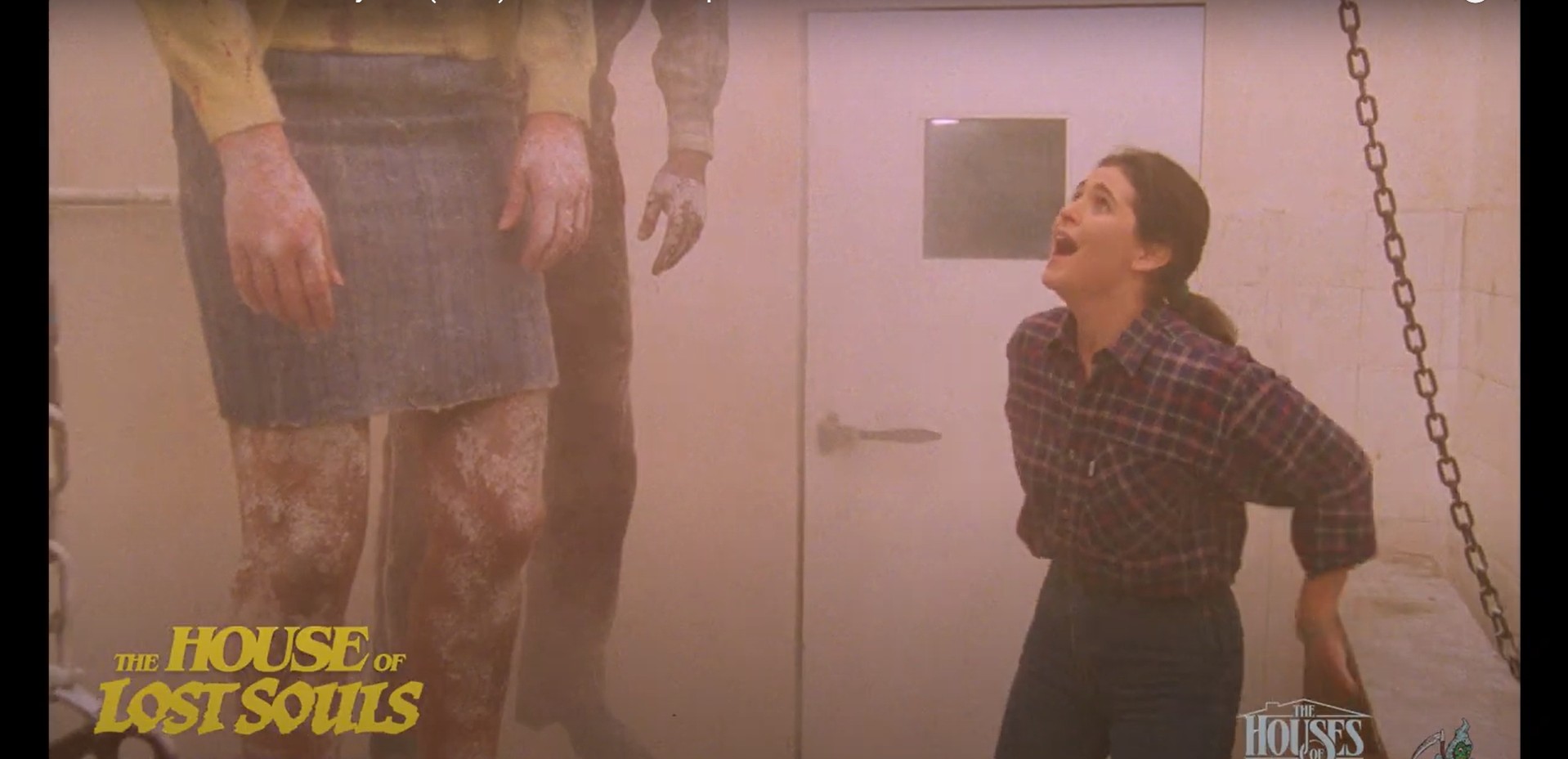
A different ghost house picture than Lucio Fulci’s “The Sweet House of Horrors’ but still contributes the same inhuman intensity of one person (or one ghost person) can against another person.  Yet, for Umberto Lenzi, his story thrives through the house’s, or rather hotel’s, ability to dispatch the innocent with household items.  Decapitating dumbbell waiters, a cabinet with a ripping chainsaw blade, a head-eating washing machine, and almost even a walk-in freezer become the tools of fatal terror.  Lenzi depicts little in the way of person-on-person violence with only implied deaths at the hands of another person; instead, the personification of ghost house miscellany is definitely more exciting, very unexpected, and a lot of fun to watch the hapless have their heads fall prey to household items that are supposed to be helpful, not hurtful.  Perhaps, Lenzi’s intentions were to explore the negative dependency of gadgets or appliances and how easily we’re allured by their safe nature marketing and profound assistance to our daily lives that it makes us easy targets with our guard down.  Lenzi also doesn’t believe in nepotism when casting young actors as the two child characters become fair game for the house’s thirst for slaughtered souls, dooming them with an equal risk to a brutal death.  The storied hotel’s notoriety serves as the vessel that drives ghosts to go berserk but the story’s miss is bringing back to the killer hotel owner who chopped the heads off of his guests to rob them, stowing them away to hide his transgressions, only for them to be the root of the ghosts’ reason for revenge against any and all who trespass through the lobby.  As the origin of the ordeal, the omitted owner serves as just flashback fodder that fuels the floor-by-floor fiends. 

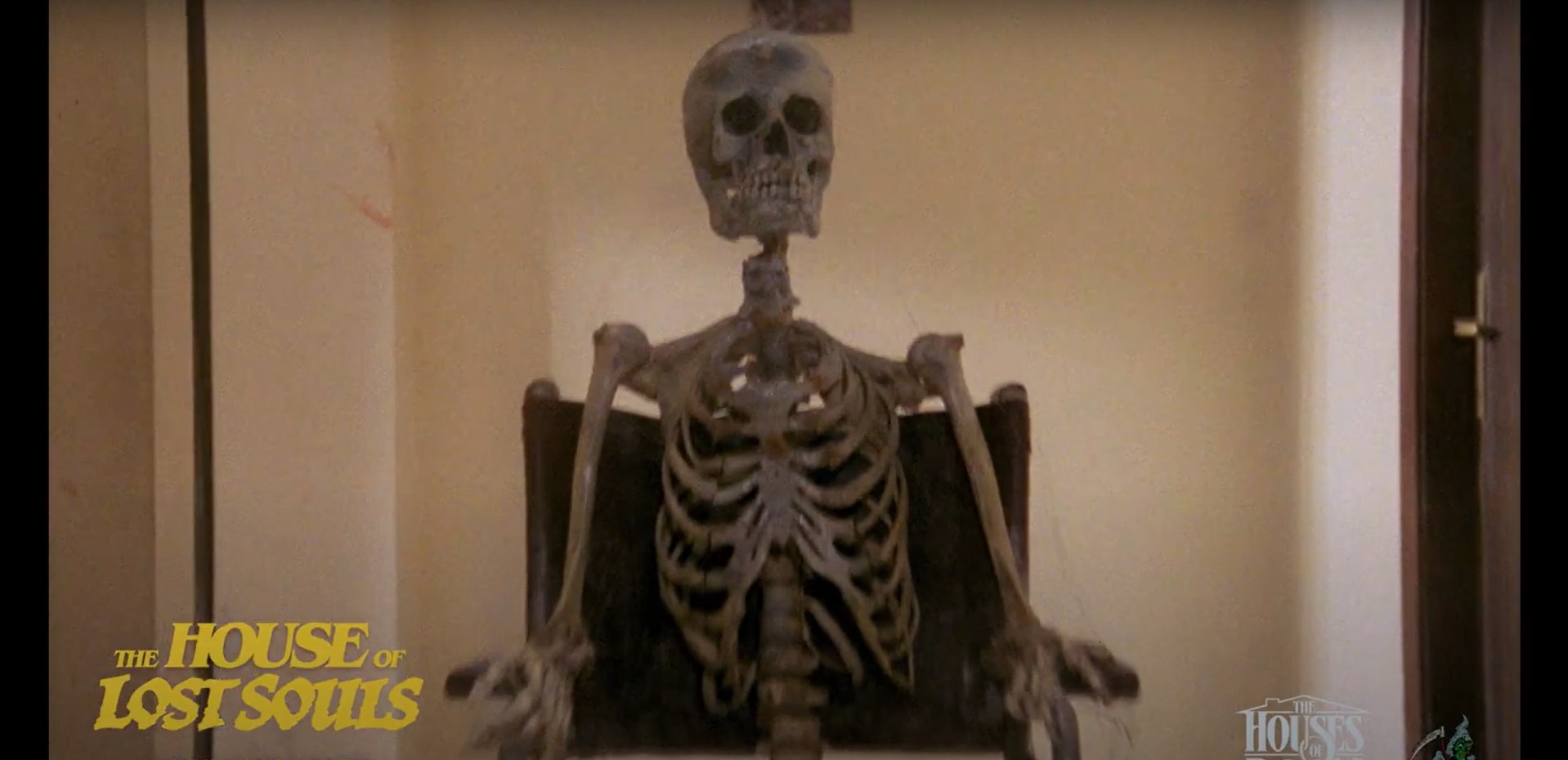
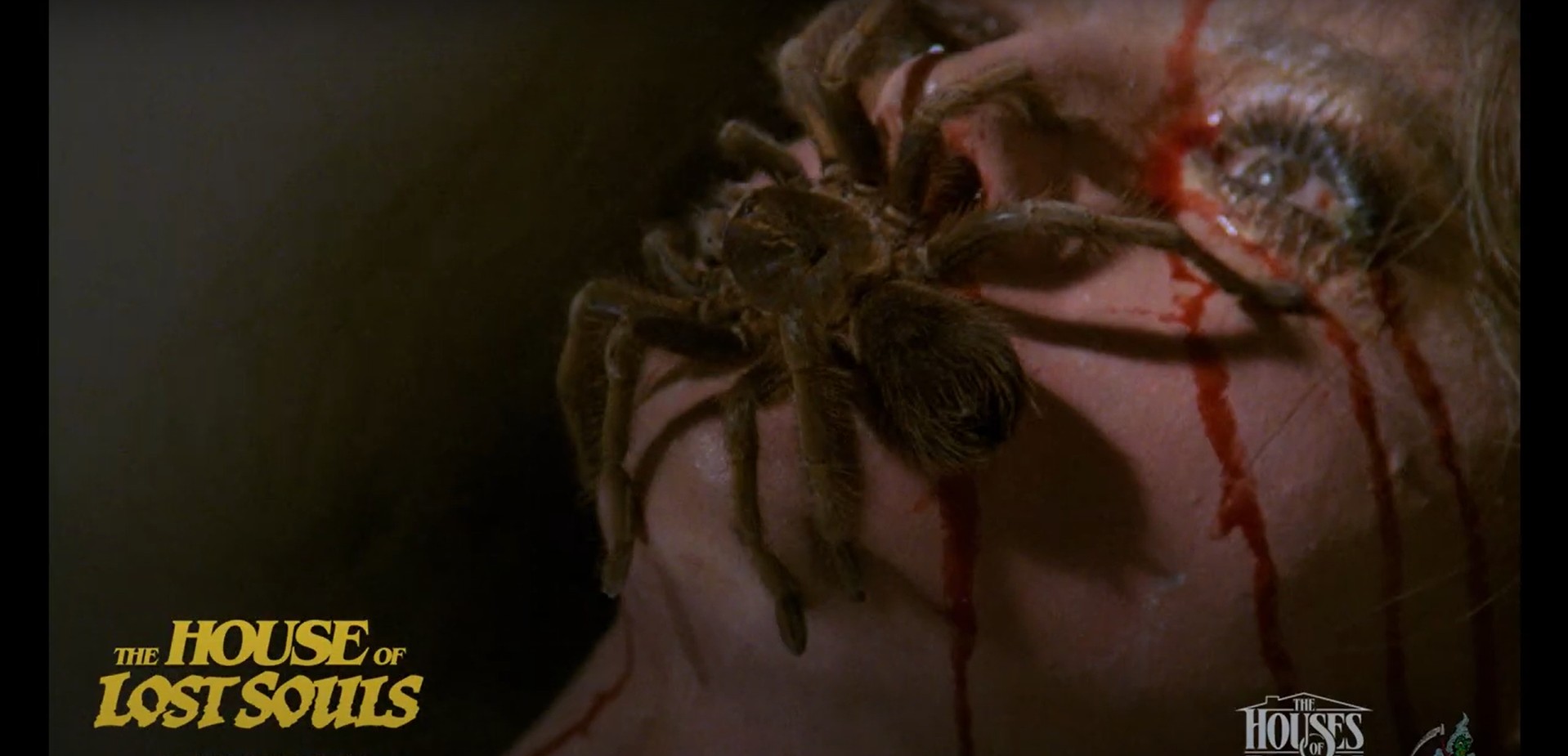
Spiders, skeletons, and severed heads make up, but are not limited to, Umbero Lenzi’s “The House of Lost Souls” now on Blu-ray as the last The Houses of Doom release from Cauldron Films.  Presented in the European widescreen aspect ratio 1.66:1, the new 2K scan was restored and released uncut from the original film negative, inviting a clean and beautifully vibrant pictures for a dark, haunted hotel feature.  However, like with many Lenzi pictures of the time, the final product has softer image detail that’s brilliant for producing color but relaxes the stringent textures to a still better than mild palpability that’s more than enough beyond the bar of image quality.  There are no compression anomalies to speak of as Cauldron Films, again, produces an excellent high-definition encoding, much like with the other three Houses of Doom installments.  Audio setup includes an encoded English and Italian 2.0 mono with optional English subtitles for the English track and forced English subtitles on the Italian.  The ADR hits and misses the mark with vocal ranges seemingly too mismatch with the actors, such as with Massimo who looks like a tenor but has a bass voice, or the boy Giancarlo with an unsettling falsetto and you can lipread those who are actually speaking English compared to those who are not native English speakers.  The overall track has no compression issues with a powerful dialogue projection and an adequate ambience that hits every keynote to bring the composition together.  “Demons” and “Tenebrae” composer Claudio Simonetti produces a charming little synch rock trap-threat and of a score that becomes essential to “The House of Lost Souls” snare and stalk of the geologists caught in the wrong place at the wrong time.  Special features include Cauldron Films’ exclusive interviews with FX artist Elio Terribili Working with Umberto and composer Claudio Simonetti The House of Rock along with two audio commentaries, one with Samm Deighan and the second with Rod Barnett and Adrian Smith, and bringing up the rear is a 2001 interview with Lenzi going through points in his lustrous independent career of exploitation, poliziotteschi, and giallo contributions to Italian cinema in The Criminal Cinema of Umberto Lenzi.  The not rated, region free Cauldron Films standard Blu-ray release, encased in a clear Scanova Blu-ray case with original Matthew Therrien and Eric Lee illustration cover art and logo design, has a runtime of 87 minutes.

Last Rites: That’s a wrap on the fourth and last film on The Houses of Doom collection from Cauldron Films and it’s a beauty scanned onto a new high-definition transfer that brings doomed television features back to life, to live again, to breathe its hot breath of death all over a new generation of viewer unfamiliar to Lucio Fulci, Umberto Lenzi, and even Italian horror!

Don’t Lose Your Head in “The House of Lost Souls” on Blu-ray!

Scarf Michael and the Fiddler’s Power that Draws Upon EVIL! “The Outcasts” reviewed! (Deaf Crocodile / Blu-ray)

“The Outcasts” on Blu-ray Now Available Here!

Ireland 1810 – a small farming village sustains a livelihood off their crops, marital successors, and superstitious belief.  Widower Hugh O’Donnell and his three teenage-adult daughters find themselves in the midst of all three mechanisms with his eldest daughter forced to live with him into widowed spinsterhood, a middle daughter’s secretive betrothal to a neighboring farmer boy despite Hugh’s disdain for the family, and Maura, the youngest daughter, who acts strange and fearful making her an easy target for ridicule.  When the village crop faces blight, bad luck ensues many of the surrounding farmers, and a sudden, expected snow fall threatens harvests and income, Maura is accused of conspiring with witchcraft of a wraith fiddler known as Scarf Michael whose music invokes visions and creates mischief.  Nearly crucified by the fearful villagers, most of whom derided for her aberrating strangeness, Maura is saved by Scarf Michael to be taught his outlier ways that could lead the young woman to never return home again.

Through themes of folkloric belief, societal class structures, family, marriages, mental illness and how it’s ostracized in an early 1800s setting, “The Outcasts” is a cold, hard, and solemn look at daily affairs of a 19th century, poor Irish seaside village, fenced in with the unusual conducts of Maura whose mind is more curious and vastly hungry for knowledge than her peers’ and that creates an escapism component to try and be equal, or perhaps get even with, those that look down upon her.   English writer-director Robert Wynne-Simmons tackles his debut feature-length film with great understanding of tradition and human fear, elemental human nature bred from the uneducated and localized myth seen in his original devilish script from 1971’s “The Blood on Satan’s Claw” by director Piers Haggard.  “The Blood on Satan’s Claw” was certainly far better suited for success with Haggard’s additional scenes of brackish deviltry aesthetics, plenty of full-frontal nudity, and visible vibrant and rich blood.  “The Outcast” is a return to the slow born of an eventual decline and degradation of not just Maura but her family and her village.   “The Outcast” is part of an Irish production conglomerate of companies, including Arts Council of Ireland, The Irish Film Board, and the Toymyax Company with Tony Dollard producing.

Mary Ryan is the centerpiece of the fantastical and fraught tale because of her teenage character’s childlike innocence that’s deemed unusual, weird, and, eventually, in bed with a spiteful spirit, labelling her character, Maura, as a cursing occultist.  Ryan, who would go on to have minor roles in “Rawhead Rex” and “The Courier,” brings a balance of beauty and blamelessness to Maura’s undesired disposition, one that allows her no friends and is even on the edge of displeasure from her older sister Breda (Brenda Scallon) and father Hugh (Don Foley) whom both found love and lost them over a rough course of untimely death.  There’s still obvious love between them, but Maura likely reminds them of mother, especially from Hugh, and sees a same early grave fate for the youngest and adrift daughter.  Middle Daughter Janey resides on the opposite side of the spectrum with unconditional love and support for Maura only to be intertwined with her own serendipitous affairs with local farm boy Eanon (Máirtín Jaimsie), finding themselves rushed into proper marriage when Janey comes home expecting.  And while Maura made faultless inconsequential ripples through the family and the village, she was initially not on the forefront of everybody’s concern as Janey and Eanon became a jovial celebration that sought the joining of two well-known families and farms until Scarf Michael reappeared to play his fiddle.  Mick Lally fiddles as the musical wraith casting his violin strokes against those essentially bullying Maura with trickery that led to subsequent fears and accusations of agricultural assassination and magical maligned mischief that turn the rural villagers away from Janey and Eanon’s blessed marriage to an acute decline of rationality that put Maura in the crosshairs of suspected supernatural conjuring.  Scarf Michael’s intentions are not to whisk Maura away into what she sees and believes is as blissful freedom from those nasty looks and mocking that surround her as well as Michael’s tenderness to which she falls in love for the first time, like a child growing into adulthood.  “The Outcasts” round out with Tom Jordan, Cyril Cusack, Gillian Hackett, Brendan Ellis, Hilary Reynolds, Donal O’Kelly, James Shanahan, and Paul Bennett.

Not ever story about the loss of innocence from growing up is portrayed in a good light.  Maura wants to hurry grow up and be free of her childish qualities without realizing the consequences.  Falling in love with Scarf Michael proves to be perhaps folly of Maura who gives into the dream, or fantasy, of a man who quickly enters her life and charms her with the mystical fiddle.  By the end, indications of Scarf Michael nothing more than a rake leaves a sour and sad aftertaste that shutters Maura from the rest of her family as she willing joins him on the other side, practically begging him to free her from an unforgiving reality.  Perhaps Maura was also led to believe in no other choice, condemned to a watery grave, the same fate that befell Scarf Michael, by her fearful village peers and elders.  Robert Wynne-Simmons is often playing devil’s advocate by building up Scarf Michael as a savior and a romantic, but Maura drinks the Celtic Kool-Aid because, frankly, she knows no better and received no beneficial direction from those who surround her, leaving the alluring fiddler to warn her of the choices she desires.  Wynne-Simmons and Seamus Corcoran’s soft-and-dreamy fairytale indulges a bit of surrealism through soft-lighting, soft focus, and crude yet effective editing tricks to create a specter’s intermittent visibility amongst other slight of sight practical effects. 

If ever a time to be totally physical media inclusive toward all the obscure outliers, now is the time with “The Outcasts” arriving onto a newly restored 2K transfer for the first ever Blu-ray in the U.S. courtesy of Deaf Crocodile.  Presented in an European widescreen 1.66:1 aspect ratio, the AVC encoded, 1080p high definition, BD50, plus the restoration efforts conducted by the Irish Film Institute – Film Archive, retains that airy softness of a daydream inlaid to suggest a surrealism surrogation but the story is rooted in reality, the reality of early 1800s Ireland to be exact, and so this impoverish, austere, and salt of the Earth land and it’s people are often absorbed by superstition belief that’s awfully real for them but to the audiences, it’s bordering the illogical.  Details are generally soft but the upgrade increases the contours and create a nice layer of depth between foreground and background, bathed in the muted and ascetic green, brown, and tan color scheme of a traditional period piece wardrobe and materials, leaving behind any ounce of hue pop to not spoil the intended grading that lives and dies by somewhere between the RGB and the average grayscale, but there are times of an eerie dressed lighting of added backlit blues and bright whites to secure a fantasy, or spooky, flare.  The fidelity reproduction on the Irish-English DTS-HD mono track diffuses distinct aspects through the single channel without any vague overtaking.  The brogue English did, at least for me, require the optional English subtitles to be turned on for my untrained ear to decipher certain antiquated period terminology and the strong Irish accents that would drown out an entire sentence; this is not an issue concerning the quality of the audio track as it’s nicely achieved without any damage to note or crackling, hissing, or other obstructions to interfere.  The dialogue is also fairly robust and prominent.  Steve Conney’s lyrical and guitar score enchants with traditional Irish folk and is ascertains the mix of commonplace and otherworldly mood Wynne-Simmons seeks to create.  Bonus content includes a new video interview with writer-director Robert Wynne-Simmons, a new video interview with composer Steve Conney, producer and film professor Rod Stoneman, former head of The Irish Film Board, and physical media expert Ryan Verrill provide a video essay, and concludes with five Robert Wynne-Simmons’ short films:  “L’Eredita di Diavolo,” “The Greatest All-Star Advertial of All Time,” “Bomb Disposal,” “The Scrolls,” and “The Judgement of Albion – Prophesies of William Blake”  These shorts include appearances/cameos by Charlton Heston, Sammy Davis Jr. and Peter O’Toole to name a few.  The clear Blu-ray Amaray has an appearance that’s about a stark as the film’s aesthetic with a gray coverart composition of celebration fiddlers in their straw masks overtop an isolated Maura.  An insert advert with a QR code offers to access transcribed bonus content.  The disc is pressed with the same front cover image and the reverse side of the primary cover has a still from the film.  The unrated release has a runtime of 105 minutes and is hard-locked with region A encoding.

Last Rites: An obscure gem of Irish cinema, a folklore and social explication of “The Outcasts” outlives antiquation with a new Blu-ray release from obscure aficionados Deaf Crocodile!

“The Outcasts” on Blu-ray Now Available Here!