EVIL’s One Brush Stroke Away From Losing It! “Spiral” reviewed! (Ronin Flix / Blu-ray)

The New “Spiral” Now on Blu-ray!

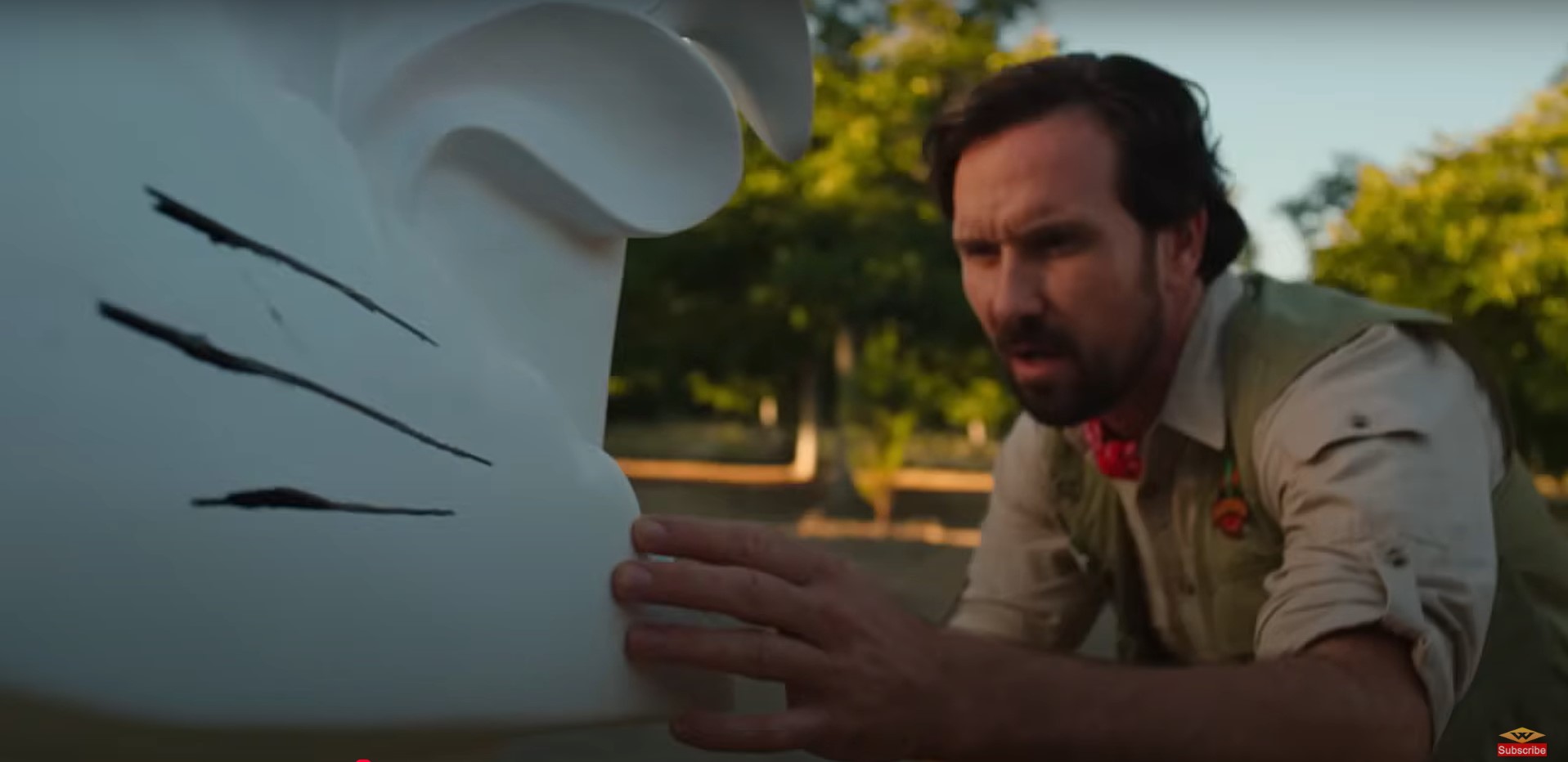
Mason, a socially awkward painter and car insurance telemarketer, struggles to cope with a seemingly bad breakup that might have turned into a misdeed, but a quick call to his only, childhood friend Berkeley helps keep his anxious emotions from spiraling out of control into nightmarish allusions.  As Mason gradually works to purge his previously relationship, a woman who was also his inspiration for his artistic work, he suddenly meets Amber, a new amiable hire in his company, sitting with him on his lunchbreak outside bench.  Amber’s able to slowly break down Mason’s guarded wall of insecurity and two begin an innocent, romantic relationship as Mason continues to push his haunting past aside for Amber to fully step into being his modeling muse, but the further imbed she becomes into his life the more enigmatic secrets are revealed surrounding Mason’s life, even the darkness that slowly spreads and loops into it.

Actor Joel David Moore had established himself as an actor in early 2000s, usually portraying the lanky, awkward, if not ungainly trope in comedies most notably in “Dodgeball” and “Grandma’s Boy,” playing a supporting protagonist as well as lead antagonist.  Director Adam Green quickly became an overnight success amongst genre fans with his release of the Cajun miscreant slasher in “Hatchet” that would spawn a pair of sequels.  Having worked as actor and director respectively on “Hatchet,” Moore and Adam became good friends and decided to take a step further to not only expand upon an acting career and expand upon the objectivity of storytelling but also to co-direct their next project entitled “Spiral.”  The script, that orbits around the romantic-psychological thriller purview, is cowritten between Moore with debut feature writer Jeremy Boreing.  The 2007 film revolves around and enters the disconnected mind of an emotionally compromised individual and how he copes and handles everyday life while in constant fear.  “Spiral” is executively produced by Moore and costar Zachary Levi along with Boreing, David Muller, Kurt Schemper and Cory Neal producing under the Balcony 9 and ArieScope Pictures production flag.

If you haven’t gathered already, “Spiral” is Joel David Moore’s baby.  Moore’s idea natural earmarked him as the executive producer and the project is the first to land him a directorial and a writer credit, so unsurprisingly, the role of the socially recluse and mentally scarred Mason went to the Portland, Oregon born actor, likely a role he wrote with himself in mind.  As Mason, Moore breaks the mold that has trapped him in previous films that were relegated to what producers might have considered not leading man material, leaving much to be desired when stuck in a second of third string supporting role.  Then Adam Green puts Moore in “Hatchet” and in the principal protagonist role.  The opportunity proves Moore had more than just comic, sidekick relief and he really cements Mason’s depth with ticks, tantrums, and a taste for tenterhook romance.  Meeting Mason in the ambiguous opening stirs internal conflict for how we’re supposed to receive this hyperventilating wailer confessing to something vile we’re not privy too just yet.  From there, we meet the philandering, go-with-the-flow, and Mason’s best bud, only friend at that, Berkeley (Zachary Levi, “Shazam!) and the quirky cute and Mason-eyer Amber (“Amber Tamblyn, “The Ring”) that develop upon Mason’s home-work relationship that highlight his interests – painting and jazz – as well as his disinterests – basketball and speaking about his past.  The very opening scene compared to the heart of much of the story has stark contrast and, so much so, that audiences will tend to forget Mason’s late-night phone call ramblings and fear to his friend Berkeley, his wake-up screaming nightmares to wear he looks at his hands for blood, and his overall highly anxious persona when he’s talking shop and girls with Berkeley and breaking out of his shell of solitude with Amber in a lengthy string of normalacy.  Ryan Chase, David Muller, Annie Neal and Lori Yohe fill out the cast.

“Spiral” is all about the trauma, a fiercely common theme inside the heads of the mental thriller subgenre.  With deeply troubled lead character, an at interval switchboard that lights and darkens between the protagonist and ambiguous antihero storyline, watching Mason grow, fall, grow, fall, grow, and then finally collapse in a heap of his own trauma is terrifyingly satisfying, mostly to the thanks of Moore’s added plummeting nuances that spit his character back into abnormality.  Mason’s arc circulates in a circular pattern and the evidently timebomb is ticking away but in the middle of that circulation forms a bond, a friendship, an affair, hope, compassion, and every affirmative adjective you can think of to bring happiness to what shouldn’t be a happy trajectory because in the back of our minds, darkness lies.  That’s the sublayer of this trauma-laden yarn with a repressive factor and the key to unleash years of pent up unlocks a whole new side of Mason, one that isn’t completely illuminated upon until the shocking, device-destroying end.  

Ronin Flix rekindles Joel David Moore and Adam Green’s “Spiral” back to Blu-ray with an AVC encoded, 1080p resolution, BD50. Comparatively to the Anchor Bay 2010 Blu-ray release, which also presents the film in a widescreen 1.78:1 aspect ratio, Ronin Flix edges out the now decade previous release but not by much. The back cover only notes the label went through a film restoration with no other details or specifics to elaborate but from a spectator’s view, the 2024 restoration handles a sharper delineation that provides excellent depth that plays key to the various scenes of Amber and Mason’s painting sessions, Mason’s guilt-ridden obsession with the bathroom door, and Mason’s overhead cubicle viewpoint to name a few examples. Details are much more specific in brighter, ambient-lit scenes than the darker shades of key lighting or night sequences not only because of the innate lack of illumining exposure. Blacks tend to crush slightly, bleeding in the details and washing them out in blank of black. Skin and textures particularize better on Ronin Flix’s upgrade that uses a newer codec for compression, elevating the elaboration for this under-the-radar indie. The English DTS-HD Master Audio 5.1 manages the lossless mix much in the same was as Anchor Bay’s with greatly clear articulation on the forefront, a spacious and spatial ambient track, a patterned sound design dynamic to the progression, and a supporting soundtrack that while isn’t overly worthwhile does aid the varying moods, especially when Mason turns on a dime intertwined with jazz brass. Decent sound diffusion through the back and side channels to harness surrounding elements while the fronts tackle the predominant dialogue until an occasion acousmatic turns our heads and our attention. English subtitles are available for selection. The static menu offers special features that includes exclusive content, such as a newly put together making-of “Spiral” entitled Paint it Red, an audio commentary with Adam Green and Joel David Moore, director of photography Will Barrett, and editor Cory Livingston an a behind-the-scenes documentary featurette with interviews from Green, Moore, Livingston, Barrett and co-star and producer Zachary Levi. Archival content includes an audio commentary with the co-directors, director of photography, Levi, writer Jeremy Boreing, and actress Amber Tamblyn, and rounds out with the theatrical trailer. A cardboard O-slipcover sheathes the Blu-ray Amaray case and both contain the same more-gruesome-than-it-really-is cover art and David Levine package design. Inside the case is just the disc pressed with a third copy of the hand dripping blood, or paint. Ronin Flix release is rated PG-13 for disturbing behavior, violence, some partial nudity and language, has a runtime of 91 minutes, and also unlike the Anchor Bay release, this release has region free playback.

Last Rites: “Spiral” paints Joel David Moore in a whole new light, colored in vague tones that just nip at nerves, and slaps you square in the face just when things start to feel warm, cozy, and safe.

The New “Spiral” Now on Blu-ray!

The James Brothers’ EVIL May Not Compare in “Killers” reviewed! (Synapse Films / Unrated Director’s Cut Blu-ray)

“Killers” Unrated, Director’s Cut on Blu-ray from Synapse!

Odessa and Kyle James paint half their faces with skull imagery, don their Santa hats, and load their pump action shotguns and on Christmas Eve, walk into their parents’ bedroom and unload multiple shells into them where they lay without mercy.  A trial sentences them to death row for their crimes despite their calm efforts to dismiss the State and prosecutor’s case against them.  Years later, the brothers escape from the maximum-security prison and are the loose in the town of Beatty where the Ryan family happily watch television and play board games on a stormy night.  With U.S. Marshalls hot on their tail, Odessa and Kyle invade the Ryan home where their strangely more than warmly welcomed by the mother and two daughters.  It quickly becomes clear their usurpation of the Ryan household is more of a sheep in a wolf’s clothing and the meager, goody-two shoes Mr. Ryan will reestablish dominance and show the James Boys the real man of the house.  

1996 marks the year of Mike Mendez’s debut feather-length film, titled simply “Killers.”  “The Covenant” and “Satanic Hispanic” segment director writes and direct a philosophical and brutal home invasion thriller cowritten by one of the film’s principal actors, the late Dave Larsen (“Vampire Centerfolds”), full of unusual twists that can second guess everything you know about storytelling.  “Killers” cements under his greenhorn feet novel elements of twisted character studies while finding homes for bad boy cool characters, stylized shootouts, and a smoky noir and dark dwelling cinematography to commingle with his anarchic structure and tale.  The U.S. produced film is independent funded by star-producer Dave Larsen under the LLC of The Lost Boys, a reference from the film’s story that labels the escaped convicted brothers as such, with Joseph E. Jones-Marion as coproducer.  Most of the funds were secured by Dave Larsen’s father, S.E. Larsen, after remortgaging the family home.  Eventually, the home was foreclosed upon after Dave’s premature death.

Dave Larsen and David Gunn entrench themselves into the sordid souls of sociopathic brothers Odessa and Kyle James, inspired almost to the exact murder by real-life killers the Menendez Brothers who committed parricide in nearly the exact shotgun-loaded manner in Beverly Hills 1989.  Portraying mindful. ruthless killers with intellectual monologues and a panache that’s very Mickey Rourke pastiche, the solemn faces and confidence carrying Larsen and Gunn go greatly above and beyond the call for the titular types.  Thinking the summit has been reached and there could be nothing more grave than two brothers snuffing their own mom and dad without hesitation, who kill Beatty locals with intent, who steal daughters (Nanette Biachi, “The Killer Eye,” and Renee Cohen) and a wife (Damian Hoffer) for their own carnal pleasures, and who bully and insult a respected husband, father, and man (Burke Morgan, “Bloodsucking Babes from Burbank”) of the Beatty community, the tables suddenly and jarringly turn and viewers will be knocked unbalanced when the police storm the door, lead by U.S. Marshal Lorna McCoy, played by the quick and sarcastic lip of Wendy Latta, and discover just then who that two killers are actually more in this seemingly quiet and small suburban house, rivaling the James boys, if not surpassing their malevolence even if just a little.  The “Killers’” cast doesn’t stop there as Ellis Moore (“Femme Fontaine:  Killer Babe for the C.I.A.”), Ivan Vertigo, Chad Sommers, and Carol Baker becomes a part of the fray.

“Killers” defined is simply a conceptual paradox.  If two unstoppable forces collide, the logical result would be an unfathomable outcome as nothing can stop an unstoppable force.  Instead, what may occur is a massive particle explosion, a rift in dimension time and space, or a vast nightmare so bizarre nothing can compare to it.  “Killer” embodies every quality of the latter in its maniacal melting pot of phantasmagoric potpourri, especially through the Mendez lens of engulfing shadows and mostly Duke blue and poker hot red gel tints.  Following the progression is a guessing game unto itself with welcoming and shocking pivots that parade forth a Hell on Earth turn of events.  You think the story’s going one way then it acutely shifts, and this happens more than once to the point where none of the previous groundwork or what’s instore for the future can be taken for granted in this fluid, subversive, kill-or-be-killed home invasion and cannibal bipartite.  For a first-time independent production, weapon props are extensive, gory moments are effective, makeup has grotesque appeal, and the dialogue indulges in shades of conversation complexity that equally match the complexity of the characters’ MacGuffin backgrounds.  Mike Mendez’s impressive start to his career has provocative monologue and stylish notes of Quentin Tarantino and William Freidkin bathed in primary color gels and a tale zigzagging with zeal.

Available for the first time in high-definition, the director’s vision, restored by the Multicom Entertainment Group, is in the hands of Synapse Films, delivering “Killers” to the cult physical media table with an AVC encoded, 1080p high-definition, BD50 Blu-ray. Presented in the 1.78:1 aspect ratio, “Killers” has a stylistic choice of being tenebrous, whether in shadow, in night, or just to over exuded a sense of gloom and doom in tone and in what’s visually shown. Delineated blue and red gel lighting beam through and glow the necessary bits for effulgence effect to contrast the darkness. Another popping source of lighting and colors are the individualized, punchy Christmas colors because, for all who don’t know, “Killers” is actually a Christmas movie. Because of the cheerless grading, details are not inherently sharp but Synapse and Multicom’s restoration enlightens quite a bit than previous versions, putting rightfully on display the details where once shrouded by lower resolution or otherwise mishandled. Skin tones appear natural as well as the grain with a scintilla of white speckle. The lossless English DTS-HD Master Audio 2.0 stereo has an organic dual-channel dynamic, catering a central focus on the monologuing, that translate to the dialogue exchanges also, with great enthusiasm and clarity. Not the best in edited sound design that has layer slippage but pulls enough ahead and into the fold to not be an unsynchronous, incongruous mess. “Killers” could have greatly benefited from a surround mix with the varietal exchanges that emits a full-bodied arrangement of resonations, mostly in the interiors and playing to those specific in locations. English subtitles are available. Special features include a feature-paralleling audio commentary with director Mike Mendez and horror journalist Michael Gingold going over backstory, tidbits, and the goals of making “Killers,” an alternate, pared-down ending that’s loses a lot of the original film’s feasting flavor, and the original promotional trailer. The black Amaray case comes with new illustrative cover art without a reversible option. Inside contains a 6-page essay My Brother Death: Mike Mendez’s Killers by cult film enthusiast Heather Drain, a Synapse 2025 product catalogue, and a disc pressed with Odessa’s half-skull covered face. The region free release has a 96-minute runtime and is unrated.

Last Rites: Synapse Films have brought “Killers” from out of the shadows of obscurity. A schismatic, soulless killer of a film, “Killers” has the heart of madmen and madness meshed together in one seriously sideways story.

“Killers” Unrated, Director’s Cut on Blu-ray from Synapse!

Cartagena’s Secrets are Mountainous EVIL Aliens! “Top Line” reviewed! (Cauldron Films / Blu-ray)

When Everyone’s Out To Get You, You Get “Top Line” on Blu-ray!

Washed up, alcoholic feature journalist Ted Angelo drinks himself into a stupor on the porticos of Columbia.  Having just been fired by his magazine editor for lack of content, Angelo scores big when led down the path of ancient tribal artifacts that proves the terminus of one of Europe’s famous new world explorers, rewriting history of the disappeared pioneer, but what he truly discovers is bigger, and more frightening, than history itself as he unearths a large alien spacecraft hidden within the Columbian mountains, big enough to enclose the explorer’s lost mast ship.  The discovery of a lifetime becomes the bane of Ted Angelo’s existence as he’s suddenly on a kill list and every organization, from the C.I.A., to the K.G.B., to former Nazis, is hunting him and wanting him dead.  Unable to trust anyone and nowhere to run and hide, the desperate writer is determined to expose the secret-to-kill-for to the world but not if the aliens have anything to say about it. 

Let’s talk about a film that is a bit of a smorgasbord with tapas plate tastings of just about every genre that exists.  That’s one way to serve the description of Nello Rossati’s “Top Line” with an inarguable action coating menu overtop the varietal lifeblood veins of science fiction, espionage, drama, parody, horror, and driven by a sensationalized historical context.  Directed under Rossati’s Americanized pen name, Ted Archer, and known alternatively as “Alien Terminator,” “Top Line” tries to appeal to western audiences with brazenly broad script cowritten by “The Woman in the Night” director and Roberto Gianviti (“Don’t Torture the Duckling,” “Murder Rock”) at the height of Italian ripping of popular American movies.  Filmed on site in Cartagena, Colombia, the Italian production was produced by Luciano Martino (“The Island of the Fishmen”) and productionally sanctioned under companies Dania Film, Reteitalia and the National Cinematografica. 

What’s likeable about Ted Angelo is he’s simply a writer.  He’s not a crack-shot, he’s not a world-class fighter, and he’s not one for conjuring up a complex master plan.  Instead, Ted Angelo is a flawed man under the influence of a bottle and is a low-level womanizer where the bedroom interests are more about local information than about the sexual activities.  Franco Nero (“Django,” “High Crime”) goes against his multifaceted ruggedness and muscular physique to be the more of an adaptable and instinctual hero that tries to make up for slouching about Columbia’s drink selection.  Nero’s the hero while Deborah Moore, of “Warriors of the Apocalypse” and daughter of former James Bond Roger Moore, tiptoes about the love interest trope after her character’s senior colleague, who is also Angelo’s good friend, is murdered in the plot and the two become intwined and more goal oriented in unearthing the reason in a minor ploy of revenge.  Yet, the trick is on them after discovering a U.F.O. right in their mountainous backyard and the hunt for their lives is on by a former Nazi and antiquities collector Heinrich Holzmann (George Kennedy, “Naked Gun”), a whole slew of clandestine organization spooks, and Rodrigo Obregón (“Savage Beach”) doing his best Arnold Schwarzenegger “Terminator” act as a large cybernetic man with a stoic and half-exposed face.  “Top Line” supporting cast includes William Berger (“Devil Fish”), Sherly Hernandez, Larry Dolgin (“Caligula:  The Untold Story”), Steven Luotto, Robert Redcross, and Mary Stavin (“House”) as Ted Angelo’s ex-blonde beauty editor girlfriend.

“Top Line” has one of those cinematic stories that’s all over the place pieced together by western inspiration like some sort of genre stitched together Frankenstein’s monster.  Unlike the flat top and bolt-necked creature born of electrical current and held together by suture and mad scientist sorcery, “Top Line” doesn’t have any hideous scars or an unfavorable attitude deterrent but what the Nello Rossati film does feature similarly are the monstrous best parts, such as unpredictability, a pendulum of excitements, and an everyone has grabbed their pitchforks and is out to get you sentiment.  “Top Line” is a wild, exciting, volatile ride set in the heart of a landscape and culturally showcased Cartagena and the ever game, Italian actor Franco Nero at the helm steering what at first appears to be an adventurous escapade of treasuring hunting and covert coverups in act one and two suddenly careens into an assault of astro-terrestrials forces to the tune of the fourth Indiana Jones film, “The Kingdom of the Crystal Skull, by crescendoing third act.  “Top Line” is just as theatrically thrilling without the whipcrackin’, fedora-wearing, family friendly archaeologist with multiple blood squib shootouts, a superb tongue-and-cheek car chase down winding mountainside road, and the hydraulics-driven special effects transfiguration your eyes need to see to below.

Cauldron Films proudly presents “Top Line” onto Blu-ray for the first time, the resulting 2K transfer sourced from the camera negative. The AVC encoded, 1080p high-definition, BD25 decodes a clean, color stable picture that feels organic around the diffused color scheme, and that palette pops without being artificially enhanced. Grain appears in check, natural, and consistent throughout. Presented in the original aspect ratio, a widescreen European ratio 1.66:1, does capture the grandiose of a 17th century exploration ship inside the cavernous mountain without a squeeze of the frame, providing more depth with the help of the art direction to visualize and construct an actual set. Textures, fibers, and other tactile s are limited around the jungle setting that does offer a nice leafy and lush setting that depicts a thicket of a developing country without just being a smear of the same color arrangement but outside of that, what does source de facto is sumptuous textural material. Two audio options are available to choose from with an English DTS-HD Master Audio 2.0 mono and an Italian DTS-HD Master Audio 2.0 mono. The Italian is done in post with ADR and has that nagging space between action and voice while the English track goes through less dubbing, or more exact dubbing, with Franco Nero, and other cast, having their voice heard in scene and in synch. The only issue concerning comes with George Kennedy’s dialogue which is dubbed to be more archetypical German of the Nazi-era; however, this route was not heavily travelled with very few lines being delivered by Kennedy, or rather Kennedy’s voiceover actor. Ambience travels amply and disseminates well for a single signal to travel through a stereo output and this jumps the eclectic range of action from the speakers to your ears. Granted, the action is very selective as you don’t every nuisance of jungle skirmishes and the other village landscapes, but there is enough and what’s not covered is often overlayed with Maurizio Dami’s tribal, tropical paradisio percussion and parallel synth with echoing vocal snips, such as whistling, and peppered with scene bytes – the chase sequence where the first batch of armed men running down Ted Angelo is audio composition gold. Special features on Cauldron’s standard Blu-ray contain an exclusive, new interview with lead man Franco Nero Black Top!, an interview with Eugenio Ercolani The Strange Case of Ted Archer, parapolitic researcher Robert Skvarla takes at examples of known alien sightings and speculations in Alien Terminated: The Alien Theories, an audio commentary by film historian Eric Zaldivar that includes interviews from Deborah Moore and Robert Redcross, and with additional insight on Italian cult films from actors Brett Halsey and Richard Harrison. The clear Amaray Blu-ray houses reversible cover art, both representing original artwork from the film’s release. The primary art is more adventurously exciting with Angelo’s arm wrapped around Moore and a rope, reminiscent of “Romancing the Stone,” while the interior cover plays to the science fiction side of the story, more “Terminator-y” to be exact. There are no inserts or other tangible items included. The 92-minute feature is presented unrated with a hard encoded region A playback.

Last Rites: “Top Line” is a top tier title with a little bit of everything for everybody that’s accentuated by a on-the-run Franco Nero performance with a new, gorgeous 2K transfer Blu-ray packed with special features from our friends at Cauldron Films.

When Everyone’s Out To Get You, You Get “Top Line” on Blu-ray!

Tonight’s Next Guest is EVIL! “Late Night with the Devil!” reviewed! (Second Sight Films / Limited-Edition 4K UHD and Standard Blu-ray)

Check Out the Package on Second Sight’s Latest Limited Edition – “Late Night with the Devil!

In the golden age of late-night television shows, Jack Delroy was one of the hottest late-night comedians and talk show hosts of the early 1970s, only to be beaten out by inches by rival talk show host Johnny Carson every year.  By 1977, Delroy’s viewers and popularity on his show Night Owls was slipping after multiple failed attempts to revive the show’s viewership figures and to hit the number one spot for syndicated station UBL during sweeps week year after year.  That years Halloween episode, during the sweeps week, would promise to be one to be remembered when Delroy brings a medium, a magician-turned-magician promulgator, a paranormal psychologist, and her adopted subject, a young girl who was the last known survival of a Satanic cult.  While the lineup entertains the live audience and those viewers at home throughout the night as well as being excellent for the ratings game, Halloween thins the layer between the real world and the supernatural world and an awry demon summoning goes horribly wrong, caught on the station’s camera, and with Jack Delroy and his guests caught in the middle.

If you’ve never had the pleasure of seeing “100 Bloody Acres,” the 2012, underrated Australian comedy-horror has a fine entertaining balance of black humor, gore, and suspense.  The directors behind the little-known venture, brothers Cameron and Colin Cairnes, may not have moved the needle with their debut feature in Australia, nor globally for that matter, but their latest, a 1970s, found footage, period piece surrounding demonic catastrophe on live television entitled “Late Night with the Devil,” carries with it significance and growth, personally and globally.  Having also written the script, the Cairnes recreate a time period when television use to capture grotesque and jarring images to shock the masses in full, unbridled color through the whimsical lens of a late-night television show.  In a production company opening that seemingly would never end, “Late Night with the Devil” is a conglomerate effort from IFC Films, Shudder, Image Nation Abu Dhabi, Spooky Pictures, Good Fiend Films, AGC Studios, VicScreen, and Future Pictures and produced by Adam White, Steven Schneider (“Trap”), John Mulloy (“Killing Ground”), Mat Govoni, Derek Dauchy (“Watcher”), and Roy Lee (“Barbarian”).

In order for “Late Night with the Devil” to work, the Carines brothers needed a principal lead to understand what it means to be a charismatic and funny host of 1970s late night television.  They found niche trait in “The Last Voyage of the Demeter” and James Gunn’s “Suicide Squad’s” David Dastmalchian who is an adamant man of horror himself from genre scripts, articles, and comic books to being a horror themed host himself as Dr. Fearless hosted by Dark Horse comics.  Dastmalchian plays a different sort of host for the film, a quick-wit, neat as a pin, and handsome Jack Delroy who has lofty goals of elevating his show to the number one spot in the domestic market.  Early success drives Delroy who will do anything to outscore late night king Johnny Carson but when his wife (Georgina Haig, “Road Train”) falls ill and dies early, the ratings battle slows for Delory’s show until his return to try and revive glory with kitschy content.  Halloween 1977, sweeps weeks, proves to be a chance for Delroy and his manager (Josh Quong Tart, “Little Monsters”) to spice things up with phantasmagoric guests in Christou (Fayssal Bazzi), an arrogant former magician turned cynic (Ian Bliss, “The Matrix Reloaded”), and a paranormal psychologist (Laura Gordon, “Saw V”) and her adopted subject Lilly, the debut feature-length film of Ingrid Torelli.  Aside from Chicago-born Dastmalchian, the rest of the Australian production is casted natively and do an impeccable vocal mimicry of an American accent while stunning and convincing in their respective roles, especially for Torelli whose piercing blue eyes, rounded check line, and gently raspy voice gives her an uneasy accompaniment to her off-putting innocence that works to the story’s advantage.  The cast rounds out with key principal Rhys Auteri playing Jack Delroy’s quirky sidekick host Gus McConnell whose story progression trajectory borders the voice of reason ironically enough and without McConnell and Auteri’s spot-on depiction of host announcer and comedic adjutant, there wouldn’t be steady fidelity for those who grew up on late night TV.

Late night TV essence is beautifully captured with mock production set of a 70s television studio, acquired era garbs, costumes, and accessories, and performances that provide a real flavor for programming of that time, and I would know as I would obsessively glue my attention to Johnny Carson reruns at a young age in the 1980s to early 90s.  The Cairnes and director of photography Matthew Temple deploy a studio reproduction of a three-way camera system to unfold the carnage; yet the forementioned behind-the-scenes moments in between live-air tapings feels forced, unnecessary, and artificial to the story with a lack of explanation to who and why these in-betweens are being done.  The black-and-white scenes vary in cameraperson positions from behind the coffee and snack table, behind fake floral, or just right in their face that steals from the live-tape realism.  What then ensues when the demonic light beams from one of the guest’s split open head does redirect attention to the psychokinesis death and destruction and this removes those behind-the-scenes fabrications with a replaced personal, interdimensional Hell for Delroy, shot in a more conventional style outside the confines of found footage under omnipotent means.  Cameron and Colin’s part-documentary, part-found footage, and part-conventional efforts prologue the story with an out, one that sets up connections to link violence on a single character lightning rod with maximum collateral damage, and that lead up of information almost seems trivial but works to the advantage on not only the character’s background but also generates a real spark of juicy, full-circle, nearly imperceptible greed that comes with a cost. 

Second Sight Films knows a good movie when they see one and quickly snatches up the rights to release “Late Night with the Devil” on a limited-edition, dual-format collector’s set.  The UK distributor’s 4K UHD and Standard Blu-ray combo box comes with an HVEC encoded, HDR with Dolby Vision 2160p, BD66  and an AVC encoded, 1080p high-definition, BD50, both formats decoding at a refresh rate around 24 frames per second and presented in the three aspect ratios to reproduce 70’s era television ratios with a 1.33:1 and European ratio 1.66:1 as well as seldomly switching to a 2.39:1 widescreen for more down the rabbit hole sequences.  Much like the variety of aspect ratios, an intentional ebb and flow design between color and black-and-white draws demarcating lines from the colorful live tapings to the monochromic backstage footage after the live cameras stop broadcasting.  To help lift the period piece, three-way studio cameras film within a broadcast simulated fuzzy aberration, interlacing or analog abnormalities, and color reduction used to flatten out the vibrancy some, just enough to be perceptible, until the transcendental camera takes hold and the color because richer, glossier in a moment of unclear clarity.  Textures are often lost in the fuzziness but emerge better out of the backstage footage and the eye-in-the-sky scenes.  The lossless English language DTS-HD Master Audio 5.1 adds an eclectic charge to the mostly grounded television broadcast, rooted by a single set nearly most of the duration.  In frame band elements and instrumentation adds that upbeat and jazzier score denoting late night introductions and commercial breaks.  Vocals are often muffled when viewing the show on a screen and in depth but becomes more robust and clearer when switched to camera angle; this goes hand-in-hand with the dialogue which is clear and acute when needed.  The demonic presence can come off as artificial but still manages to work within the construct.  The range is impressive for a single setting that sees audience’s reactions and loop tracks, the hustle and bustle of backstage when off air, spontaneous combustion, sickening wrangling of bodies, and, naturally of course, a blazing beam of light.  English subtitles are optionally available for the hearing impaired.  With Second Sight’s limited-edition contents, you know you’re getting your money’s worth in exclusives.  Both formats include bonus features, which is surprising considering the UHD takes up a lot of space.  These features include a new audio commentary by film critics Alexandra Heller-Nicholas and Josh Nelson, a new interview with The Cairnes brothers Bringing Their ‘A’ Game, an interview with actor Ian Bliss Mind if I Smoke?, an interview with actress Ingrid Torelli We’re Gonna Make a Horror Movie, an interview with actor Rhys Auteri Extremely Lucky, a video essay entitled Cult Hits by Second Sight content creating regular Zoë “Zobo With A Shotgun” Rose Smith, behind-the-scenes, the making-of the Night Owls brassy band music, the SXSW 2023 Q&A panel with star David Dastmalchian and directors Colin and Cameron Cairnes.  Limited-edition contents come with a rigid, black slipcase of minimalistic but effective artistic work of Jack Delroy and the devil’s pitchfork complete with pentagram on the backside.  Inside the slipcase is a tall, media jewel case to hold both discs on each side, each represented with a story character in front of black backdrop.  A 120-page color book provides new essays by Kat Hughes, James Rose, Rebecca Sayce, Graham Skipper, Juliann Stipids, and Emma Westwood, plus storyboards, costume designs, and a behind-the-scenes gallery.  Lastly, there are six 5 ½’ by 7” character collector cards.  Second Sight’s Blu-ray release is hard encoded region B playback only but the 4K is region free with both formats clocking in with a runtime of 93 minutes and are UK certified 15 for strong horror, violence, gore, and language.

Last Rites: Once again, Second Sight Films clearly has their eyes on the prize and contributes to dishing out the best possible transfers and exclusives when considering physical media. Their latest, “Late Night with the Devil,” is no longer the host but the hosted with a tricked out limited-edition set best watched from under the sheets late at night and thoroughly enjoyed within its special features after the film credits roll.

Check Out the Package on Second Sight’s Latest Limited Edition – “Late Night with the Devil!

You’re Not Going Crazy. EVIL Has Snuck in Its Egg! “Cuckoo” reviewed! (Neon / Blu-ray)

Fresh Horror for the Taking! “Cuckoo” Available on Amazon!

Moving to the Bavarian Mountains can be breathtaking, relaxingly scenic, and peacefully remote.  For Gretchen, however, the involuntary move comes shortly after the death of her mother, and she’s forced to leave the U.S. with her father, stepmother, and half-sister to now live at the base of the German Bavarians where an isolated vacation resort is overseen by Herr König who has hired Gretchen’s father to architecturally design an extension to the resort’s vast campus.  Reluctant to make the best of an undesirable situation, Gretchen attempts to run away with another woman and go back to America but on the way, an accident lands Gretchen in the nearby hospital and the odd, omnipresent and oppressive sensation that has surrounded her upon her arrival begins to unravel around Herr König and the resort grounds.  Disorientating visions and sounds, entranced female guests vomiting in the hotel, and an aggressively cloaked women pursing her in the shadows, a battered and bruised Gretchen can’t convince her family of the oddities around her or the ones that have plagued her mute half-sister without warning like a flash flood but with the help of a police detective, the only other person who believes her, the two investigate the strange threat that’s closing in on Gretchen’s family.

For fans of the 2018 under-the-radar, mighty mite demonic possession film “Luz,” director Tilman Singer helms another inimitable horror that’s literally for the birds.  “Cuckoo” is Singer’s this year’s released production in which he penned the script.  His sophomore feature-length film, a plotted preservation of a quickly diminishing deadly, infiltrating species, keeps in line with his Germanic heritage by filming on site at the base of the Bavarian Mountains around the North Rhine-Westphalia region of Germany.  “Cuckoo” is a production of Neon, Fiction Park, and Waypoint Entertainment, spearheaded by producers Thor Bradwell (“Saint Clare”), Emily Cheung, Maria Tsigka, Josh Rosenbaum, Ken Kao (“Rampart”), Markus Halberschmidt, and Ben Rimmer (“Midsommar”).

Having established himself as a refined and charming British actor in the widely popular BBC series “Downton Abbey,” Dan Stevens has slowly but surely infiltrated himself in what Lydia Deetz might describe as strange and unusual films.  Shortly after the untimely demise of the Matthew Crawley character, the principal love interest to Lady Mary (for those who know, know), Stevens jumped right into the Adam Wingard thriller “The Guest” where the then slightly over 30-year-old actor proves himself capable of portraying so much more than a stiff socialite.  As resort owner, nature preservationist, and the overall prototype of Zen in Herr König, Stevens displays another side of his deranged splits while showcasing his perfection of the German language.  Opposite Herr König in the teen heroine role is the rising star from “The Hunger Games:  The Ballad of Songbirds & Snakes” and the provocative HBO series “Euphoria,” Hunter Schafer.  As Gretchen, Schafer instills a grappling of grief for a mother she was not ready to let go, institutes steadfast judgements about her father’s new family, and impresses a level of loneliness when having to move away from familiar America to the foreign and alienating grounds of Eastern Europe which all evoke the epitome of teenage angst who can’t see beyond her music, her longing for home, and her new family aversion to see that all those negative, destructive traits innately push her away from what’s important, her family.  Herr König embodies Gretchen’s impediment to move forward while another, Henry the detective (Jan Bluthardt, “Luz”), is stitched to ground Gretchen as the past representation of events you can’t change and the anger it has over you.  Jessica Henwick (“Love and Monsters”), Marton Csokas (“Evilenko”), Greta Fernández (“Embers”), Proschat Madani, Kalin Morrow, Astrid Bergès-Frisbey (“Pirates of the Caribbean:  On Stranger Tides”), and the introduction of Mila Lieu as the mute Alma rounds out the cast.

There are no Coco Puffs to go for here in what will be Tilman Singer’s signature breakthrough hit in the cult genre.  “Cuckoo’s” unique spin on the certain genus of the titular bird is next to none as it radicalizes extreme measures to save a mimicking, infiltrating, surrogate-forcing species from extinction.  The story, which takes on the play God and find out narrative, is a perfect prefect of cutting your nose off despite your face in both the sensationalized horror element and in the rite of passage of teenager squabbles that oxymoronically favors a contrasting parallel.  “Cuckoo” falls into area of weirdness that could be an episode of the “Twilight Zone” in its earthbound peculiarity hidden from public view for decades, if not centuries, blending the once unforeseen man and animal into one and trying to keep that unity intact no matter what the natural process of survival decrees; the story goes between the shadows into its lockbox of nature’s little dirty secrets left in the dark recesses of the forgotten closet and what’s found there is unnatural, wrong, and perhaps even prehistoric.  “Cuckoo” might be too weird.  Understandably, audiences may find “Cuckoo’s” birdy thriller too intractable and maybe too, too far-fetched for a horror film that tiptoes around political hot topics, such as with the violation of women’s bodies and the pregnancy genetics that ensues.  Yet, that controversial conversation starter inside a soupy mixture of on-your-toes tension and the solid acting from Schafer, Stevens, Bluthardt, Bergès-Frisbey, Lieu, Henwick, Csokas, and Morrow develop a much needed off-the-wall and cacophonous-stirring horror that offers a new breed of horror.

The unbelievably scary ordeal arrives onto Neon’s standard Blu-ray set with an AVC encoded, 1080p high-definition resolution, BD50, presented in the anamorphic widescreen aspect ratio 2.39:1 CinemaScope.  Graded with a lower contrast, “Cuckoo’s” antiquated, perhaps wall-to-wall 70’s or 80’s veneer, elevates the finish with bolder conventional colors, enriching wood paneling, gaudy wallpaper, and the like to pop out rather than blend in.  Textures are retained in finer fabrics but appear to be lost on much of the skin surfaces with the revolving door of lighting.  Cinematographer Paul Faltz’s play on light, shadow, and depth creates tension, mood, and a lasting impression.  The lossless English (and some German, which isn’t listed) language DTS-HD Master Audio 5.1 mix provides favorable fidelity, especially when a partial of the film’s story revolves around immersive sound – Gretchen’s music, vibrating vocal sirens, Herr König’s recorder tune, etc.  Depth and range hit on the exact spatial amalgam, diffusing nicely and dynamically into the back and rear channels when scenes play out to a chase or civilly devolve into gunfire.  The second, accompanying audio option is an English Descriptive Audio 2.0 mix that provides same quantity without much of the immersive quality.  English and Spanish subtitles are optionally available.  Bonus features include the making-of “Cuckoo” with snippet interviews and behind-the-scenes look, a video diary series, on-set interviews with actor Hunter Schafer, costume designer Frauke Firl, and production designer Dario Mendez Acosta, a handful of deleted scenes, and a teaser and theatrical trailer.  Neon’s hard-encoded region A, standard Blu-ray comes in the traditional blue Amaray case with the poster art as primary cover design.  Disc is pressed with a black background and “Cuckoo” in red font.  There are no inserts or other tangible features.  The R-rated film, for violence, bloody images, language, and brief teen drug use, has a runtime of 102 minutes.

Last Rites: “Cuckoo’s” a devouringly devilish and deranged nightmare discording from the pattern to breach onto a new form of terror.

Fresh Horror for the Taking! “Cuckoo” Available on Amazon!