This Little Pit Stop of EVIL Doesn’t Have Gumdrops and Lollipops. “Candy Land” reviewed! (MVD Visual / Blu-ray)

Visit “Candy Land” On Blu-ray. Purchase Here!

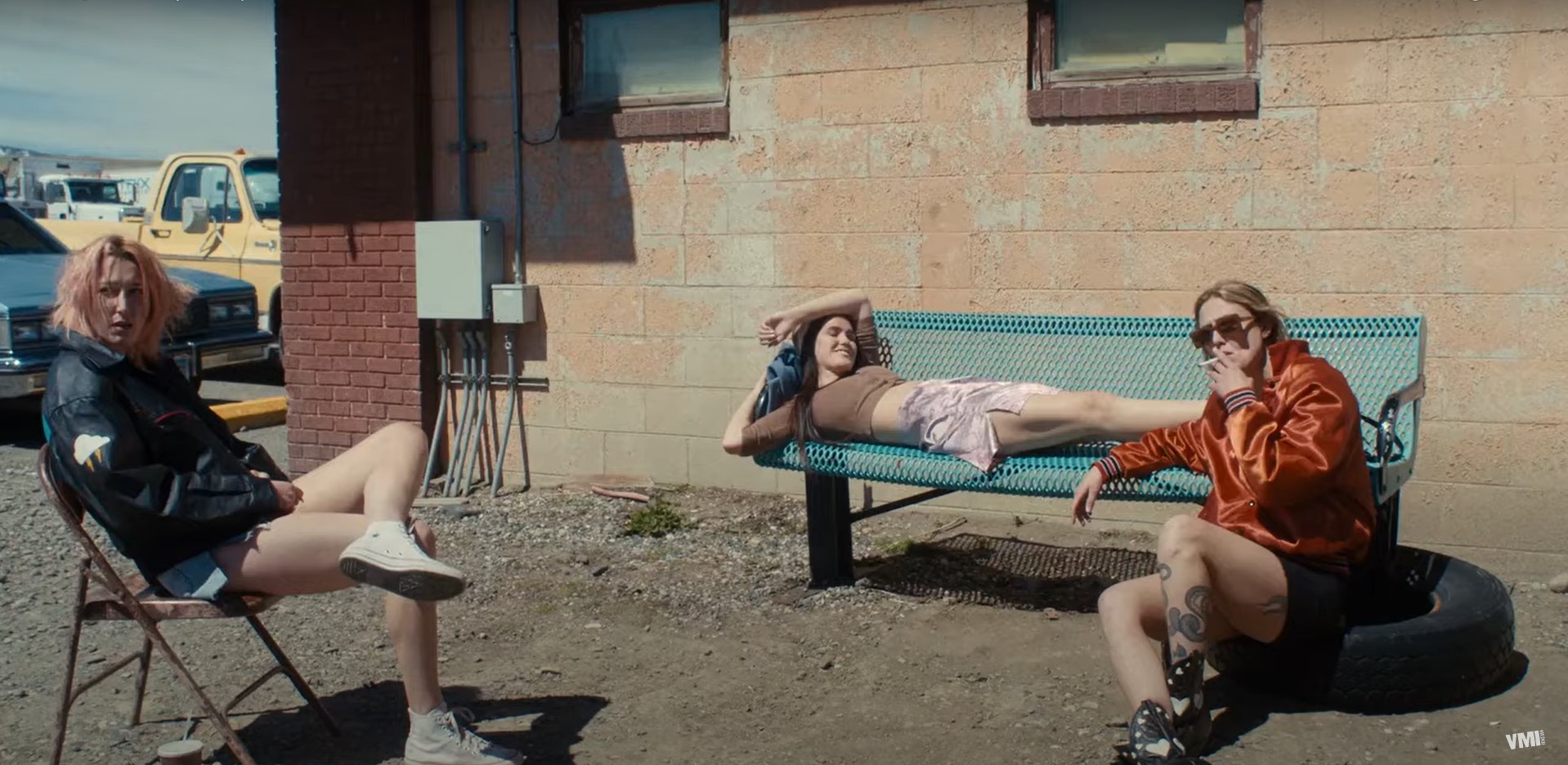
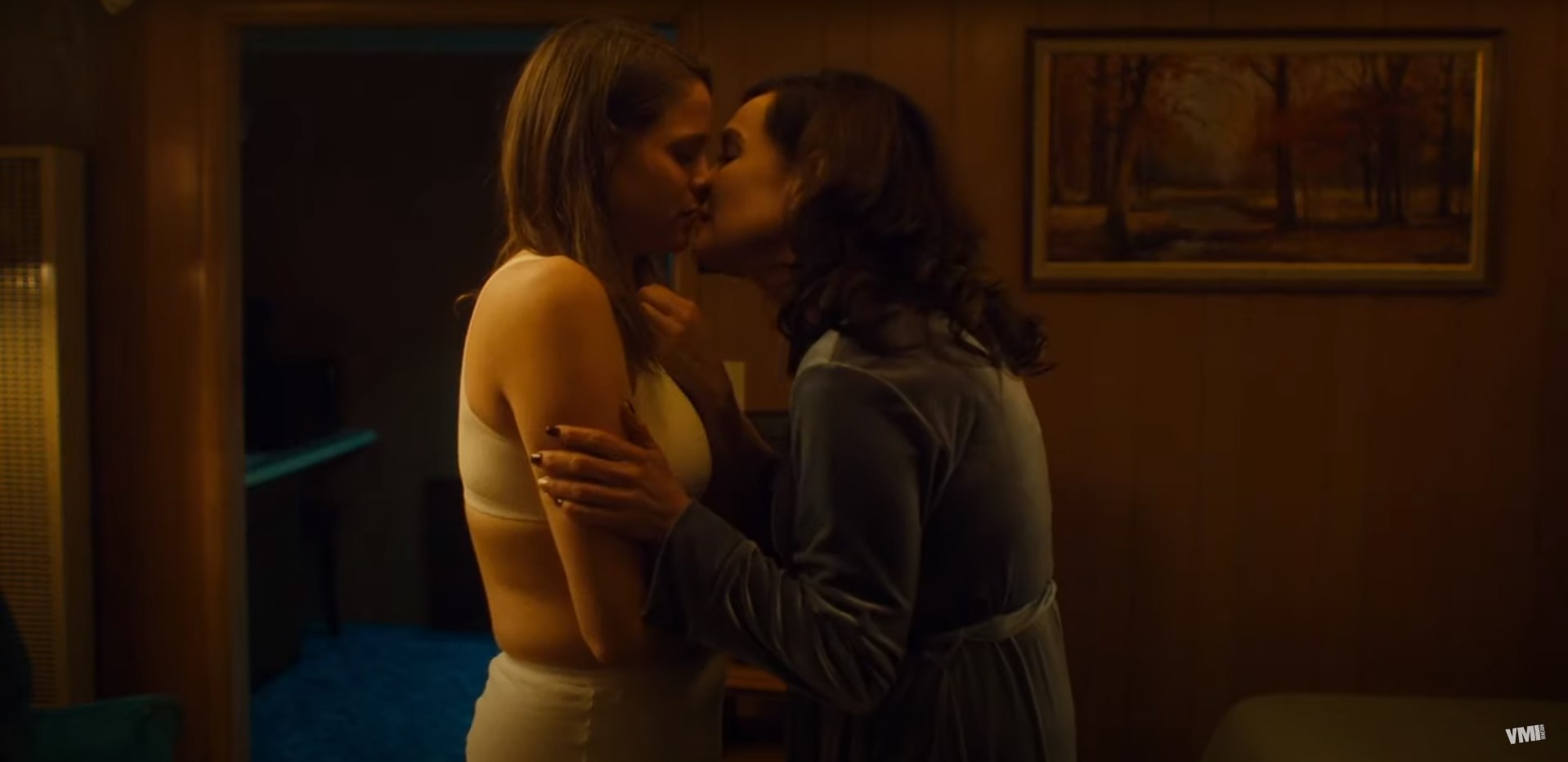
Candy Land is the bestowed designation of a truck stop at one of the last exits through Bible Belt country.  The monikered hotspot is home to four prostitutes, Sadie, Riley, Levi, and Liv, who work for ends meet, servicing all the needs of commercial truckers, those passing through, and even the local sheriff as long as they can cough up the cash.  The only ones not seeking pitstop sex worker services at Candy Land is a religious cult trying to spread the world of the lord around the same stretch of space.  When one of the members, a young and naïve Remy, shows up ostracized from the zealot sect, the sex workers take her in, treat her with kindness, and convince her to be worked into their profession.  Shortly after, gruesomely murdered bodies are found in and around the truck stop turning the once desired Candy Land into a life-threatening place to work, and enlightening the lot lizards that Candy Land is more seedy than once believed.

Shot in the foreground of the scenic Montana mountains, John Swab’s “Candy Land” is a lewd offering that screams the ugly part of something beautiful.  The 2022 USA horror-thriller is a written-and-directed by the “Run with the Hunted” and “Body Brokers” filmmaker Swab in the director’s first go at fringe horror that involves sex work, crazy cults, and hidden knife sheathed inside a large wooden cross.  Swab’s script takes a path less trodden perspective to most similar narratives and pulls inspiration heavily from the 70’s grindhouse era with lots of skin and lots of blood.  Swab produces his own film alongside fellow “Run with the Hunted” and “Body Brokers” producer Jeremy Rosen (“I Am Fear”), with Robert Ogden Barnum (“31”) and Michael Reiser (“Abandoned”) as executive producers, under the production banner of Roxwell Films.

The ensemble cast is comprised of Hollywood veterans, up-and-coming actors, and even a famous last name.  The latter would be then 29-year-old Eden Brolin, daughter of Josh Brolin (“No Country for Old Men”) and granddaughter of James Brolin (“The Amityville Horror”), who is quickly paving her own path having landed as a season regular on the widely popular modern western series “Yellowstone.”  The “Blood Bound” actress is joined by equally young and hungry talent of Sam Quartin, a multi-time John Swab collaborator with roles in “Run with the Hunted” and “Body Brokers,” Virginia Rand (“I Am Fear”), and Owen Campbell (“X”) who are definitely not shy showing of their bodies, simulating explicit sex acts, and step into a compromising prostitute’s shoes as “Candy Land’s” unashamed lot lizards, or that’s what they portray for their characters on screen.  Together, a bond is formed between the working stiffs of sex workers, leaning on each other for support while seemingly living a free and uninhibited life with a good chunk of change in their pocket, but their profession is no walk in the truck lot as taxing moments in sidestepped affairs of the main plot show the darker side of prostitution, mostly involving Owen Campbell’s Levi as a straight man willing to anything for cash in a male dominated over-the-road trucking industry.  Their chimera’s end of the beginning is when Remy strolls into their lives like a lost puppy.  “It Follows’” Olivia Luccardi plays the meek and underestimated cult girl turning tricks as a way get a foot-in the door to cleanse damned souls to send to Gods’ pearly gates in Heaven and while Luccardi has the substantial feign madness well set in her eyes and actions, her story slips below that of the original four truck stop hookers as much of Luccardi’s backstory or even her perpetual motion through her perspective loses to the arbitrary wanes of killing for the sake of killing when the chance is at hand.  Cast rounds out with Guinevere Turner (“American Psycho”), Brad Carter (“The Devil to Pay”), Bruce Davis (“Agnes”), Billy Blair (“What Josiah Saw”), Mark Ward, and another famous last name from William Baldwin (“Flatliners”) as the daunting, downlow Sheriff Rex who has a strong, affectionate thing for Levi. 

The very first opening scene and montage of a sandy-blond Sadie going truck-to-school bus-to-bathroom stall to give a sense of what to expect and the down-and-dirty daily workload for our principal prostitutes sets the tone of Swab’s lickerish thriller with grindhouse endowments.  “Candy Land” is more than just a nutso cult film with all the hallmarks of sordidness as the interpretation received from the story is this temporariness in these characters’ lives.  From the transient paying clients of a truck stop, to living in the impermanence of a hotel room, to even the things they ingest, such as the smoke of incessant drags of cigarettes as a brief coping mechanism and the food they eat with the Hostess Snowballs that have fleeting substance in them to stave off hunger for a little while and only provide negligible nutrition, the temporarily speaks volumes toward the plot of a killer under the influence of a radicalized cleansed ideology wasting away those in provisional moments.  Swab finely sets up character quirks, an unsavory, realistic world, and distinct dynamics to enmesh the characters in a life they attempt to put a pretty face on only that pretty face is a pig wearing lipstick, forcing them into uncertainty and wearing them down to a point they can’t face what’s important and dangerous right in front of them – a young, confused girl led astray and looking for answers.  Instead, that girl, teetering on the edge of purity and dissolution having nowhere to call home, is not safeguarded and is folded into their own licentious lives and, like a Trojan horse, she ultimately become their downfall. 

For “Candy Land’s” inaugural home video release, VMI Distribution and MVD Visual releases the John Swab horror onto Blu-ray.  The AVC encoded, high definition 1080p, BD25 conscripts not a single compression issue in the breathtaking, mountainous landscapes of Montana, affixing great distance between Candy Land and the rest of the world to describe the troubled brief getaway from reality without actually saying it. Presented in a widescreen 1.78:1 aspect ratio, details are greatly appreciated here with the graphic and vulgar markings inside the restrooms, skin tones fair a natural coloring, and a good amount of the whole film is lit naturally with the occasional greenish-yellow gel work to enhance the dinginess of a seedy truck stop. The English language, lossy Dolby Digital 5.1 surround track settles the best fidelity that it can muster, reining in unbridled tracks for a more subdued approach that befits more the lowkey motel suspenser than a fueled high-rise stimulator. Dialogue is clean and clear enough; a few instances cause for mumbling concern but quickly pass and that link is quickly made in the off word that’s missed. Soundtrack contains well-blended, well-intermingled snippets of classic rock, alternative and R&B from the 90s, and a quaint Christmas selection. Yes, “Candy Land” could be considered a Christmas movie! English subtitles are optionally available. Special features are limited by the disc capacity that houses only John Swab’s commentary track and retroesque, in-character stills of a digital zine. The standard Blu-ray Amaray snapper case for this limited-edition release is nothing short of pedestrian with a homage cover art that, I must admit, made me suspect Candy Land” was more a vampire film than a cultist’ coup of truck stop sex workers because of my lack of doing any kind of film prep for any of the screeners I receive – keeps me objectively aligned. You’ll find the same image pressed on the disc itself with no insert accompanying. Not rated and locked on a region A playback, this release has the film clocked in at 93 minutes.

Last Rites: “Candy Land’s” sweetness derives from its in-your-face sexual audacity that rings a certain truth inside the unsavory cash-making aspects of the oldest profession and Swab takes us out from the game’s usual vivarium of the darkened streets and the dingy underpasses into the brightly lit and very populated desert with a different breed of the species. The instilled cult angle feels more slapdash in comparison that sunders the acts more acutely and without a clear reason, leaving the finale unsatisfactory like a $20 handy.

Visit “Candy Land” On Blu-ray. Purchase Here!

Might Be Dressed as a Fool, but EVIL Can’t Outwit This Jester! “The Wrong Door” reviewed! (Visual Vengeance / Blu-ray)

“The Wrong Door” Collector’s Set Available at Amazon!

Ted, a radio sound design student, has to perform a singing telegram dressed in a jester costume on the very evening of having to pull an all-nighter to finish his final college class project.  After his melodic duties are fulfilled and the guests are entertained, he discovers a girl’s unconscious, bleeding body in an adjacent, dark apartment, a girl that he recognizes from campus.  Frightened by the sight and the shadowy figure in the apartment with him, Ted goes for help only to discover the girl vanished with no one else inside the apartment.  His drive back home is full of contemplation on the shocking memory when he notices the girl lying lifeless in the backseat of his car.  From then on out, Ted becomes embroiled into a murder mystery and pursued by the killers who are hellbent on tracking down the Jester-cladded man to cover up incrimination evidence and tie up loose ends.

Even though our unlucky protagonist wears a court jester outfit, there’s nothing funny about the 1990 thriller, an intense bird-dogging murder-mystery, known as “The Wrong Door.”  Helmed by the creative ensemble of friends, the film is written and directed by James Groetsch, Shawn Korby, and Bill Weiss who eagerly sought to make a feature film on a strapped for cash budget after success of their Super 8 short films.  Contemplating using tape for their inaugural throes into feature film land, the auteurs revert their thinking back to film, settling on a faithful celluloid format to which they have experience with in, the ever gritty Super 8.  What results is a tenebrous yet effectively taut confrontation of frenetic hunting and a shocking homicide driven more with ambient sound than character dialogue.  The three creative minds behind “The Wrong Door” formed Sandman Films and coproduced alongside John Schonebaum for the Minneapolis Twin Cities’ production.

Cast locally around Minneapolis area, “The Wrong Door” is chock full of directors’ acquaintances who turned out to be really quite good at the parts they play.  Matt Felmlee stars in his debut performance as Ted, the class assignment under the gun student looking to knock out one last paying singing telegram gig before cutting and splicing audio for a final exam.  Felmlee isn’t given much dialogue to work with and his credibility relies burdensomely on nearly a vocally silent rundown from Jeff Tatum and Chris Hall respectively as deranged stalker and ransacking lunatic Jeff and his accomplice Vic.  Jeff Tatum makes for a good hardnosed psycho in a subtle yet menacing take of a trench coat robed coup de grâce kind of thug but the thug’s partner Vic is left as an nearly obscured sidekick and we don’t get to see Chris Hall ever come out and shine independently from Tatum’s enormous shadow.  Concluding on the three talking roles, unless you consider Loreal Steiner’s mostly dead body popping up performance where she speaks only in Ted’s nightmares, “The Wrong Door” instruments of interaction circulate around the three male principals peppered with Steiner’s maybe lifeless, maybe lively body stringing Ted along in order to slip him damning evidence on who and why she is being brutally murdered, in a nod of Hitchcockian hamboning.  A cast of supplementary, locally sourced pop-ins, including Jeanine Bourdaghs as Ted’s Radio classmate bestie, Stephanie.

Obscured to the depths of regional relevance, “The Wrong Door” is opened only to adventurous cinephiles who are willing to spend hours upon hours scouring through the vastly lower-to-no budget, independent films lost behind the borders of zonal solitude  A Hitchcockian thriller venerated on a humble scale in regard to the storytelling’s use of focused sound design to narrate a chased protagonist under the gun, literally and figuratively, that turns a studious radio sound design student with a final exam project to complete into a marked man hunted down in a foolish jester suit.  Bookend by dialogue setup and a tense, skirmishing climax, the near omission of dialogue in order for sound to reign supreme as atmospheric tensions force viewers, and force them appealingly I might add, into Ted’s chest-tightening, alone-in-fear experience with not only being incognizant of the particulars of the murder surrounding the young woman he was once smitten with but also to his being pursued by goons that hangs us on tenterhooks.  There’s also pulsing paranoia of where the dead set antagonists are hot on his trail and will suddenly appear unforeseen out of the blanketing darkness of an exterior cat-and-mouse game.  This leads into ambiguity near the end that asks the question, did Ted experience all of this strife or was it a clever cut and splice of imaginative audio files to create a whodunit thriller?  A brief sense of hesitation brings a sigh of relief from the nightmare and also onsets a different kind of anxiety of not knowing what truly went down until the very last shot that explains it all. 

Wrong place at the wrong time is the theme for “The Wrong Door” which is the right door to open if looking to walk-through to an understudied tensioner. Well versed in greatly misunderstood, profound stepped over, and overall underdog pictures is the smaller picture championing Visual Vengeance, the distributor behind the collector’s edition Blu-ray release of “The Wrong Door” with an AVC encoded, 1080p high-definition, BD50 product presented in a full screen 1.33:1 aspect ratio. For the first time on disc anywhere, the Super 8mm film receives a brand new, director approved 2K HD transfer from the original elements. The perception of Super 8mm does not hold water here with a relatively pristine image quality for the sized celluloid with a mighty clean image. Other than the white speckles of dust, other signs of minute debris, and the natural amount of grain of Super 8mm, no cigarette burns, light emitting on the frame edges due to perforation alignment, and hardly any scratches hinder quality. Poor lighting conditions in the exterior, and even some interiors, plays to the strengths of negative voids but, in my opinion, adds to the gloomy puzzler filled with action, suspense, and acrimony. While 8mm’s grasp on a grittier saturation, the tonal shading refuses to pop inside the faded film stock. The English Dolby Digital 2.0 stereo doesn’t do the new transfer justice. The lossy format likely not the best choice on a sound gimmicky, indie film that uses more innate ambient sound and Foley to tell the story rather than through dialogue. Though manageably capable to pull through to the end, the already lo-fi standard now compressed audio file has anemic energy through the dual channels but while the distinctions are dainty, some distinct distancing between more than two effects does convey. Switching between ADR and boom, there’s never a sense of uniformity with the dialogue that can sounds lively and volumes with post-production recordings yet also be frail within natural earshot of a recording device. Optional English subtitles are available. What’s most impressive about this 14th release from Visual Vengeance amongst 13 titles before it is the seemingly incalculable number of special features within the submenu of the flat, rodded colorful cutouts on the fluid main screen. New grouped audio commentaries with directors Bill Weiss and Shawn Korby in one and the third director James Groestsch and John Schonebaum on the second kick off the content followed by a new documentary with interviews from all three directors in Men Make Movie, If Not Million$, individual interviews with James Groetsch, Shawn Korby, Bill Weise, and actor Bill Felmlee, an interview with Film Threat founder Chris Gore who was one of the few in the field to put the film in his magazine, an alternate, director’s cut of “The Wrong Door” coming in as a second feature, Super 8 shorts: Raiders of the Lost Bark and The Pizza Man, a 20-minute television episode from The Gale Whitman Show, the original unedited Muther Video VHS intro, image gallery, original storyboard gallery, the original ran print from Film Threat, a Visual Vengeance 2023 cut trailer of “The Wrong Door,” and other Visual Vengeance trailers. Tangibly, the release comes with a rigid O-slipcover hypnotically graded in Jester colors of subtle pink and purple. Inside is a clear Amary Blu-ray case with the illustrated cover art that also does double duty for the motion menu and the folded mini-poster insert. Also inserted is a double-sided Blu-ray acknowledgment one sheet, a Visual Vengeance exclusive “Do Not Disturb …The Disturbed!” doorknob hanger, and a retro sticker sheet that’s come standard with every release to date. Reversible cover art displays the original VHS cover, and the disc is pressed as a mock play of a cassette tape’s supply reel teeth – neat! The region free Blu-ray comes unrated and has a runtime of 73 minutes.

Last Rites: Do you hear what I hear? No longer lingering in the vacuous space of radio static, “The Wrong Door” was once another shamefully sidestepped film that has been resurrected by Visual Vengeance for the first time anywhere on disc and, all I can say is, it’s about damn time.

“The Wrong Door” Collector’s Set Available at Amazon!

Slacking Off at School is Grade A EVIL! “Cutting Class” reviewed! (MVD Visual / Blu-ray)

“Cutting Class” Available on 4K UHD and Blu-ray at Amazon.com

Paula Carson seems to be the eye of affection.  The popular, walk-the-line student and high school cheerleader finds fast-and-loose fun as the girlfriend of jock and overall jocular lesson slacker Dwight but is also pursued by Brian, a loner recently released from the mental hospital after killing his father, and even the quirky principal Mr. Dante who can’t careen his aberrant attention away from his lovely young student.  When faculty and students go missing and the vice principal is found brutally murdered, the recently released, convicted criminally insane Brian becomes the prime suspect and flees the scene, but days later coming out of hiding, Brian pleas with Paula to help convince people he’s innocent of the crime and not responsible for those missing.  Suspicions and accusations disperse in many directions as a killer continues to thin out the student body with Paula stuck at the center of the killer’s chaos. 

Many of today’s A-lister leading men have had a role in a horror film at one point in time early in their careers.  Before being the face of the latest “Ocean’s 11” films, George Clooney starred in “Grizzly II:  Revenge” and “Return to Horror High” in the 1980s.  Before being a lovable halfwit with good fortunate in “Forrest Gump” and the voice of Woody in “Toy Story, Tom Hanks’ debut feature was “He Knows You’re Alone,” a horror-thriller about stalked woman unable to escape a serial killer.  Then, there’s Clooney’s “Ocean 11” co-star Brad Pitt and he’s no exception to the rule with “Cutting Class,” an American high school melodrama with strong hints of the slasher genre helmed by a not-so-American director in “Excalibur” adaptation screenwriter Rospo Pallenberg from the United Kingdom.  The script is penned by Steve Slavkin which would turn out to be his one and only feature film work before remaining in television.  Shot in Los Angeles, the April Productions and Gower Street Pictures film is produced by Donald R. Beck and Rudy Cohen, who the latter went on to produce “Feardotcom” and “The Black Dahlia.” 

A youthfully green Brad Pitt joins the remake of the “The Blob’s” Donovan Leitch and “The Stepfather’s” Jill Schoelen in an unfolding love triangle of student shenanigans, peer pressure, and murderous suspicion.  Pitt plays Dwight, a popular basketball stud with a carefree attitude that’s slowly being chipped away by his parents, teachers, and even girlfriend Paula to be more responsible and forward thinking.  As Paula, Schoelen indulges herself into the perfect student who is studious, kind, and beautiful that attracts seemingly all walks of school hallway life from peers to teachers and doesn’t even bat an eyelash about it either by obliviousness or just likes to lap up the attention.  Leitch as the school misfit Brian Woods dons the oversized black blazer and soft-spikey hair to give his character more of an edge, but the script is thin on showcasing Brian to feel like an outcast or even makes the protuberant effort of a character convicted murderer, mentally unstable and recently deinstitutionalized.  Leitch crafts his own approach to elevate Brain Woods into that persona while teetering the line of being a suspected bad or good guy for the approx. 90 minute runtime.  Acting legends Martin Mull and Roddy McDowall are integrated into more cameo roles that are running gags on the comedic side of “Cutting Class’s” genre blend.  “Clue’s” Mull, playing as the district attorney and Paula’s father going duck hunting for the weekend, has an orbiting role that surrounds the whodunit trunk narrative with subplot intercut scenes after he’s been perforated with an arrow and crawls back to civilization, amusingly frustrated and weary as he continues to be passed by and stepped on while in the muck.  McDowell’s absurdity is illuminated in a different objectifying light as a sock-covering mic sniffer with a giddy perversion for Paula.  See McDowell gawk at the stretched panties of a bent over Jill Shoelen made me personally feel really uncomfortable, perhaps I still see McDowall as the heroic Fearless Vampire Hunter Peter Vincent from “Fright Night” and can’t unseen him to be anything else, especially a smirking, sexualizing oddball.  “Cutting Class” fills out the cast with Brenda James (“Slither”), Mark Barnet, Robert Glaudini (“Parasite”), Dirk Blocker (“Prince of Darkness”), Eric Boles (“C.H.U.D. II: Bud the Chud”), Nancy Fish (“Exorcist III”), and Robert Machray.

Prefacing this review’s analysis, I understand “Cutting Class’s” campy comedy intentions before its backlot slasher sublet.  The smell of teen palaver and mischievous comedy odorously laces the late 80’s production and its eccentric character, more so with the latter of the two.  This also includes sexual perversities to run rampant in what was then a free-for-all of anything goes types of behavior.  Character Paula Carson, the near epitome of good high school student, becomes the lust of every principal male character with a hypersexualization of her innocence.  Paula, cladded with a short skirt and white panties, can’t get through many of her earlier scenes without being objectified.  She’s penned to bend straight over, exposing her panties, and have Principal Mr. Dante gleaming with a grin and gawk in his hots for the student, caught half naked washing her hair over the bathtub, caught in a conversational scene with suspected killer Brian Woods, and is repeatedly pleaded with by Dwight to take advantage of her father being not home for extra circular activities.  Not to forget to mention constantly being googly eyed by all three throughout the picture.  It’s funny how this particular perception becomes the one thing to catch my eye and discuss as it speaks to the kind of depraved person, I am but also factors into what “Cutting Class” really is, a dumb movie.  The sit back and enjoy the ride type of teen-comedy, semi-slasher hits upon most of the benchmarks expected of a Pallenburg slasher made in a America with a fair amount of personal style and not enough connective tissue to strengthen the bond between the two battling genres.  For example, the out of left field satire of Martin Mull’s swampy trek back to civilization has the detached sensation of an out of place running gag, lost amongst the rest of the film by the lack of detail (Mull’s character is shot with an arrow but has seemingly healed miraculously as he’s able to crawl and walk back to the suburbs) and spatial awareness (Paula’s class fieldtrip to the very same swamp Mull’s character was shot, making the area appear in proximity to the high school and suburbs instead of isolated backwoods).

MVD Visual, through the MVD Rewind Collection, proudly presents “Cutting Class” on a new 4K UHD and Blu-ray 2-disc set. Both scans of the 35mm original camera negative are from the Vinegar Syndrome 2018 restored print; however, MVD’s LaserVision Collection edition is the first fully functional 4K resolution with a HEVC encoded, Ultra High-Definition 2160p, BD66 as well as tagging along an AVC encoded, High-Definition 1080p, BD50. Can’t complain at all about this print despite negligible differences other than the increased resolution in HDR10, a format that often misrepresents true image fidelity with irregularity. Yet, we don’t see that that really here with a shade darker image that results rounder delineation on the characters and objects. Same can be said about the 1080p, a crisp image defines mostly through. There are rough patches of varying grain levels within the 1.85:1 aspect ratio presentation that leave a scene or two looking optically haggard for a brief moment as if stretched and overly granulated. Grading design has a natural 35mm film saturation that’s robust with a vast range of hues that don’t bleed or run together, sticking to distinction rather than attempting to be fancy to a fault. The audio options on both formats include a lossless PCM 2.0 mono and a lossy Dolby Stereo. For better fidelity, the uncompressed PCM really opens up the English inlaid audio mix by appealing to vigorously clear and forefront dialogue with ambience and soundtrack firmly encroaching but stays firmly moderate in the depth. There’s a nice breadth of effects captured, such as the machine shop climax with isolating each cutting, sawing, and drilling tool’s specific sound in its specific space. English subtitles are optionally available. Special features mostly reside on the Blu-ray disc as the UHD’s capacity is limited to just 66 gigabytes, barely enough for higher dynamic resolution feature with the only additional supplementary being the HD theatrical trailer. On the Blu-ray, a quite a few Vinegar Syndrome produced content is encoded into this release in what practically a mirrored 1080p copy with an interview with actress Jill Schoelen who, in summing up her discussion of “Cutting Class,” would love to erase this film from her memory and career bank, an interview with Donovan Leitch and his experiences hired in on the role as well as working with the cast and crew, a Kill Comparisons featurette that contrasts the edited and unrated feature kill scenes with additional seconds added into for more gruesome, lingering effects, the VHS retailer promo Find the Killer and Win, and the original theatrical trailer. Also included is the 91-minute R-rated edit with the shorter death scenes, but I don’t understand why anyone would want to watch something edited. Like the first three MVD LaserVision Collector’s Editions, the fourth entry is incorporated with retro finesse that doesn’t stray away from original marketing elements. The cardboard O-slipover views as a porthole into the original poster art of the three principal characters. A black Amary cover houses the same cropped encirclement of the characters but with a solid black other rim while inside the 4K disc (right side snapper) and the Blu-ray (left side snapper) each pay tribute to the laserdisc era in their own way. The insert houses a folded mini-poster of the slipcover design. The front cover is reversible with a complete poster element reduced to fit centered on the design with a wooden school desk serving with pencil, paper, and ringlets of blood as the border design. Unrated, region free, and with a runtime of 91 minutes, “Cutting Class” is worth skipping your school studies.

Last Rites: A highly favorable and upgraded release for the Brad Pitt startup campy teen slasher that confirms to us the actor hasn’t changed his acting method in the last 35 years, but “Cutting Class” doesn’t stand out amongst the masses of similar 80’s ilk with a fickle way of handling the nebulous and illusory villain killer on school grounds and an obtuse comedy angle too out of alignment to be risible. The only option left is to sit back, hit play, and soak into the mindless meat-and-potatoes.

“Cutting Class” Available on 4K UHD and Blu-ray at Amazon.com

EVIL Wants to Cut Out Your Unborn Child. “Inside” reviewed! (Second Sight / Blu-ray)

Order The Limited Edition Copy of “Inside” From Second Sight!

Four months after deadly car crash that claimed the life of her husband, a disheartened and depressed Sarah is 24 hours away from being induced into labor on Christmas day.  Just wanting to be left alone, Sarah is eager to lower her head into her work as a photojournalist of capturing horrifying images that bear a resemblance to her own accident and inviting her editor over later to discuss the work ahead.  As the even lingers into night, an unexpected woman knocks at the door and menacingly tries to break into her house.  As the police arrive to investigate the incident, the woman is nowhere to be found and brush off the incident with little concern, but the woman returns, finds herself inside Sarah’s home, and is determined to cut the baby directly from Sarah’s womb to be her own child.  The tormenting violence becomes a cat-and-mouse game between the two women with an unborn child hanging in the balance. 

Extremely violent and soul biting, “Inside” is one of the more corrosively dehumanizing and destructive films under the French New Extremism, French New Wave Horror, flag.  The 2007 French feature cowritten-and-directed by Alexandre Bustillo and Julien Maury broke the duo into the industry as formidable and fearless filmmakers, reaching global heights having helmed later in their careers a segment of the popular anthology “ABCs of Death 2” and tackling one of America’s more renowned and bred-and-buttered horror franchises with the chainsaw-wielding cannibal in “Leatherface.”  “Inside” comes after the tremendous success of Alexandre Aja’s “Haute Tension,” opening the flood gates to other extreme French horror films in early 2000s with also “Martyrs” and “Frontier(s).”  La Fabrique de Films and BR Films in association with Canal+ server as production companies with later “Frontier(s)’s” Teddy Percherancier, Frederic Ovcaric, Rodolphe Guglielmi, and “Witching and Bitching’s” Franck Ribière and Vérane Frédiani producing the film known as “À l’intérieur” in France.

Not your typical home invasion ultraviolence, Sarah and who we know as labeled only as The Woman are two vipers circling each other, ready to strike when the guards are let down.  Of course, both have distinct personalities and strategies in the measured way of attack and survival that will impress on viewers preconceived notions about them.  As Sarah, Alysson Paradis, younger sister of Johnny Depp’s wife Vanessa Paradis, is bathed in exposed light, literally and figuratively, as the pinpointed principal woman from the start, battered and bloodied in the opening two car accident, to the end, in the final harrowing moments with the relentless Woman but though Paradis performance reeks greatly of depression and perhaps hopelessness with the death of her husband with a baby soon to be brought into this world without a companion by her side, the momentum shifts towards proposed surface villain of the story, The Woman, in a frightening portrayal of stony guile and grim severity by the established, character provocateur French actress Béatrice Dalle (“The Witches’ Sabbath”) in comparison to Paradis relatively filmic beginnings.  Dalle’s role expresses more physically than vocally with motivation coursing through her eyes, facial expressions, and body language that strikes a transfixing chord, turning Dalle’s the Woman into not only an unpredictable killer but an on-screen killer with a lighted purpose without confounding arbitrary slaughter as the yearning for The Woman’s reason never breaks silence until the shocking end.  François-Régis Marchasson, Nathalie Roussel, Ludovic Berthillot, Nicolas Duvauchelle, Aymen Saïdi, Emmanuel Lanzi, and Dominique Frot (“Among the Living”) fill out “Inside’s” cast.

Most will plainly see and interpret “Inside” as a regular home invasion thriller of a pregnant woman defending herself to survive a mad woman’s unborn baby obsession, and maybe that’s how Alexandre Bustillo and Julien Maury mostly intends the narrative to be as an overly graphic portrayal of hate and envy that makes us uncontrollable sinners at heart.  However, there’s something inside me to dig deeper below the face value of terrorizing prenatal torment of a young, expecting mother-to-be in what could be construed as a double-edged explanation.  The Woman doesn’t hold a name as she symbolizes all the worst qualities of a mother, such as anger, deceit, and she even smokes, in Sarah that could be considered a split persona or an archetype of duality.  Sarah is cladded in a bright white nightgown while The Woman is dressed all in black from head-to-toe, contrasting a good versus evil, and both want the same child.  The climax does rebuff the split duality theory to an extent but the way the script is written and how the film is shot very much suggest these two women are cleaved from the same whole with a patriarch-less presence and, to add as an interesting note to further examine and contemplate, all the male characters in the story are slain by the same women while the only other female character is brought down by the other in what is a powerful suggestion of split gender and how gender plays a role in their individual lives.

In what can be said to be the most definitive edition of one of the most brutal films ever produced, Second Sight Films’ Limited-Edition boxset of “Inside” is amply packed with goodies, in application and in a tangible sense. Presented in a widescreen 1.78:1 aspect ratio, the AVC encoded, 1080p high-definition, double-layered BD50 from the UK label holds tremendous value with not only new special features and neat and attractive corporeal contents but also valued by retaining image fidelity with a gritty 35mm print. Natural grain and low-fi celluloid present the seedy grindhouse overlay that’ll take audiences from the comfy, cozy reality into a dark, anomalous atmosphere with warm muted coloring, lambency, and an overall light general haze suffused into the setting. The cinematography has been purposefully constructed with analog building blocks for a rough look for a rough story. Not technically applicable here but “Inside” is set around Christmas, Christmas eve into Christmas day to be exact, but the choice production dressing exhibits little holiday spirit with a far less ostentation presentation and in how the characters dress the season feels more fall like than winter. The lossless French 5.1 DTS-HD master audio offers plenty of spatial awareness during intense pocket skirmishes inside the quaint two-story home, which is the primary setting of the story. The range provides laceration slits and surgical squishes of blades and scissors while gunfire shocks with an innate immediacy. Even with a mostly prominent inconversable back-and-forth, the dialogue that does come up carries through with robust confidence without overbearing the action or feeling out of synch. Speaking of being in synch, English subtitles are available with the French audio track and are error-free and pace well. Special features include a new audio commentary by The Final Girls’ and film critic Anna Bogutskaya, new audio commentary by editor Elena Lazic of the online magazine outlet Animus, a newly produced interview with writer-directors Alexandre Bustillo and Julien Maury First Born as well as newly produced interviews with principal actress Alysson Paradis Labour Pains, producer Franck Ribière A New Extreme, cinematographer Laurent Barès Womb Raider, and stunt coordinator Emmanuel Lanzi Reel Action, with The Birth of a Mother, a Jenn Adams analytical essay focusing on a denied mother’s perspective and the opposite. The limited-edition physical elements of the release add additional magic to the whole package with a rigid, cardboard sleeve case with new artwork by Second Sight retainer artist James Neal. Inside the “Inside” sleeve is a 70-page book with color pictures and thematic essays from film historians and critics Chad Collins, Kat Ellinger, Annie Rose Mahamet, and Hannah Strong. There are also 6-5×7 collector art cards adjacent. The green Blu-ray Amary case houses the same Neal front cover from the rigid sleeve, likely will be the face of the standard release, with the interior disc art having a simple yet effective image of a blade open pair of scissors and psycho-split or -sliced title in red and while. UK certified 18 for strong bloody violence and very strong language, this Second Sight release is B region locked and has a runtime of 83-minutes.

Last Rites: Second Sight invests in “Inside” and its first-time French directors nearly two decades after initial release with a comprehensive package that not only elevates beyond what many labels sought to get out of the gore-laden entropy, quick cash, but this premier release also has depth and range into the film’s applied style and dives into demystifying the breadth of thought preluding random terror.

Order The Limited Edition Copy of “Inside” From Second Sight!

Killed by Your Monstrous, EVIL Twin Set on Repeat. “Island Escape” reviewed! (Dread / Blu-ray)

“Island Escape” Available Here at Amazon.com

Chase, a washed up mercenary with touch of amnesia regarding his past, is hired to round out a six-person team for a rescue mission on the Isle of Grand Manan where a top secret TSL research facility has gone dark and a high-level CEO’s daughter has gone missing.  Ordered to retrieve the daughter inside a 48-hour window, the team arrives on the seemingly deserted island to find multiple dead scientists having been torn to shreds.  The team soon learns they’re not alone when attacked by bigger, aggressive, monstrous versions of themselves.  Unable to believe their eyes, the one scientist left on the island has determined they’ve been trapped inside an encircling wormhole that resets the island and it’s inhabitants every 3 days, turning those left alive after the third day into these humongous, blood-hungry creatures.  With the mission quickly dissolution, it’s quickly being pieced together that the rescuing mercenaries are the ones who actually need rescuing and their only way to escape would nearly destroy them all.

I’ve said this once before and I’ll say it again.  Weaving wormholes, time loops, time travel, and the like into a narrative is a tricky, tricky business.  Bending time and space can calamitously collapse a story so bad that every internet warrior and science fiction nerd, including myself, will pick apart and ridicule the film until the end of time, but if the portent collapse can be averted and little-to-no complaints with the time travel aspect of the story can go unscathed for a better part of the runtime, then the power of the multi-dimensional space time continuum can be magical and enthralling.  Writer-director Bruce Wemple (“Altered Hours,” “My Best Friend’s Dead”) wraps his hand around a wormhole-driven action-horror “Island Escape” to grasp ahold of the unruly concept of time.   The Traverse Terror production, a division of producers Cole Payne and Mason Dwinell’s Traverse Media in association with Wemple’s 377 Films, and presented and produced by Patrick Ewald’s Dread Central, “Island Escape” rounds out the producer set with Vincent Conroy.

Bruce Wemple carries with him a cast entourage, a staple of actors who have worked years with the filmmaker through a number of project.  “Island Escape” is no different as Wemple signs aboard his trusted troupe to tackle the terror on TLS island with a rescue gone wormhole wrong.  The story has a trifold focus Chase (James Liddell, “Hell House LLC Origins:  The Carmichael Manor”) as the washed up gun for hire with memory loss, Addison (Ariella Mastroianni, “My Best Friend’s Dead”) as team lead and recruit of the Isle of Gran Manan mission, and Russ (Grant Schumacher, “My Best Friend’s Dead”) as the dithery team member not in Chase’s good graces based of fragmented memories of a failed mission.  Between the three characters there lies a fleeting tautness that’s not tremendous carried out as expected from initial introductions.  Instances such as Chase expressing his distrust for Russ never has the tension reach open air in any time they’re together or in the case of Addison as a melancholic memory for Chase that eventually evolves into mid-misison romance that’s more spontaneous than building momentum to in the first and second act.  The undercooked characters fail to establish boundaries, positions, and progressing or regressing dynamics and arcs.  There’s more headway with supporting staff in Tag, a self-penancing father doing dirty, dangerous work to support his young daughter and this consistently shows throughout his screen span, hitting upon the nerve of a father trying his best for the sake of his child.  The cast rounds out with a handful more of mercenaries and scientists to become minced meat by their devilish doppelgangers with Chris Cimperman (“First Contact”), Michael L. Parker (“First Contact”), Andrew Gombas (“The Tomorrow Job”), William Champion (“The Tomorrow Job”), and the feature length debut of Renee Gagner filling those roles. 

Wormholes.  The suspended openings in space let the Dominion race invade Star Fleet in the Alpha Quadrant of “Deep Space Nine,” dropped a fiery plane engine on top of the titular character “Donnie Darko,” and brought back something alien and terribly evil in the titular ship “Event Horizon.”  For Bruce Wemple and his “Island Escape,” wormholes have become more earthbound thanks to a shady research corporation delving into dangerous methods and unscrupulous science practices for the go-to cover up slogan of a better world tomorrow.  While Wemple spins an intriguing yarn needled quick to be full of cankerous clones coming from all corners of the island to attack their uncorrupted selves while trying to survive and flee, the filmmaker skip stitches during his knitting of a tight narrative, fashioning an uneven story that can’t quite get the pattern right for in some of the more restlessly difficult areas of trouble island.  Fleshing out Chase’s blank slate produces no reason to light, Russ’s lack of motivation in divulging life-and-death information, the deep dive into Island experiments fall to the wayside, the CEO’s daughter seemingly dead to all of a sudden be alive, and I could go on with all the loose ends that kneecap the better parts of story, such as the creature action and the wormhole aspect, but the fact won’t escape that there’s a mishandling of the island’s treacherous overgrowth that’s severely underplayed and the epic scale Wemple tries to impress is torpedoed by omitted small cogs that turn the bigger, weight-bearing gears. 

Dread presents Island Escape onto a high-definition Blu-ray distributed by Epic Pictures.  The AVC encoded, 1080pm, BD25, presenting the film in an anamorphic 2.35:1 aspect ratio, is a slurry of personal style and cinematography issues.  Capacity-wise, not a ton of wall-bearing issues that would make the visuals crumble; a few fleeting areas of dark side banding and quick movement aliasing pop up occasionally.  Where most of the issues stem are stylistically with poor VFX compositions that stymie any high-action utile climaxes.  The light pink/fuchsia grading replaces much of the island’s, or island-like setting’s, innate green foliage for a broad one-tone that has an adverse effect of unnaturally darkening the characters.  Two English audio options are available to select:  a Dolby Digital 5.1 and a Dolby Stereo 2.0.  Both lossy formats offer what this particular films needs, a fast and loose sufficient mix that gets the job done without causing too many waves.  Most of the dialogue has a ADR pretense that I would take a wild guess and say is more a sound design issue of not creating space in the depth field.  Each character sound to be on the same audio plane that forces a full-on push of dialogue right to the front of the audio layering that makes ever channel in the 5.1 the same.  Ambience Foley is harshly isolated from other tracks so if a character is walking through the forest, you hear nothing else but the lonely crunching the tree litter that doesn’t mesh with onscreen movements.  With most digital recording, no interference and damage flaws are present.  Optional English SDH and Spanish subtitles are available.  Special features include a roundtable commentary with writer-director Bruce Wemple at the helm with most of the cast speaking through Zoom or some kind of video chat program.  In addition, the commentary is greatly colorful with more jokes and jabs at one another and at themselves that reflect how much of a good time they have working with each other on this film and previous Wemple credits.  Also included in the special features are a few deleted scenes, the making of “Island Escape,” feature trailer, and other Dread presented film trailers.  Like most Epic Releasing products, a standard Blu-ray Amaray case displays an intriguing cover art for Dread’s 47th at-home title with a wormhole opening to an skull-faced Island and a helicopter and four soldiers walking toward it.  Disc art renders the same image and there’s no insert included opposite side of the case.  With a region free playback, “Island Escape” has a runtime of 86-minutes and is not rated. 

Last Rites:  The haphazardly executed science-fictional survival film “Island Escape” has good plot bones underneath the shambled edifice of an ambitious façade with only decent monster mayhem and creature effects dwelling inside. 

“Island Escape” Available Here at Amazon.com