EVIL Minds the Door! “Raw Meat” reviewed! (Blue Underground /2-Disc 4K UHD Blu-ray and Standard Blu-ray)

“Raw Meat” Its What’s for 4K UHD and Standard Blu-ray Dinner!

Young lovers Alex Campbell, an American studying abroad, and Patricia Wilson discover an unconscious man on the steps of a London metro subway station.  When they alert a beat cop and make their way back to the spot, the man had vanished.  Assuming the well-dressed man an alcoholic sleeping off a bender, David and Patricia move on with their lives while the police report comes across the desk of Inspector Calhoun, an eccentric investigator who recalls a recent string of disappearances surrounding the same London station.  Over the next few days, several more station related disappearances occur, forcing Inspector Calhoun to dig deeper into the mysterious circumstances involving a missing Mi-5 agent and three subway employees with David and Patricia his only witness to at least one of them.  When Patricia suddenly goes missing with her last known siting at the subway station, a concerned David explores the train tunnels that connect the last known whereabouts of all whom have vanished, leading him to a tragic history of collateral damage survival, long forgotten generational lineage, and cannibalism. 

London, England was the first to introduce the metro subway station to the world in 1863 with the Metropolitan Railway.  It seems only fitting that London be the setting for “Raw Meat,” a subterrain horror that integrates London’s metro history with the consequential hazards of an early underground railway, the insufficient costs that prove to be costly, and the pitied blamelessness of unthinkable survival from neglectful businesses.  Originally entitled “Death Line,” rebranded to “Raw Meat” for American audiences, the 1972 film is actually directed by an American, Chicagoan Gary Sherman, in his debut and would go on to helm “Dead & Buried” and “Poltergeist III.”  Based off an original concept form Sherman, one that takes the plausibility and some fact of workers being buried under a collapsed railway project and survive generationally living off the nourishment of each other in more ways than one, the script is penned by Ceri Jones and is a production of Harbor Ventures and Kanter-Ladd Productions with the late “Police Academy” franchise’s Paul Maslansky producing

I’m going to preface this character introduction with “Raw Meat” would not have been as entertaining if it wasn’t for the peak performance by a more eccentric Donald Pleasance in a pre-“Halloween” performance.  As Inspector Calhoun, Pleasence is fully in charge as an intimidating case investigator with a snarky wit, or as Christopher Lee’s MI-5 character put it, what a droll fellow you are in a stiff yet jab remark exchange interaction between the two British icons of a bygone cinema industry.  Lee’s role is only a fraction in comparison to Pleasance and would have been two big personalties too big for the meager production to contain.  Another staggeringly highlighted performance comes from an unknown in Hugh Armstrong’s portrayal of the subhuman cannibal whose fellow inbred family members have all left by deceased means, leaving him alone and the last of his kind with mumbling tunnel vernacular and unkempt open sores all over his body and face in a state of unhealthy living conditions.  Armstrong’s acted ungainliness renders the man a monster amongst society standards but also sheds a softer, compassionate light upon reflection of his forced position into a world he knowns no better about having grown up completely in the railway tunnels all his life, living off what he can scramble up which included human flesh and organs.  In contrast to Pleasance and Armstrong, David Ladd (“The Klansman”) and Sharon Gurney (“Crucible of Horror”) impress as middle ground, plain as can be, characters being two lovers in the midst of mystery, almost becoming history themselves when the man targets her to amend his loneliness in a gibberish mind the door effort to show her affection.  Normal Rossington (“House of the Long Shadows”) and Heather Stoney are the only two understated completely overstated in the film as Inspector Calhoun’s constant whips demands for bolos and tea.  James Cossins, Hugh Dickson, Jack Woolgar, Clive Swift, Gerry Crampton, Terence Plummer, and Gordon Petrie pull into the station as the remaining cast.

Hovering between the horrifying truth of early construction, underground railway accidents and the urban legend of trapped workers under tunnel collapses, Gary Sherman unearths middle ground terror somewhere in between the two with a plausible terror line narrative that not only instills recognition of the past and those who gave the ultimate sacrifice but also invites the nonfictional hunting-cannibal rising to the surface in search for food and, to an extent, companionship.  The cast elevates “Raw Meat’s” character efflorescence but there’s also other areas to illuminate its noteworthiness that take the film from out of the tunnel shadows as cinematographer Alex Thomson’s bleak tunnel aesthetic rouses filth and a sense of hardcore survival over a century.  The 7-minute tracking shot near the beginning, at the introduction of the cannibal’s tunnel home depicted with a decorum of decaying and freshly strewn corpses salvaged for their organic parts, is an astonishing backwards tracking shot without a blip of hesitation and lingering just enough to seed an unsettling undergrowth of grisly ghastliness.  The only drawback from “Raw Meat,” if looking for one or perhaps it’s not even a big deal, lies with the young couple Alex and Patricia.  It’s possible to stumble into a situation, as they did after coming off the last train for the night and crossing paths with an unconscious man on the staircase up to the surface; however, Alex and Patricia were not exactly looking for trouble or pursuing a follow up on the man’s health-and-wellbeing, God knows they argued over about their stance on helping ailed strangers in public, but they wind up having this off topic tangent about said contentious topic and rebuild the tumbled down building blocks of their relationship for a stronger bond.  Yet, lightning strikes twice in the subway tunnel and Patricia is whisked away by the tunnel ghoul in a second pure coincidental interaction that ignites Alex to make good on that stronger bond with Patrica by investigating her last known whereabouts.

Be a cannibal and consume “Raw Meat” on a new 4K UHD and Standard Blu-ray 2-Dsic combo set from Blue Underground. Restored and scanned in 4K 16-bit from the original uncensored camera negative with Dolby Vision HDR and presented in a widescreen 1.85:1 aspect ratio, “Raw Meat” comes from out of the near total blackout of tunnelling darkness of standard definition and poorly contrasted previous Blu-ray editions with a precision of delineating crafting brilliance, adding depth of separation between object and background.  The HVC encoded,2160p ultra high-definition resolution, BD66 was well aimed to squash any compression issues, leaving blacks black and textures coarse that nearly lift off the screen.  You can actually try and count the whiskers on Christopher Lee’s caterpillar mustache.  Colors have also improved and enhanced in saturation without being overly intensifying; “Raw Meat” thrives on the dank, dark world of not only the abandoned tunnel line but also the cold and sleazed London streets.  Alex Thomson’s tunnel life aesthetic musters an earthy and dingy frontage and coupled with some hard glowing red, yellows, and the subsequently mix orange, there’s a real harrowing subterranean tone in the man’s macabre ossuary home.  The 2nd disc standard Blu-ray is AVC encoded, 1080p resolution, BD50.  Blue Underground’s release offers multiple audio options, including a new Dolby Atmos mix alongside the already established DTS-HD 5.1, both rendered in English.  Toggling between both surround sound mixes, there’s little-to-no difference in the immersive experience.  Atmos provides an echoier shaft experience that can be heard as directionless whereas the DTS specifies the reverberating soundwave direction based on channel markers.  Mind the Door is certainly more accentuated as it lingers through the chambers just a little more ubiquitous and chillingly underscored.  With no crackling or hissing, dialogue is clean, clear, and robust that solidifies Donald Pleasance as a master of quick wit and blunt investigation tactics as well as the track cherishing the quality of all other players involved.  Some instances of dialogue are ADR, likely due to poor record quality, resulting in an artificial separation between the action frame and the post-production recording.  Train sounds play a supporting factor and are acutely integrated into the design of a makeshift substation construction from an abandoned platform.  The other audio options include an English 1.0 DTS-HD and a dubbed French 1.0 DTS-HD.  English SDH are available.  Disc 1 – the 4K UHD Blu-ray – contains two commentaries a 1) archived writer-director Gary Sherman, producer Paul Maslansky, and assistant director Lewis More O’Farrell and 2) a new critique and analyst commentary discussion from film historians Nathaniel Thompson and Troy Howarth.  Bringing up the UHD rear are radio/TV spots and various trailer cuts.  Disc 2 – standard Blu-ray – has all of the above on disc one plus an interview with writer-director Gary Sherman and executive producers Jay Kanter and Alan Ladd Jr. Tales from the Tube, an interview with star David Ladd, producer Paul Maslansky, and assistant director Lewis More O’Ferrall From the Depths, and an interview with the now late Hugh Armstrong, the cannibal tunnel man, Mind the Doors.  An extended poster and still gallery flesh out the standard Blu-ray’s supplemental content.  The classic poster art has been upgraded to a textile vision of blood red and half-naked men and women with blank chromium eyes within the embossed image on the slipcover and that extends to the sides and back of the O-slip.  The same illustration also graces the black 4K UHD Amaray as primary cover art, but this different variation has more natural coloring on the hair, tattered clothes, and skin tones on the white-eyed ghoulish faces.  The reverse side of the cover is the original “Death Line” titled cover art as seen on the old MGM DVD with the bearded man walking on the railway with a lit-up train to his back and a woman lying seemingly dead on the rails in front of him.  The Blue Underground release is Not rated, clocks in at 87-minutes, and is encoded to play in all regions.

Last Rites: A classic of subterranean horror, “Raw Meat” is much more than a broad line of cannibalistic terror. The new Blue Underground Ultra Hi-Def release illuminates the wretched state of being and the ugly truth of generational survival that provides a strange brew of compassion for the forced feral human who feeds on human flesh.
“Raw Meat” Its What’s for 4K UHD and Standard Blu-ray Dinner!

Who is This EVIL Named “Dariuss” reviewed! (SRS Cinema / DVD – Extreme and Unrated)

Find Out Who “Dariuss” Is With this SRS Release!

An experimental vision quest of loss, grief, and death takes refuge in a small English town, inside an old and quaint English house.  A mother grieves for the loss of her child, sobbing uncontrollably and mindlessly wanders with distant stares as the heart pains for her child.  The grandmother, doing what she can, comforts her daughter’s newfangled distraught nature while the husband, grieving in his own isolated way, stays out late at night to drink himself into a stupor.  When madness lurks about their home and intrudes upon their privacy, a vile and heinous loss of life bathes a depraved lunatic in their fluids.  Neither mother, father, nor grandmother is safe from terrific travesty in corporeal form.  A sickness has arrived to cure the inconsolable, eradicating them slowly of the pain in the most painful of ways imaginable, and doing it all with a bloodstained maniacal grin stretching from ear-to-ear.

A hellish loop of defeating pessimism, “Dariuss” fringes the black void areas around reality and escapism that evoke the uncomfortable nature of people and the unpredictable tides that turn for the worst when already at rock bottom.  “Dariuss’s” brackish, brainsick narrative is the brainchild of Guerrilla Metropolitana, an Italian artist crafting his underground and dark cinemaverse of misanthropic mayhem and esoteric eroticism.  The writer-director Metropolitana lives and creates out of London, UK and “Dariuss” is his 2023, debut feature-length film behind an oeuvre of distressing shorts of human imperfection and immortality encroached by a constant line of madness.  Metropolitana not only self-funds and produces his film, where he achieves total control to push back against not only major studio norms but also conventional independent stratagem, but provides the avant-garde cinematography, unorthodox editing, an experimental score and sound design, and even costars the trench coat covered naked body of the antagonistic killer. 

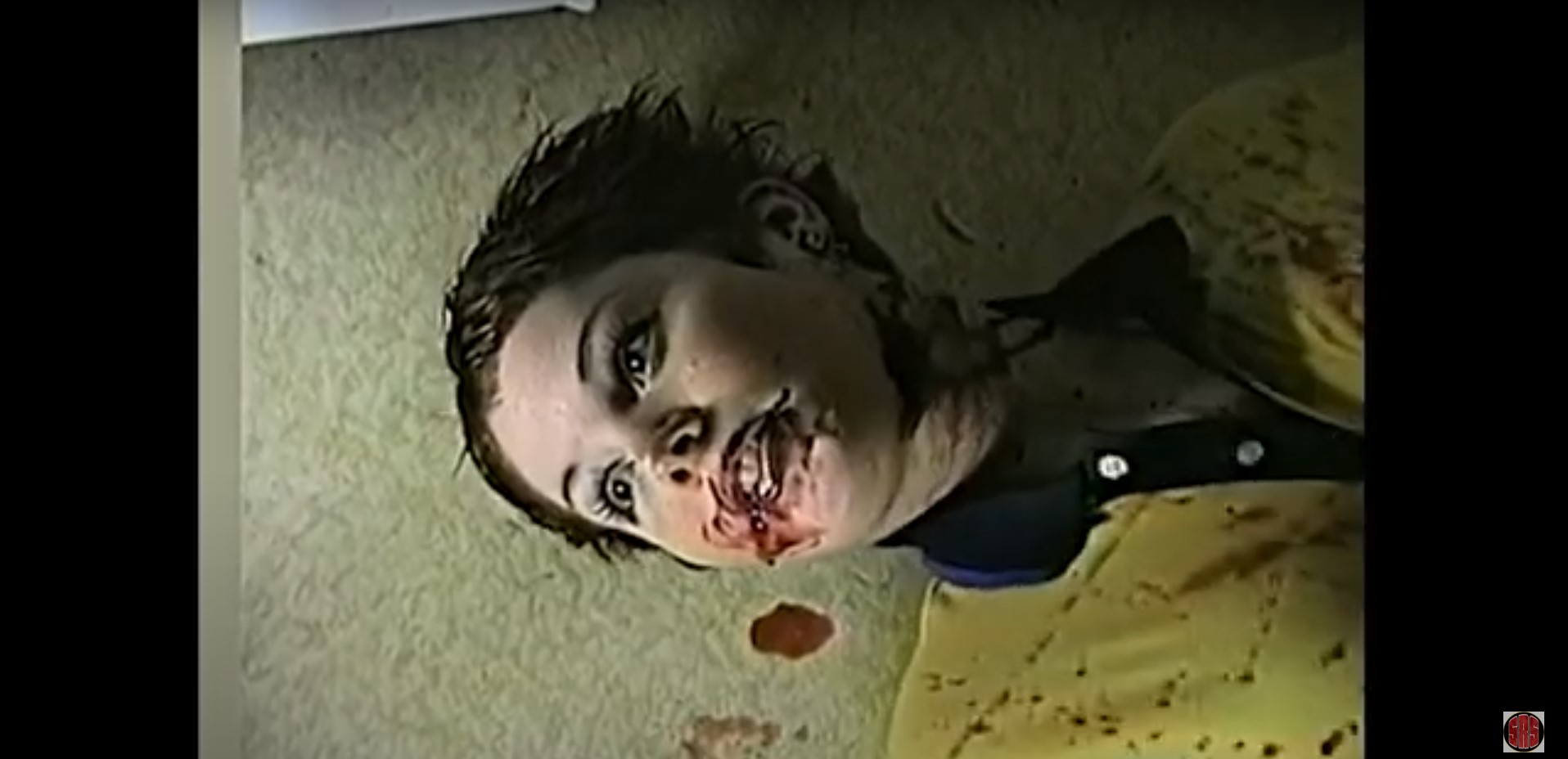
One element to not forget to mention before going through the cast is that “Dariuss” is completely without dialogue.  Metropolitana’s sound design manipulates and repeats many sound clips, such as the plops of water droplets or the high-pitch lip trilling, to fashion an uncomfortable audio sensation sporadically strung throughout that parallel’s the coupled low tumbling score and baby laughter, the later more so when referring to child loss or the abhorrent reincarnation of the child.  Ila Argento holds the majority screen time, especially since the pregnant woman credited as Sarah Isabèl is also Argento as well in some sort of meta crafting or illusion, and she plays the grieving, depressed wife wailing, screaming, and just distantly starring in vast quantities and in a daze of mirrored or painted inversions about the English home.  “Dariuss” is more than just extreme performance art as it embodies interval wretchedness associated with trauma, or in this case more specifically, loss through a reverse world looking glass.  As the wife is tended to by the grandmother, played with apneic conditions and posturing concern is Marie Antoinette de Robespierre, Archibald Kane’s the husband role is scantily around for a father who just lost a child and when the father is in frame, he’s idling in his car drinking, or rather gulping, from a bottle.  Both the grandmother and father roles are a part of Metropolitana’s message of a shattered family structure of insincerity and disconnect. Feeding on that dysfunction is the childlike maniac, played by Metropolitana himself, with rapacious amusement off the back of the household’s suffering.  Almost as if the maniac is a reincarnation of the lost child, perceived by play like antics in a nearly naked and hairless state and audible by the babylike, post-introduced laughter, returning home to exact horrific horseplay on his family involving rape and murder and cannibalism alongside the frolicking and breast milk chugging.  

Let’s preface with an important fact that “Dariuss” will not be everybody’s cup of tea; in fact, Metropolitana’s film is more like bitter black coffee with a pungent, sour smell as a narrative series of images, like a splayed, taped together string of polaroids, giving godawful glimpses of grief and gore.  Sounds and images repeat that beg for madness to emerge out of the nouvelle vague filming style, experimenting with various inverted images, mirrored and angled shots, different types of aged filters and strange lighting, various camera speeds, and oddly framed shots will subject audiences to pricklier sensory sensations than the depicted violence and gore, which is graphically ghastly and extreme with necrophilia and cannibalism.  Story structure also veers into non-linear territory but the gist of the acts is present, if not loose and equivocal for open interpretation and choice cinema characteristics that stray from normal convention, to mold a beginning, middle, and end in only a way Metropolitana can construct by contrasting melancholic grief with stagnating indifference, with a maniacal pleasure of a sandbox of sinew, and, in way, comical by way of the insanity with disturbing imagery mixed with playful mischievousness. 

Just who is Dariuss?  That’s the obstruse person perhaps at the centermost of this ghastly, grisly story that’s now on DVD from SRS Cinema as a part of their Extreme and Uncut label.  The DVD comes MPEG2 encoded, 480p standard definition, 5-gigabyte DVDR that showcases a wide-range of filters, inversions, lighting designs, grading, and you name it, “Dariuss” likely did it of cinematography techniques that stay in the rough patches of eccentricity rather than being comfortable in the fairways.  Picture quality fluctuates and varies depending on the aesthetic chaos methods being deployed, leaving behind not the sharpest looking picture with noticeable pixelation on anything above a 32″ television but not enough of an eyesore to be an imperceptibly deterrent.  Depth has fair spatial qualities but range and saturation is pretty limited to an anemic neutral palette to only when the monochrome or higher contrasts are not in play. The LPCM 2.0 stereo contains no organic matter, meaning that none of the sound is captured within the scenes, as Metropolitana modulates, manipulates, and modifies singular notes and tones for creepy and ear-splicing effect. This also pertains to the soundtrack being completely devoid of dialogue to give the auteur complete authority of how his film she be heard and every bit of that sound design is front loaded and high-powered but to an intended unrefined audio art. English captioning for the deaf and hard of hearing is available. Special features encoded are a behind-the-scenes still gallery and SRS trailers while the standard Amaray comes with an SRS illustration of the film’s original one-sheet, transposed to the disc pressing. There are no inserts included nor slipcover. SRS Cinema’s release is region free and has a runtime of 62, ideal, or even a tad bit too long, for this type of experimentation.

Last Rites: Not to be confused as a nail-biting, popcorn thriller, “Dariuss” will only speak to a select few able to bend the mind to impressionistic, dark eroticism and savagery, both qualities of which Guerrilla Metropolitana has and depicts in droves.

Find Out Who “Dariuss” Is With this SRS Release!

Mother Russia’s Most EVIL Serial Killer is “Evilenko” reviewed! (Unearthed Films / Limited Collector’s Edition 4K UHD and Blu-ray)

Limited Collector’s Edition 4K and Blu-ray Available Here!

Kyiv, 1984 – An aging schoolteacher named Andrej Evilenko is stuck in Josef Stalin’s quickly dwindling sociopolitical communism party and finds himself dismissed from the school after being accused of attempted rape of one of his preteen students.  His release from vocation obligates him to write letters to the Communist party still clinging to control and from those letters comes a job with the KGB under the guise of a railroad inspector.  Evilenko’s empowerment by the party drives his dangerous urges to rape, kill, and cannibalize women and children over years around Kyiv and Crimea, using his position of inspector to travel.  In 1987, Magistrate inspector, Vadim Lesiev, is assigned by the D.A. to hunt down the serial killer who has by then murdered over 30 victims.  Over the course of the next eight years, Lesiev finds himself chasing his tail and fearing for his own family’s safety against a monster that has all of Kyiv frightened. 

Based off the true crime story of notorious Soviet Russian serial killer Andrei Chikatilo, “Evilenko” tells the fantastically frightful tale of the real “Butcher of Rostov” who did confess and was convicted for rape, murder, and the cannibalization of 52 young women and children, of both sexes, from 1978 to 1990.  The Italian-English production is spearheaded by Italian filmmaker David Grieco who directs the film as well as supplies the story’s base material from his own semi-biographical novel on Andrej Chiktilo, entitled “The Communist Who Ate Children” (“Il comunista che mangiava i bambini”).  Grieco, the son of the of the founding members of the Communist party, finds a financial means to produce a visual adaptation from Britain’s Pacific Pictures consisting of Michael Cowan and Jason Plette of “Killer Tongue” and produced by Italy’s Mario Cotone (“Malena”), representing the MiBAC, the Italian Ministry of Cultural Activity.

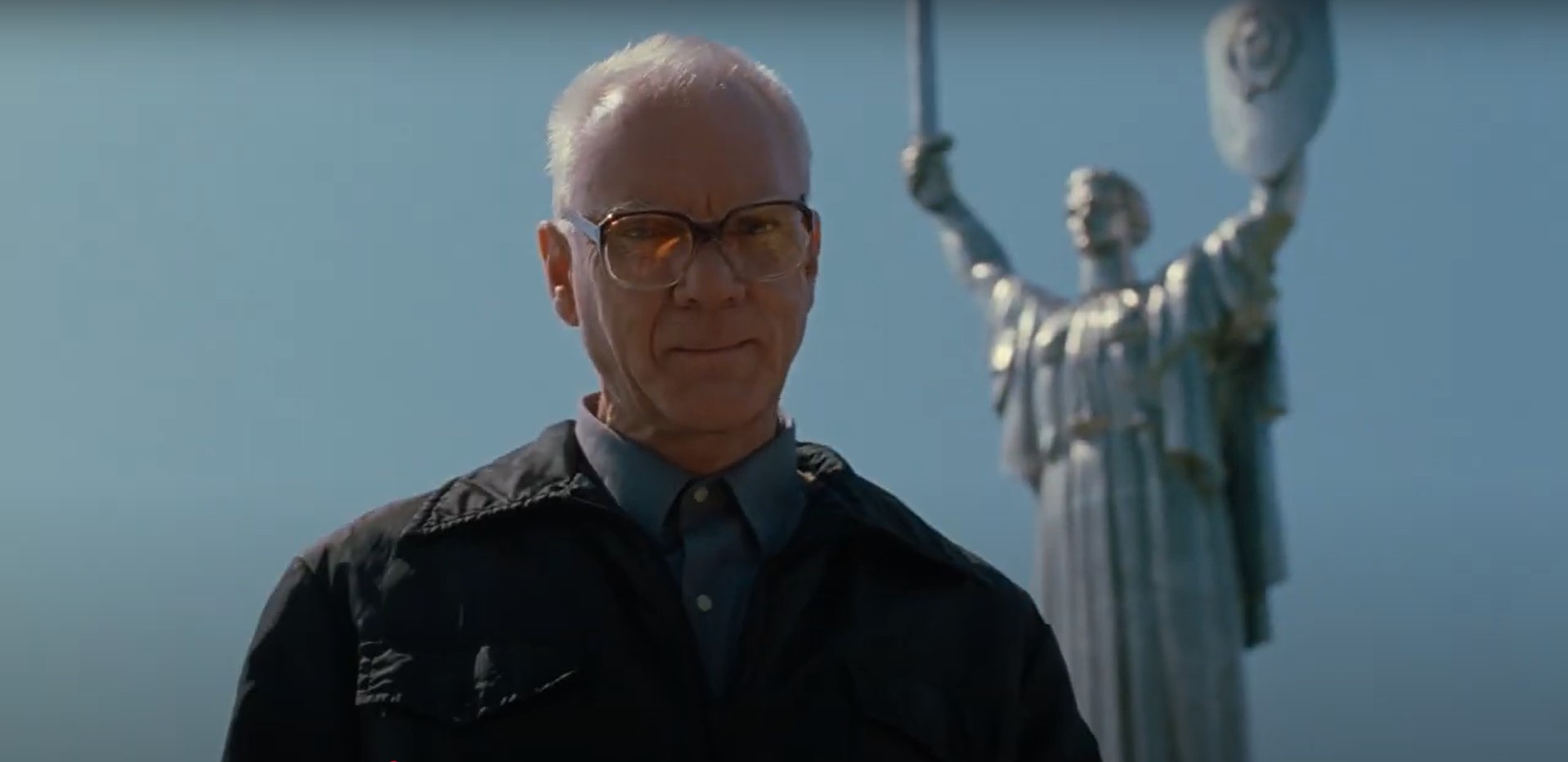
Who better than to portray a variant of the child molesting, murdering, and eating Soviet Andrej Chikatilo than Malcolm McDowell, the British actor who is no stranger to controversial films and performances having the lead roles in both Stanley Kubrick’s celebrated violence in a dystopian society in “A Clockwork Orange” and in the pornography spliced infiltrated titular performance film of the sultry period drama “Caligula.”  Being older and wiser doesn’t phase McDowell to shy away from committing to difficult scenes involving minor aged costars, especially scenes with sexually ambiguous dialogue and being pants less while speaking it, and while not a physically demanding role for McDowell nor is it filled with the intense-eyed actor’s usual fiery fervor, but in the shoes of Evilenko, he nails down the real serial killer Chikatilo’s exterior appearance, despite attempting to make McDowell appear younger with just only a wig to convince audiences of the 20-year span in the story, and touches upon the oddities and the quirks that make Chikatilo a delusionally faithful comrade, justified by his own investment into the communist party.  Evilenko’s archnemesis comes in the form of district attorney magistrate investigator Vadim Lesiev, played by the underutilized New Zealand born actor Marton Csokas (“Lord of the Rings,” “Cuckoo”).  “Evilenko” is clearly the Malcolm McDowell show but Csokas gives his all to a man not only doing his duty as an official of the Russian pervading prosecution but also as a family man haunted by his inadequacies and his inabilities to catch the perverted serial killer that might just strike close to home, putting Lesiev on edge with that nagging worriment.  Grieco’s editing and story development greatly undercurrent Csoka’s motivations and plights, distorting his complexities to a minor key of his true self, and letting McDowell have free reign over his subsidiary counterpart.   Yet, neither character is fleshed out definitively, none to compel a reason for their idiosyncratic methods and behaviors, which goes hand-in-hand with the purgatorial editing that is loose with the timeframe.  Ruby Krammer (“Alien Exorcism”), Frances Barber (“Superstitition”), Vladimir Levitskiy, Ihor Ciszkewycz, John Benfield (“Hitler’s S.S.:  Portrait in Evil”), and Ronald Pickup (“Zulu Dawn”) as a psychotherapist assisting tracking down the killer.  

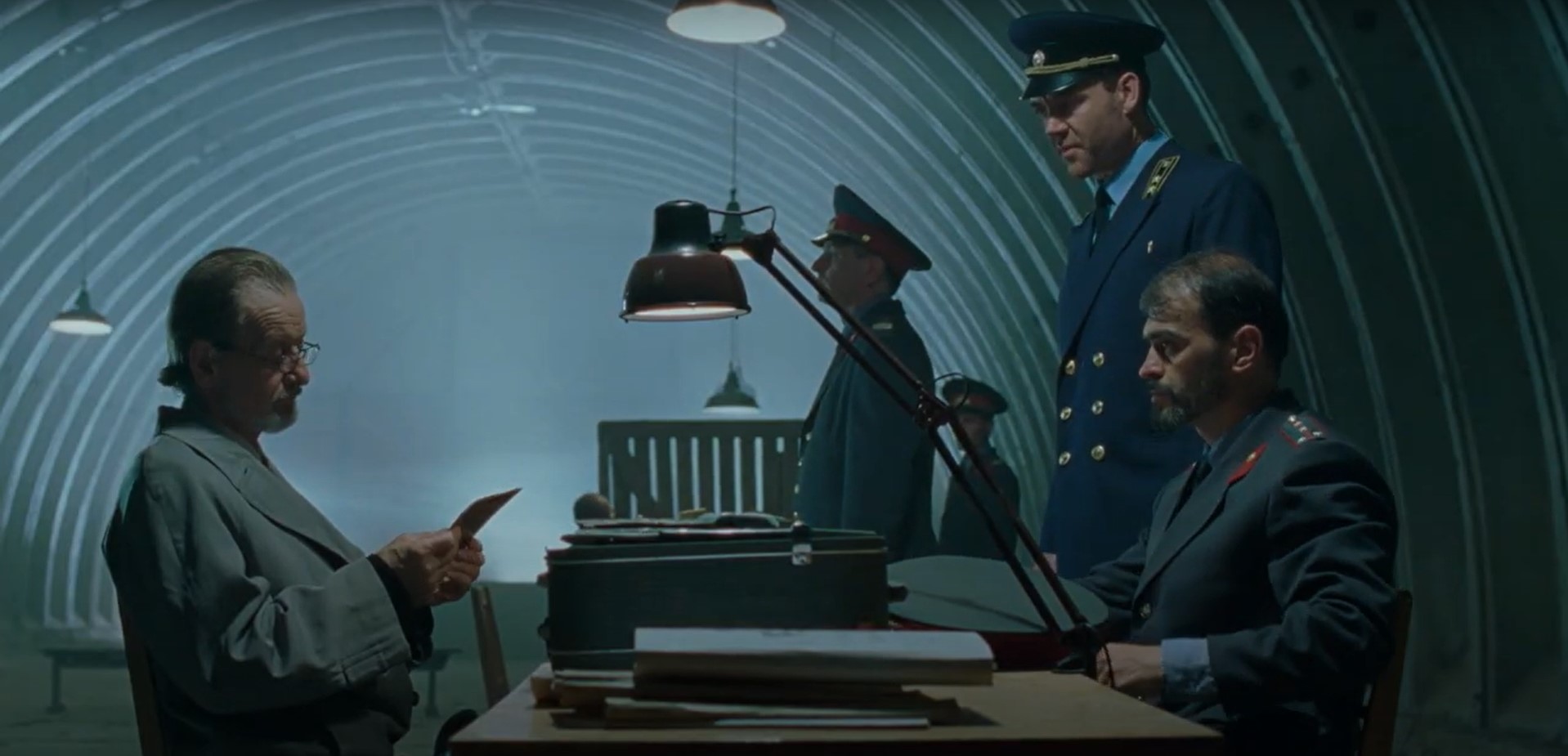
As much as the Grieco and McDowell dynamic works to monstrously depict a coldhearted and crafty serial killer coupled with a sliver of slithering supernatural propensities to lure women and children in a fixed trance or, in more conventional means, into doing what he wants with an spellbinding combination of stares, manipulative conversation, or just overall emitting a towering communist cloud of authority, “Evilenko” is deflated by the story’s time lapsing.  Opening with Kyiv 1984 and then subsequently in Crimea five years later in 1989, the noting of years or periods is hereafter eliminated from the narrative that becomes a back-and-forth yarn between a select of Evilenko’s pied piper lures and kills and magistrate Lesiev always behind the eightball pursuit of the elusive, unknown killer.  There’s a loss of sight on Lesiev’s psyche that is very important to the story and more so at the climatic interrogation scene where both men are stark-naked in a power and controlling situation that harks back to Evilenko’s mesmerizing tactics used against the adolescent prey and Lesiev’s fear and obsession of losing his family to what once was an uncatchable slaughterer who hallmarked with mutilation and devouring.  Grieco’s willingness to be grisly is tamer than the expected based off the prologue scenes of Evilenko exploiting and nearly raping a preteen girl but doesn’t take away the effect that the entire narrative arouses an uncomfortable experience teased to always be on the edge of overly graphic but never breaking that threshold; “Evilenko” is one of the biggest blue balls instigators is in last 20 years and that rush of not seeing or knowing can be more thrillingly charged for some than anything totally explicit ever could produce. 

Unearthed Films limited collector’s edition has 2-disc, dual format capacity with a 4K UHD and Blu-ray.  The second 4K UHD from the label, behind their release of “The Guyver,” solidifies the extreme horror company a player in the ultra high-definition game.  The New 4K transfer restoration of the original camera negative is HVEC encoded, presented in a widescreen 1.85:1 aspect ratio with 2160p UHD, on a massive three layered BD100.  The Blu-ray comes AVC encoded, 1080p high-definition, on a BD50, presented in the same aspect ratio.  What’s gathered from both presentations is that there’s nothing to fault them with as both excel to their max output abilities.  In fact, the transfers are pretty much identical, integrally achieved by digital optimization of an already optimized digital camera, a Sony PMWEX3 with 35mm adapters, which at that time was the bigger brother and flagship model of the Sony line.  A slight grading reduction instills a sense of austere or lackluster coloring that mocks a communist Russia veneer.  Close ups on McDowell’s unique features and the expound of particulars in the surroundings, especially when engulfed in leaf-covered and tree-thick woods, tell of the emerged details and textures in a higher pixel count.  An English DTS-HD 5.1 Master Audio is the sole mix available.  The back and side channels are essentially used sparing for a few flakes of brief ambient hubbub in what’s mostly a frontloaded conversational piece of mostly McDowell in one of his great monologuing moments. We get some nice oblong orchestral pieces from the late David Lynch regular composer Angelo Badalamenti (“Lost Highway,” “Twin Peaks”) that incorporates haunting harmonies and soft, ethereal vocals that play into the loss of innocence theme. Dialogue’s healthy and prominently favorable next to the unchallenged low ran range. English subtitles are available for selection. The BD100 offers only the feature, and a new commentary track with director/writer David Griece and star Malcolm McDowell while the Blu-ray offers the same commentary plus Evilenko Dossier: Andrei Chikatilo, the examination of the real killer against the onscreen rendition, cast and crew interviews with Grieco, McDowell, and Badalamenti, a photo gallery, and the original film trailer all within the bonus content of a fluid menu with Badalamenti’s and vocalist Dolores O’Riordan’s main track “Angels Go to Heaven.” The limited collector’s edition is housed in a cardboard slipcover of one of the many variants of Malcolm McDowells face slathered in soviet red. The black Amaray has the same cover art with no reversible cover. The discs are snap-locked in place on opposite sides, pressed with another slathered in red image pulled from powerful interrogation scene between Evilenko and Lesiev. Both formats are not rated, locked region A encoded, and have a runtime of 111 minutes.

Last Rites: “Evilenko” is a heavy story that needed to be told. You don’t hear much about the USSR vulnerability and the real-life serial killer had frightened the proud, the stoic, and the impoverished alike as “Evilenko” seers as a case study mental illness, is a metaphor for deteriorating Communism, and a tale too terrible to forget and despite some pacing issues and timeline infractions, Grieco and McDowell pull off a rather nasty semi-doc of one of the worst killers to ever live.

Limited Collector’s Edition 4K and Blu-ray Available Here!

EVIL Backwoods Cannibals Are Back for Seconds! “Butchers Book Two: Raghorn” reviewed! (Breaking Glass Pictures / DVD)

Ready to Eat? “Butchers Book Two: Raghorn” Available Here on DVD!

The abduction of a wealthy family’s daughter drives the four kidnappers onto the backroads of rural America toward their way to riches.  However, things turn south as their vehicle strikes a large raghorn, instantly dissolving their escape route and their previously teetering plan.  A festering betrayal and greed divide the group that leads them into the cannibalistic hands of the sadistic, backwoods inhabitant Clyde and his monstrous freak of a brother Crusher.  Always looking for a good piece of meat and with a brutal penchant for playing with his food, Clyde takes them hostage at gunpoint, ties them up, and has fun torturing and tenderizing his foraged prize before chopping them up to pieces on a bloody stump for stew makings.  Yet, the abducted woman refuses to be the victim and let terrible, awful atrocities happen to her, and not even let it happen to her kidnappers, by escaping her confines and managing to get ahold of a double barrel shotgun.  A standoff ensues but nothing gets in between Clyde and his food. 

“Butchers Book Two:  Raghorn” is director Adrian Langley’s 2024 standalone sequel to his lowkey breakout 2020 hit, the indie backwoods cannibal-survivor picture, “Butchers”.  The sequel doesn’t stray too far from the precursory film’s primary premise with a family of degenerate provincials with a taste for human flesh whisking away stranded travelers in some kind deranged version of roadside assistance.  Langley directs and writes the script for the film based off a story conceived by Langley and Kolin Casagrande, who previously collaborated with Langley as a producer on his 2010 crime thriller directed feature entitled “Donkey.”  More than a decade later, Casagrande and Langley are again making beautiful violence together with Blue Fox Entertainment’s James Huntsman (“Bunker”), a parent company of the film’s distributor, Red Hound Entertainment, and “Butcher’s” Doug Phillips as producers and another “Butcher” producer, Kevin Preece, as associate producer.

Aforementioned, “Butchers Book Two:  Reghorn” doesn’t subsequently follow the first feature and introduces new set of paltry protagonists versus a new set of insatiable and vile cannibals deep within the middle of the woods of Nowheresville, America.  The party forcibly partook in the cannibals’ cruelty isn’t necessarily all an innocent party as they’re mostly kidnappers looking to score big from their captive.  Dave Coleman (“Ghoul House”), Miguel Cortez, Sam Huntsman (“Bunker”), son of producer James Huntsman, and Hollie Kennedy portray the ensnared antiheros with the latter two being most of the focus amongst them, seeing that they are cousins that evoke more empathy than the less empathic former.  The wild car outside of that and who are not the viciously outweighing outliers is the girl in the trunk, who is actually a man named Corgand Svendsen.  The androgynous model from Canada hikes up a skirt and wears a tight top crop to become the damsel Ash but Ash is no damsel in distress.  The story shifts from Ash’s bagged head and wrists tied helplessness to become the infiltrating protagonist to take up Clyde and Crusher to do what’s right, even if that means saving the skin, literally, on a couple of her captors.  Svendsen gives a calm and subdued performance, especially as a hostage in the money scheme and in the bloody mitts of cannibals, but perhaps there’s more than what meets the eye for Ash.  Perhaps, Ash is a part of the kidnapping scheme in a theorized plot between Ash and Sam Huntsman character Josh who frequently tries to make Ash comfortable in the whole ordeal and Ash is just trying to salvage her investment, but the strength of that theory never fully materializes in Ash’s motivation to go against two ruthless killers rather than to flee free with her life.  Clyde and Crusher are the two mysteriously originated characters who live in the woods and eat people.  Their background is not specified or shared in any minute way but “What Lurks Beneath’s” Nick Biskupek plays a mean, man-eating son of a bitch in Clyde while Michael Swatton, who previously played one of the Watson brothers in original “Butchers,” compliments his “little” brother as a colossal, head-crushing freak of a nature left in the audience’s peripheral view.  The sequel’s casts ends with Mark Templin (“We Are the Missing”) as a moment of reprieve stopgap sheriff tracking down the vehicular accident victims who may not be victims after all.

Watching “Butchers Book Two:  Raghorn” is like watching in a déjà vu fog.  The similar premise to the 2020 film peruses familiar aisles of country-chic cannibals chopping careless characters who stumble into their killing grounds.  What the sequel drops is the perversive and family legacy angle, reducing the story to just two brothers living isolated on the outskirts and barbequing people as they happenstance wander by.  Langley also doesn’t up the graphic nature but sustains the same amount of gore and mordacious violence.  Even when cutting down the killer contingent down half its size, violence remains taut and palpable for shock effect as Langley does make the savagery purposeful rather than just gratuitous.  “Raghorn” is by no means a bigger, badder sequel, as most sequels tend to try and exceed expectations and outdo the first, i.e. more blood, bigger body count, detailed special effects, etc., but the indie roots that made the original film palpable are still firmly grounded with a, literally, grab-it-by-the-balls, suit yourself story without the poking and prodding influences of a rapacious producer or studio with flashing dollar signs in their eyes. 

Breaking Glass Pictures’ “Butchers Book Two:  Raghorn” would have been a perfect fit for the distributor’s short-lived extreme horror sublabel, Vicious Circle Films.  However, we’re still glad the sequel made the home video market under one of Philadelphia’s most prominent indie distributor labels with a DVD release.  The MPEG-2, single layered, DVD5 is presented in an upscaled 1080p with a widescreen 16:9 aspect ratio.  While not receiving high-definition resolution, you’ll be fairly pleased with the quality of this release that retains some faithful reproductions in textural details, such as Clyde’s cutoff jean jacket and overall grimy attire that does highlight the jacket’s frayed ends and the outlined dirt patches or the engulfing variety of foliage that naturally exhibited innate green shades, but also the general appearance is soft in the more depth of details.  Langley, who wears multiple production hats between editing, directing, and writing, also is behind the cinematographer lens to create the space of depth and to be stylistic with a few pan and track occurrences.  The English Dolby Digital 5.1 surround mix is the only lossy option available that renders a traversable diffusion of sound throughout with balanced layers between dialogue, ambience, and soundtrack layers.  Clyde’s intelligent intelligibility under a twang tongue clearly finds the audio receptors with the remaining dialogue denoting clarity in the same fashion. English subtitles are available for optional use. While Breaking Glass Pictures’ releases do not have a wealth of bonus content, most have some content to peruse; however, this particular release is feature only. The region 1 playback DVD has a runtime of 89 minutes and is not rated.

Last Rites: From the book of Andrian Langley’s cannibal misfits, a second story lives and breathe in “Butchers Book Two: Raghorn,” a gruesome, miscreant fanned, survival of the hungriest for their cravings tale wrapped just a tad too lightly for proper consumption.

Ready to Eat? “Butchers Book Two: Raghorn” Available Here on DVD!

Eating Disorder? More Like EVIL Disorder! “Binge and Purge” reviewed! (SRS Cinema / DVD)

“Binge and Purge” on SRS DVD Home Video!  This One Is Hard to Keep Down!

Three former police officers now private sector detectives find themselves embroiled in a cannibalistic frame up by the police state in a near dystopian future.  Their no choice, self-preservation investigation leads them to a group of models who consume people in order to stay vibrant and young as if frozen in time.  The mastermind behind the models’ ravenous new diet is a former Nazi science experiment-turned-fashion designer who has not only spread his indelicacies throughout the fashion world but also into a corrupt authoritarian police department helmed by a sordid chief.   As more and more people succumb to the ghastly craving of human beings, the rebellious detectives embark on an ambitious plan to cut off the head of the snake by working up the fashion designer’s human-hungry hierarchy but are they too late to stop the meat-eating madness?  Has the world been forever infected by the touch of pure evil? 

The first Christmas horror film review of 2023!  Brought to you by the Canadian-born, “Meat Market” trilogy director Brian Clement, the filmmaker’s written-and-directed third feature, “Binge and Purge,” is the 2002 genre melting pot of action, horror, and comedy set in an undisclosed urban jungle of North America where a person’s legal rights no longer exist, beauty and fashion insidiously influence, and normalcy becomes rebel factions’ reason to fight tooth and nail to hang on to it despite the coursing corruption and taking refuge from repressive authorities on their tail.  While sounding glum and despondent, Clement’s addition of black humor adds a loose layer of lurid levity to the bizarro-world society mirroring our own that teeters toward a path of culture and humanity deterioration with radical political and influential figures.  Once considered being the third film in the “Meat Market” series and alternatively known as “Catwalk Cannibals” in other countries, “Binge and Purge” is produced by Clement under Frontline Films. 

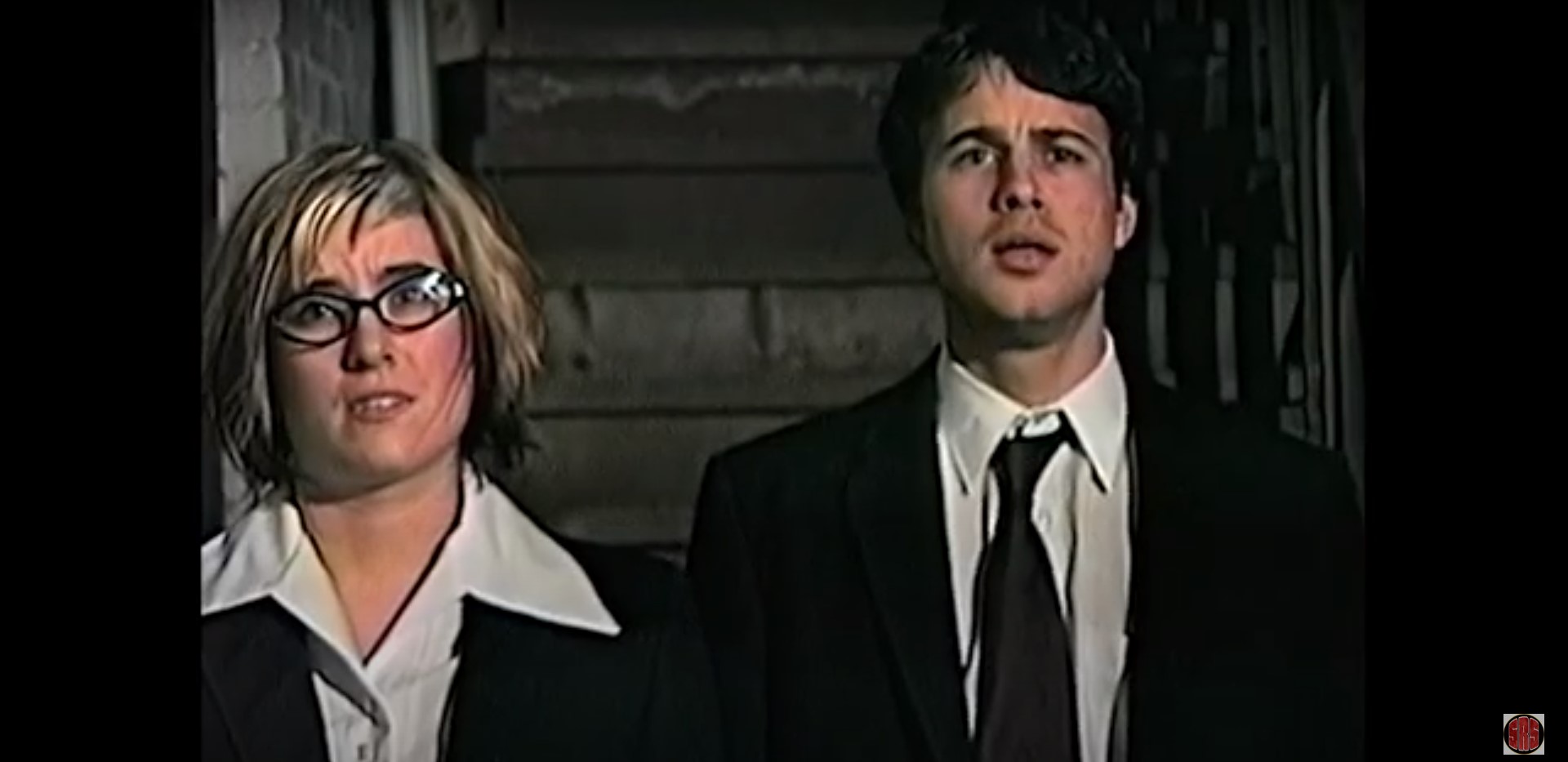
One thing to note about SOV independent production is the impressive number of cast involved.  The large cast helps manifest Clement’s ambitious dystopia and chaos-riddled world.  Without it, “Binge & Purge” would have been too anorexic to sustain selling grandiose on the cheap.  Typical formula for flesh-eater films persists with secluding a handful of principal roles, majority only speaking roles, fleshed out with an epic apocalypse contextualization of little-to-no dialogue, story arc, or any other sort of prominent screen time stock or background characters in a horde of the undead in crude bloodstained suits.  Clement establishes good guys and bad guys clearly but doesn’t necessarily the focal characters with an ebb and flow pattern between the three detectives May (Tamara Barnard), Vanzetti (Stephan Bourke, “Exhumed”), and Number 11 (Fiona Eden-Walker), who we gather was a former highly trained operative so engrained into the training and operations that her name was lost or forgotten, reduced to a number and the troupe of man-eating models under the eternal fashion designer Karl Helfringer (Gareth Gaudin). The models consist of not your slender-hip vixens with shaved down noses and hungry-looking figures but rather the curvy, pin-up types to wet a seemingly heathy appetite. Moira Thomas, Samara Zotzman, Amy Emel, Becky Julseth, Terra Thomsen and Melissa Evans lavish in so much delight over the sticky glop and spilling intestinal scenes of shoulder-to-shoulder cannibal chow downs that there isn’t an ounce of hesitation or disgust before enamel stabs into the fresh viscera but where the enthusiasm mostly falters is with the monotone dialogue deliveries with hardly any swing in inflection, tone fluctuations, or any kind of gesturing during the more emotive occurrences. “Binge and Purge” rounds out with Robert C. Nesbitt and Chuck Depape respectively as a fashion magazine reporter turned human hungry minion and the coke-snorting corrupt police captain.

“Binge and Purge” is more than just a Christmas horror.  Amidst the meandering storyline of touching points in time and space with numerous characters and flashbacks skating on thinly laid context ice, such as the Spanish Civil War of the 1930s, Nazi experiments of the 1940s, and how America became a police state, the girth of “Binge and Purge’s” main coarse actually spans across the end of the holiday season in that week between Christmas and New Year’s, approximating a Y2K scare vibe of total chaos and confusion by way of cannibalism contagion instead of a feared computer bug, but that’s one area lacking in Brian Clement’s production laced with insatiable consumerism and consumption with in regard to really hyping up the cheerful holiday atmosphere to become besmirched by the corrupted filth of dirty cops, a plague of death, and a conspiratorial coup by high fashion.  The occasional Santa hat makes an appearance in a model shoot and the end of the year countdown denotes the pinnacle of a MP5 massacring finale, and though I can’t be certain, even the soundtrack sound to be distorted versions of the perennial Christmas classics, but that’s the extent of Clement’s holiday backdrop that would have easily fissure a chasm between “Binge and Purge” and the next low-budget cannibal shocker.  If you’re going to set the film during Christmas, deck the freaking halls, man!  Where Clement bedecks the film is with blood and gore that sees stringy sinew and a high body count’s insides become outsides over an encircling of edible entrails and on literally finger food trays.  Another shining highlight area is the action with agreeable submachine gunfire and the creative pyrotechnic-flares for explosion special effects that does rich up production value, inching the film more toward a magnetic, practical effect-laden, SOV spectacle worth the viewing calories. 

Shot on S-VHS, SRS Cinema gets their hands on the best master print director Brian Clement could carve out of his body of work. The MPEG2 encoded DVD presents the feature in 1.33:1 pillarbox aspect ratio in a 480p resolution. S-VHS master looks pretty darn good despite the caliginous reflection that produces more shadows and illumination on the tape, even if S-VHS offered better illumination as a format, and a lower, poor resolution than S-VHS’s Betamax predecessor. Still, this print has enough delimiting factors to produce a well-oiled image suitable for public distribution with a mix of neon warm and soft color capturing and crude lighting for maximum gritty-palpable product. The English LPCM mono track also has admirable lossless fidelity with a bitrate decoding of 192kbs, that has come typically standard, and greatly appreciated for audiophiles, on SRS releases. Some scenes are better than others, but the dialogue does retain some tail-end hissing and can be soft in spot. Otherwise, dialogue renders clearly enough. The release offers no subtitles. Bonus features include an archived audio commentary and a new SRS cinema produce audio commentary both of which include a self-deprecating Brian Clement going through his “least favorite” work’s production wishful do-overs, where the cast are nowadays, and his favorite gags and setups, a handful of deleted scenes, a slideshow, a new SRS cut trailer, and other previews for other SRS distributions. SRS Home Video release is mocked up with a retro VHS box-impression Amaray DVD case complete with graphically printed-in Please Be Kind, Rewind and Horror stickers. The not rated film has a runtime of 83 minutes and is region free. Nowhere near being a bulimic gorge for expulsion to empty one’s cinematic capacity, “Binge and Purge” is fully digestible grubby grub of horror, action, and comedy. 

“Binge and Purge” on SRS DVD Home Video!  This One Is Hard to Keep Down!