The EVILs of Slasherman! “Random Acts of Violence” reviewed! (Acorn Media / Blu-ray)

Comic book writer Todd has hit a writer’s block wall on the last issue of his one-shot, popular and extremely graphic series Slasherman based off the gruesome string of I-90 murders of the late 1980s where the killer murdered and mutilated his victims without ever being caught.  Looking for inspiration to conclude his life’s work, Todd, his girlfriend, investing publisher, and assistant head out on a road trip from Toronto to America, specially through the small town of McBain where the murders took place, but when recent mutilated bodies resemble the grisly deaths inside the colorful pages of his comics, the semi-fictional Slasherman story becomes full blown reality that places him and his friends in a maniacal killer’s path whose flipping through the pages of Todd’s murder-glorifying comic for inspiration of his own. 

Like many opinionated reviews before mine, I never imagined Jay Baruchel directing a horror movie.  The long time comedic actor with solid relationships working with other high profile comedians, such as Seth Rogen, Jonah Hill, and Danny McBride in some of the best notable comedies on the side of the century, has stepped into the shadows and professing his admiration for the genre we all love – horror. Baruchel cowrites and directs his first horror film, the big screen adaptation of Justin Gray and Jimmy Palmiotti’s “Random Acts of Violence” graphic novel. Fellow collaborator on the “Goon” movies, Jesse Chabot, branches out with Baruchel on the script and the two Canadian filmmakers yield an intense meta-gore picture focusing toward themes of lopsided public perspective and the glorifying of violence on other less physical mediums. Published in 2010 under Image Comics, the Gray and Palmiotti publication supplied a wealth of visceral material that unfolded faithfully in Baruchel’s Shudder distributed film as a stylish comicbook-esque narrative under the Toronto based Elevation Pictures, Wicked Big, and Manis Film production in association with Kickstart Comics and JoBro Productions. Palmiotti and Gray also serve as executive producers.


Struggling in the search for his perfect ending to Slasherman, Todd immerses himself in a cerebral fixation that envelops him more so then he would like to think.  Todd’s played by social activist and “Cabin in the Woods” actor Jesse Williams whose character is thrust into essentially making a choice, entertain his profession that earns blood money off the backbones of the I-90’s victims or subside his eagerness to finish his graphic novel and be team victim alongside his girlfriend Kathy (“The Faculty” and 2006’s “The Texas Chainsaw Massacre: The Beginning’s” Jordana Brewster) researching a novel that gives the slain victims a voice over their killer.  Brewster hasn’t changed one bit in a role that resembles a mature version of her “The Faculty” Delilah Profitt character complete with glasses and a thirst for reporting.  As a couple, Williams and Brewster hit little on their unconditional love  that’s apparent in the film’s final scenes.  Aside from their opening segment in their Toronto flat, their road trip is filled with Kathy berates Todd at times or Todd never seeming interested in Kathy or her work that’s seen counteractive to his own.  Affection is thin between them and I’m wondering if that’s more of the script writing than a flaw on Williams and Brewster who are credibility solid in their roles.  Same can be said about Jay Baruchel’s Ezra, the indie publisher sponsoring Slasherman, as the writer-director plays little to a publisher’s position of pushing the sales and marketing envolope and appears more to just be a tagalong friend with moments of quietly hawking.  Without much competition surrounding him, Slasherman is the most interesting character of the bunch from prolific stuntman, Simon Northwood.  With a 1000 yard stare that’s more menacing inducing than stemmed by trauma, Northwood brings the graphic novel character to all his glory as an aspiring artist in a contemporary parallelism to Todd who both see one another as their muse.  Northwood’s Slasherman is silently frightening, even more scary when he has to psych himself up to kill, and brings the physical stature of an unstoppable slasher genre maniac.  No one is safe from the merciless Slasherman, including those rounding out the cast in Niamh Wilson (“Saw III”), Clark Backo, Eric Osborne (“Pyewacket”), Nia Roam (“Polar”), Aviva Mongillo, and Isaiah Rockcliffe.   

The hyper violence lands more with a firm hand making good on film title.  Baruchel doesn’t hold much, if anything, back when rectifying violence as the monolithic theme while hitting a few thought-provoking notes involving the public’s perspective on the infamous legacy of serial killers and the tragic, forgotten memory toward their victims.  Somewhere in the gutting-clutter is a message of meta-existentialism tearing between that thin line of a person’s cause and effect actions.  Without the I-90 killer, Todd would not been stimulated into creating the deeply grim anti-heroic antics of Slasherman and, visa-versa, Slasherman would not have returned, coming out from retirement, if it wasn’t for Todd’s life’s work and lack of series conclusion for the Slasherman character speaking to Slasherman’s sanguinary artistic side.  One aspect stiffly hard to place your finger on is Todd’s connection with the town of McBain.  Other than a brief voice over exchange with Ezra, who mentions Mcbain is Todd’s hometown area, not much more of that pivotal connective tissue seizes grounding Todd, but the graphic novelist experiences a multitude of images streaming through his far off gazes, thoughts, and dreams. A boy, the boy’s mother who we know to be one of Slasherman’s victims because of Kathy’s research book, and the collateral damage of some great magnitude of violence surrounding them carry little weight to Todd’s psyche when struggling to piece his visions and these people’s bloodshed moment together and one reasonable theory that might explain that disconnect on our part is partially racially motivated, a detail indicative of gross assumption but a detail that can easily deceive you if you’re not knowledgeable enough about the cast you’re watching. My two cents is not randomized at all on Jay Baruchel’s “Random Acts of Violence” as it’s a brazenly deep and vicious first attempt horror in his own manic words from the glossy, leafy pages of the same titular graphic novel to the tellies of terror now on home media release.

Classified 18 for strong bloody violence and gore, “Random Acts of Violence” hits Blu-ray media shelves courtesy of Acorn Media International. The region 2, PAL encoded single disc BD25 has a runtime of 81 minutes and is presented in a slightly cropped widescreen 2.38:1 aspect ratio. A diverse hue palette of neon extricates Baruchel’s off-brand, real-time comic layout, creating a gritty, yet vibrant world all his own in a near window-blinds noir fashion. The tinkering of tints reaches almost Italian giallo levels without playing much with lighting and fog, relying heavily on the different neon vibrancy as if a colorist was right there pigmenting each scene as it played out. The English language Dolby Digital 5.1 surround sound discerns very well across the board with robust dialogue that even with Williams’ slight lisp, every single word can be hung on. I didn’t think there was a ton of opportunity for depth and range as much of the action is in staged front side of the camera, but for what little there was, those areas saw solid, identifiable outputs. Bonus features include a zoom interview with a very animated Jay Baruchel providing the in depth inner works of the conception of his film while sporting a retro Montreal Expos ballcap, a showreel-esque promo entitled More Than Just A Scary Movie offers brief opinions, thoughts, and highlights on the film edited from longer, on-set interviews, and a look inside how to make an action scene. An on-your-toes, gut-wrenching slasher with a juicy slice of meta proves Jay Baruchel can wander into any genre and come out on top, but “Random Acts of Violence” has kinks to straighten out in this young director’s sophomore feature.
Be Creative, Be EVIL! “Scare Me” reviewed! (Acorn Media / Blu-ray)

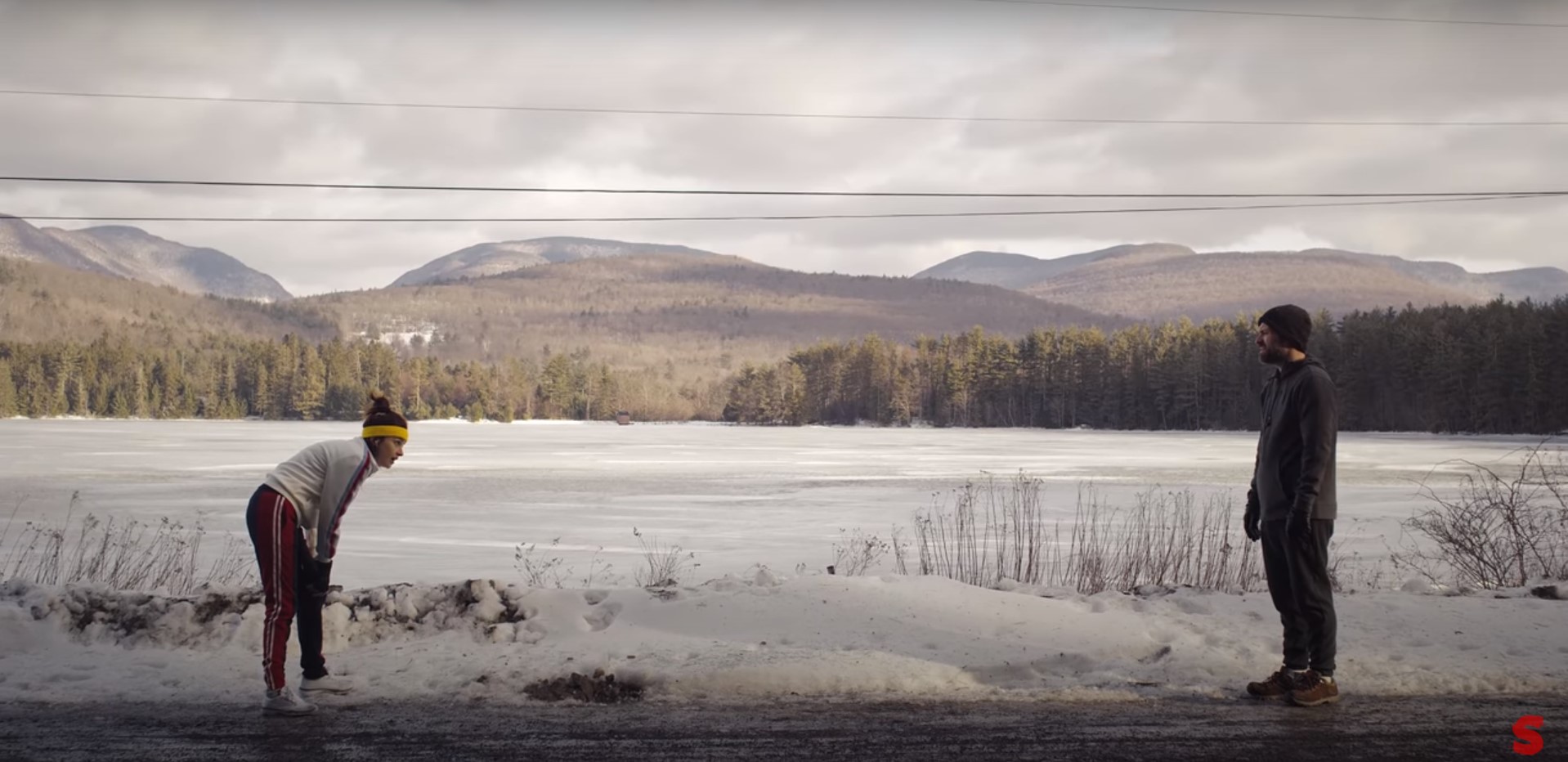
The down on luck Fred and a celebrated Fanny are both horror writers. Well, sort of. You see, Fred is an aspiring horror writer with unpretentious stories acted out by his creativity whereas Fanny is the hot, popular artist who just came out with an acclaimed novel everybody is talking about, even Fred. When their paths cross on a remote, snowy getaway during power outage, they consolidate to one cabin to stave off boredom by telling each other off the cuff scary stories, acting out every minor detail to flesh out the macabre tidbits in order for a good scare. As the night carries on and the stories become more involved, Fred’s night has been a rare highlight in recent days and now that day is on the brink of breaking, Fred has one more emotionally-driven scary story to tell the weary Fanny.

You wanna see something really scary? No, not the line from that wraparound story with Dan Aykroyd and Albert Brooks driving late a night in “The Twilight Zone: The Movie,” but rather really see a scary story come to life before your eyes with enthusiastic performances between two horror writers? Josh Ruben’s “Scare Me” does just that with the filmmakers’ 2020 horror-comedy hit. Ruben, whose latest comedy genre film, “Werewolves Within,” has been a critic success, writes and directs a petite cast packing a powerful punch pitched perfectly more so than this mouthful attempt at an awfully awkward alliteration. “Scare Me” is also produced by Ruben along with Alex Bach and Daniel Powell under a conglomerate of productions companies including Artists First (“Hell Baby”), Last Rodeo Studios (“Save Yourselves!), and Bach and Powell’s Irony Point with Shudder distributing.

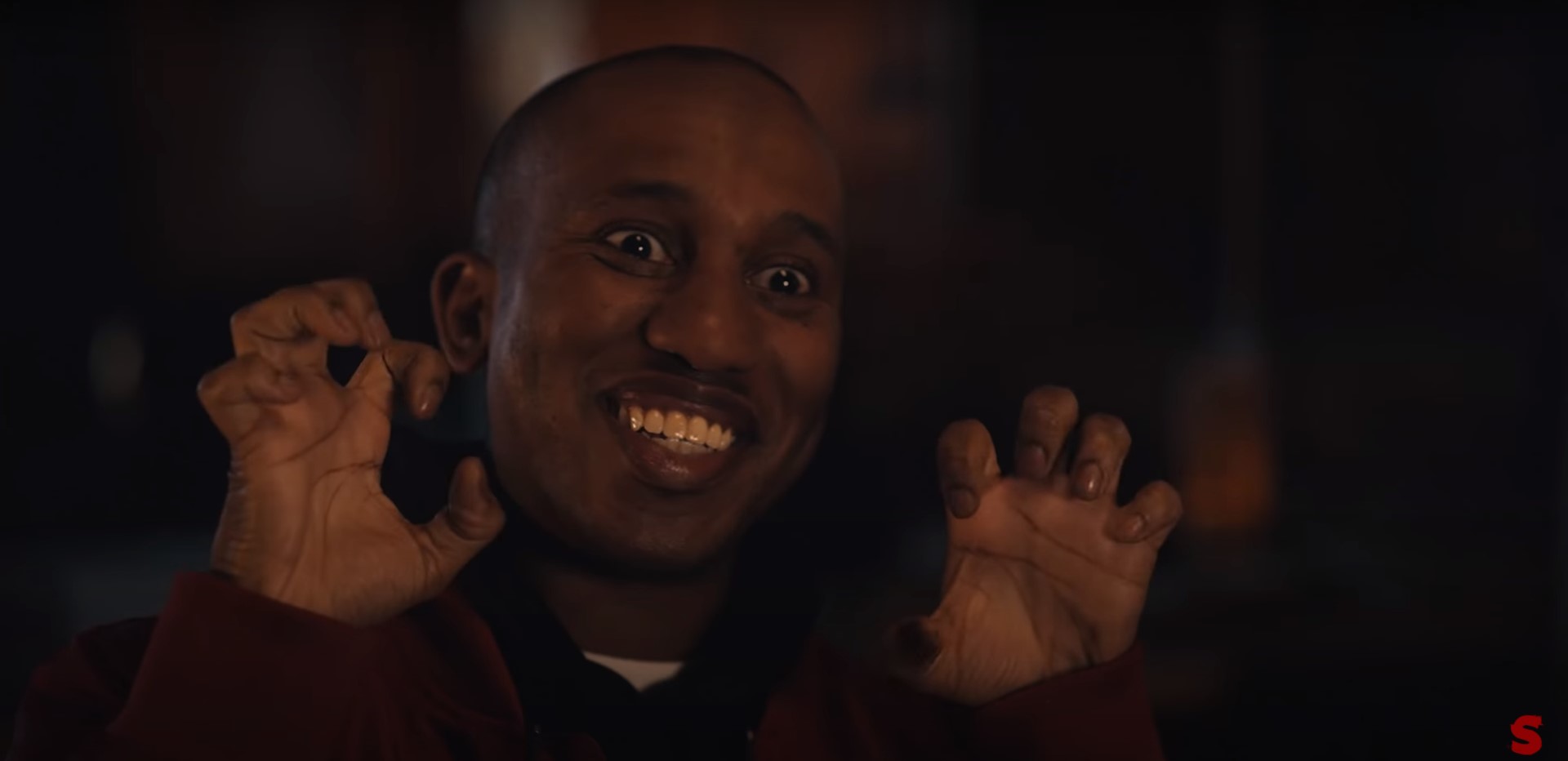
Ruben not only writes, directs, and produces his film, he also co-stars as Fred. With this Andy Serkis like looks, motions, and vocal talents, Ruben is a master at amplifying impressions and slapstick from the beginning as Fred using his unrestraint, and probably unstable, imagination to try and write a bestselling horror novel to help him get out of a life funk. Then, their is Aya Cash, who I have personally adored since her villainous role on Prime Video’s “The Boys.” Much like that role’s personality of the super-sadist Storm Front, Cash just dons snarky assertive woman to perfection as she continues the trend by embodying bestselling new age novelist Fanny with such. Fanny downright emancipates…I mean, emasculates…Fred at every chance and at every step along the way despite her warming up to Fred’s kooky lackadaisical first impressions with a side dish of caution for those who yearn for story ideas. Ruben and Cash bounce incredibly well off each other to the point of credibility between the dynamic and the dynamic is far from being a romantic love interest but more so an unlikely best friend; a best friend who constantly proclaims white male privilege whenever the opportunity presents itself. The funnies also keep on coming, especially mixed into the dialogue details, that are sharpened by Ruben and Cash’s timing and delivery telling their individual stories and the reactions each have during them, but then blend into that batter of bust-a-gut with comedian and “Vampires vs. the Bronx” actor Chris Redd, consider your every funny bone in your body rigged for explosion with the trio’s insanely charismatic skits and a musical number about a Devil possessed pop star to die for. Bringing up the rear of the comedic cast is “Key and Peele” writer Rebecca Drysdale.

If you had told me that “Scare Me’s” premise was two writers telling each other scary stories during a power outage, the film would have been near the forgotten bottom of my must-watch list with the inane dancing of “Orgy of the Dead” and the prosaic “Paranormal Activity 4.” After watching the film, all I have to say is this, Mr. Ruben, please accept my heartfelt apology for manifesting one single brain cell of doubt as “Scare Me” is the five-star movie everybody needs to see. I am not worthy. The idea behind the movie is simple, yet novel, that never ceases to peak as Ruben’s film perpetuates a steady incline of sharp-witty dialogue, an involved and spot-on sound design to create the stories’ allusions, and a trope-less ending that fits “Scare Me’s” unique, unbridles nature without being a grandiose end-all finale. Without the punctuating special effects, Ruben definitely curved a workaround with smart dialogue, entertaining writing, and with a cast who couldn’t sell the idea any better. The work lies severely on the shoulders of Cash, Redd, and Ruben and without them, “Scare Me” would probably been acerbically be retitled as “Bore Me” under the breath of many frustrated genre fans. Also, just because there isn’t knock-your-socks-off special effects, that doesn’t mean there was zilch as Fred, Fanny, and Carol (Redd) enact each stories, a slither of their dread-addicted imaginations comes to fruition like window glimpses into their minds and, damn, they can really sell their fear-stroking dark fantasies by telling classic tale spinoffs that could parallel cult favorites, many that were namedropped throughout the 104 minute runtime. “Scare Me” is without a doubt pure love of the genre and a tinseling homage to the macabre.

Better late than never, they say, in viewing Josh Ruben’s bewitching “Scare Me” on UK Blu-ray distributed by Acorn Media International. The region 2, PAL encoded BD25 presents the film in 1080p on a streaming platform dictated 2:1 aspect ratio. Aside from the bookend snowy landscapes and exteriors, much of the setting is located inside the compact two story cabin in the woods in which cinematographer Brandon H. Banks breaks into his debut feature with getting the precise angles to reassure and reaffirm Fred and Fanny’s telling of scary stories. As far as visuals go, the digital recording compression seems to hold up on the BD25 while still flaunting a good amount of bonus material and an English language Dolby Digital 5.1 surround sound. No issues here with the audio with phenomenally clarity in the diversity of sound bites and in dialogue even with Ruben and Cash’s modifying their voices for story characters. There isn’t a lot of actions to hone on and rein in the depth, but with this type of story inside, as aforementioned, a compact cabin, depth won’t make or break the audio report card. Special features include a director and cinematographer commentary, short interviews with the Ruben and Cash that run through their favorites things inside the horror genre, a behind the scenes photo gallery, a Make Cool Shit Podcast, outtakes, and “Feel the Music, Feel the Light” music video. I’m always up for a good tale of Fright and “Scare Me” slashes all the boxes with a traditional layout themed by envy and has a cast that illuminates each and every scene with funnies and fear.

A War Criminal’s Evil Influence. “Apt Pupil” review!


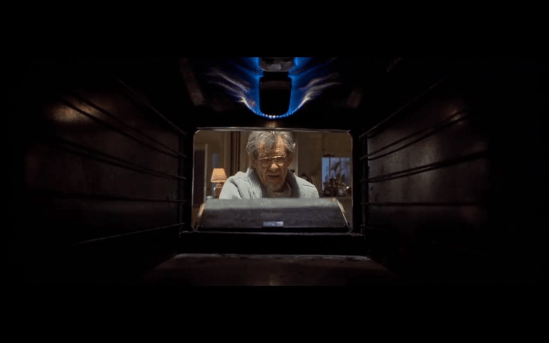
Next time you suspect your neighbor is a wanted criminal, they just might very well be as in the case of Todd Bowden, an excelling high student who discovers a WWII Nazi war criminal has been secretly living in his quaint hometown. Through his own investigation of photograph comparisons and retrieval of finger prints, Bowden confronts the old man, Kurt Dussander, about his notorious past. Living under a pseudonym and wanted by the Israeli government, Dussander attempts to dismiss the boy’s claims until his bluff to call the police is called, resulting in Bowden’s curiosity to become a blackmail gambit that puts Dussander under the student’s quizzical thumb. In return for not informing the authorities, Bowden requires Dussuander to reveal his story, the story of his stint at the extermination camps without sparing any details no matter how gruesome. Bowden even goes as far as purchasing a replica SS officer uniform that he forcibly commands Dussander to put on and march. Through his reminiscing of the past, an evil reawakens in Dussander and their banal friendship of psychological warfare goes into the dangerous trenches of survival and eradication that spreads like a cancer inside and outside their private lives.

Before the monumental eruption of continuous claims of sexual misconduct by various accusers, Bryan Singer furnished significant prominence as a director and overall filmmaker before he inadvertently kick started a very long, very successful, and very lucrative series of superhero films and their related and unrelated sequels and spinoffs, starting with Marvel’s “X-Men” in 2000…19 years ago, Holy sh*t! Well, in 1998, coming off his success of “The Usual Suspects” with fellow accused celebrity and now blacklisted actor Kevin Spacey and currently untarnished Irish actor Gabriel Byrne, Singer and Phoenix Pictures presented and released the suspense-thriller, “Apt Pupil,” a Bad Hat Harry production. Inspired by the Stephen King novella, “Apt Pupil” is the polarizing observation of two evil souls where one might be significantly eclipsing the other. Brandon Boyced (2005’s “Venom”) drafted a script based of King’s novella that was comprised of a different, and less pessimistic, ending to the novella while still uncompromising King’s baseline evil theme.

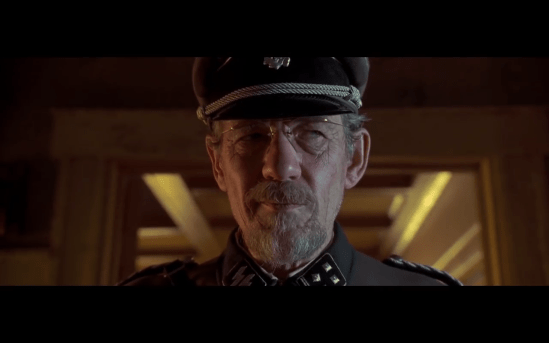
High school students, especially males, often have an aggressive temperament. Whether it’s sports, girls, or just trying to fit in, guys almost always take their tunneled focus to the extreme. For Todd Bowden, a brilliant young student, a fascination with the grim extermination of Jewish people and the Nazi culture tickled his fancy. Brad Renfro, only 14-years-old at the time of filming, stars as Bowden and really digs into the character’s adolescent psyche of relentless obsession, having his character converging all power from a big time war criminal and, even more simplistically, an older adult male, to himself, but when things go sour and Bowden starts to lose grip of his pawn, panic sets in and Kurt Dussander’s wicked and warped mind structures a counterattack that seemingly befriends the boy, but really demonizes Bowden’s already appalling obsession. Sir Ian McKellen, in a performance of pure brilliance, masterfully crafts a representative of evil in Kurt Dussander. The scene with McKellen stepping into a SS officer uniform and then marching with prerogative purpose that’s topped with a Nazi salute is perhaps one of the best chilling and unsettling performances of our lifetime. The dynamic in the scene between Renfro and McKellen, carefully shot and executed in direction by Singer, respects the bleak humanity enthralled by Stephen’s King body of literary work. There are some other amazing performances here by the supporting cast including David Schwimmer (“Friends”), Bruce Davison (“Willard”), Ann Dowd (“Hereditary”), Joshua Jackson (“Urban Legend”), Elias Koteas (“The Prophecy”), James Karen (“The Return of the Living Dead”) and Heather McComb (“Stay Tuned”).

As aforementioned, “Apt Pupil” has an evil duality narrative that contain descriptive horrors of the past, paints the means of callous obsession, and symbiotic necrosis of any good left in Todd Bowden or Kurt Dussander when together, but on the surface level, Kurt Dussander’s murderous duty to the cultural cleanse severely overshadows Bowden’s seemingly curious obsession, his blackmail of a notorious war criminal, his deception amongst those close to him, and, the inevitable, stony perception to murder. More than likely innocence could be blamed for the fact that Bowden is a child and Dussander’s a man living the last moments of his life, but Bowden becomes the catalyst for Dussander, reigniting the evil thoughts and actions of SS officer’s former life. Dussander attempts many degenerate actions from his past and never successfully succeeds in completing them whereas Todd ultimately finishes it either for Dussander, willing or not, or for his own self-preservation. By the end of “Apt Pupil,” the question you might ask yourself is how do you feel about either character? Despite the scale of their evils, which character ultimately, in the scope of Singer’s film from beginning to end, is the true representation of evil? To me, the finale feels like Dussander inadvertently passes the torch to Bowden and with his obsessive nature toward Nazism and extermination, the boy will grow up to continue being that representative of evil?

Umbrella Entertainment presents Bryan Singer’s adaptation of Stephen King’s novella, “Apt Pupil” onto Blu-ray home video. The region B, full HD, 1080p Blu-ray is presented in anamorphic widescreen, 2.35:1 aspect ratio, and the quality is crisp excellence with a sharp hi-def scan of textures and the details in Mckellen’s facial curvatures that just open up to expose the wily diabolical smirk from the vet actor. Coloring and skin tones are okay despite the release being slightly yellowish and inkier in comparison to other releases. The English 2.0 DTS-HD Master Audio does the job and is balanced all around with dialogue clear and present and the John Ottoman (“X-Men” franchise) is menacing without being overwhelming, but the ambience’s depth and range are stiffened from a lack of surround sound that could have been achieved with this release. The special effects are slim with a behind-the-scenes featurette that’s more surface level depth with cast brief cast and crew interviews and also includes theatrical trailer and TV spots. Viewers too caught up in the superhero hype might not recognize that Bryan Singer helmed “Apt Pupil” or might not even care in lieu of sexual accusations, but hardcore Stephen King fans and horror aficionados can certainly appreciate a blanket thriller with haunting performances that will be remembered more than the marring scandal behind-the-camera.

Might be a REGION 2 release, but still available on AMAZON.COM here in the states! Click the cover above to purchase 🙂

Sion Sono’s Brings the Evil Back to the Japanese School Girls! “Tag” review!


Life is seemingly pleasant and happy-go-lucky when two fully loaded coach buses of high school girls travel down a forestry passageway toward a lakeside hotel until sudden violence and gore turns Mitsuko’s classmates into minced meat. Overcome with shock and fear, Mitsuko escapes the terror only to find herself in another horrifying scenario. The vicious cycle continues as Mitsuko is thrusted into one chaotic, blood-splattering world after another, quickly losing her identity with each threshold crossing, and with no clue of what’s going on and how she got into this limbo of hell, Mitsuko must stay alive and unearth the truth behind the surreality of her being.

Nothing is more terrifying than being in a heart-pounding situation and not having one single clue why bodies are being sliced in half like corks popping violent out of champagne bottles, why childhood mentors break their professional oath and slaughter students with a ferocity of a mini-gun, or why being chased by a tuxedo-decked out groom with a gnarly pig head is in tow ready to drop kick anything, or anybody, standing in the way. Writer-director Sion Sono manifests that very chaos entrenched world in the 2015 action-horror “Tag” and, once again, the “Suicide Girls” director puts Japanese school girls back into the harrowed ways of gore and death over salted with an existential surrealism based off a novel by Yûsuke Yamada entitled Riaru Onigokko aka Real Game of Tag. Yamada’s story is followed more closely to that of Issei Shibata’s 2008 “The Chasing World” that involves a Government influence and parallel universes, “Tag” serves more as an abstract remake that Sono masters a soft touch of irrational poetry bathed in gore and strung with chaos rectified with a tremendously talented cast of young actresses.

Actresses such as the Vienna born Reina Triendl. Being Japanese doppelgänger to Mary Elizabeth Windstead with soft round eyes and the picturesque of youthfulness, Triendl transcends tranquility and innocence when portraying a content Mitsuko in the midst of many of her classmates boorishly bearing the typical, low-level adolescent anarchy. When Mitsuko’s thrusted into phantasmagorical mayhem, Triendl steps right there with her discombobulated character in an undried eye panicky frenzy whose character then spawns into two other fleshy vessels, a pair of recognizable names of J-Pop fandom in Mariko Shinoda and Erina Mano, when Mitsuko enters another zone in her fictional world. Though different in all aspects of their appearance and in name – Misuko, Kieko, and Izumi, the three women share the same existence and fathom a unbroken entity of character that hacks her way through the brutal truth. The remaining cast, Yuki Sakurai, Aki Hiraoka, and Ami Tomite, sport the high school miniskirt wardrobe and garnish a bubbly-violent J-horror persona very unique to the genre.

“Tag” is a plethora of metaphors and undertones likely to be over-the-head of most audiences, but if paying close enough attention and understanding the subtle rhythmic pattern of Sono’s direction, the gore and the fantastic venues are all part of an intrinsic, underlining message of feminism and sex inequality that’s built inside a “man”-made, video game structure thirty years into the future. Sono points out, in the most graphic and absurd method, how men treat women like objects or playthings. There’s also a message regarding predestination with white pillow feathers being the metaphor for fate and being spontaneous is the key to break that predestined logic and all of this corresponds to how Misuko, the main character, needs to break the mold, to choose her path, and to remember her past in order to free all the women trapped inside a male-driven purgatory of pain, punishment, and pleasure. Supporting Sono’s ability to disclose an epic survival-fantasy horror in such a way comes from multiple production companies, one of them being NBCUniversal Entertainment, providing the cash flow that allows Sono to flesh out the gore, to acquire massive amount of extras, and to scout out and obtain various locations.

Eureka Entertainment presents a dual format, Blu-ray-DVD combo, of “Tag” for the first time in the United Kingdom. However, the disc provided was a feature-only screener and a critique on the video, audio, and bonus material will not be conducted, but in itself, “Tag” is a full throttle encephalon teaser warranting a need for no supplementary content aside from conventional curiosity into what makes Sono’s “Tag” tick. When all pistons are firing, from the visual effects of Satoshi Akabane to “The Walking Dead” familiar score, “Tag” is no child’s game with a heavily symbolic, touch-and-go and bloodied pro-feministic essence that would serve as an abrupt and acute wakeup call to all the Harvey Weinsteins in the world that women are not to be simply playthings and that their gender destiny lies solely with them despite the misconstrued male manipulation.

This Is One Evil Bunny! “Bunny Und Sein Killerding” review!

vlcsnap-00001
An ambivalent group of people are under the relentless rampaging attack of a half man, half bunny. Kidnapped and given an unknown chemical cocktail, one man looking for creative inspiration in a quiet snowy woodland becomes forced to be the object of experimentation by armed and dangerous thugs, transforming him into a vicious hybrid seeking only one desire…fresh pussy. Shredding through every single body who stands in the beast’s path, the chances of surviving the snowy night dims rapidly in the isolated Finnish Mountainside. Under the sheath of dirty fur, the unstoppable creature runs wildly with large limp genitalia flailing about, ready to stick it anywhere and into everyone with, what constitutes as, a fleshy hole.
vlcsnap-00002
“Bunny und sein Killerding,” otherwise known in English as “Bunny the Killer Thing,” is an insanely phallic and deranged creature feature with special needs under the madness of director Joonas Makkonen. Based off of Makkonen’s short film of the same name with a noticeably different storyline, both inhabit a mythically outlandish villain with a raging hard on and mouth agape to swallow any bulbous genitalia that’s ready for the taking. If you couldn’t tell already, Joonas Makkonen is a Finnish native and, thus, the film comes straight from Finland’s snowy landscape. München, Germany distribution company Tiberius Films releases Makkonne’s pet Bunny project onto a region 2 DVD given the reason for the German title “Bunny und sein Killerding.”
vlcsnap-00003
Makkonen’s unorthodox and unpredictable story scratches at being bold and unprecedented with a maniacal furry woodland animal while still being relative with the typical tropes when creating a horrific atmosphere. When dissecting what the director does best, not one character has been penned to stand above amongst the group that continues a revolving door of hero and heroine perceptions, opening up possibilities for each character on all fronts to come forth for glory. A killer bunny with a veiny stiffy looking for the freshest of the snatches doesn’t even explain the absurd juvenility that went through the creation of this film. Yet at the same time, something has to be said about the endless amount of sleazy enjoyment being had into the viewing experience. A slimy guilt residue overtakes just one piece more of your remaining morality and innocence every time Matti Kiviniemi, in a shamelessly shoddy adult bunny outfit, twirls clockwise the at least ten-inch lifelike dildo in such a menacing and manic manner that it makes turning away from the screen that much HARDer.
vlcsnap-00041
However, there’s plenty to dislike about this particular release and none of the negativity originates from the 2015 Finnish film. The Tiberius Films’ heavily edited treatment of this release has been reworked toward a more anti gun violence propaganda film rather than a bunny rocking out with a large cock out. About four minutes, most of it gun violence, has been purposefully omitted, resulting in a slew of choppy scenes that are attempting to piece together a coherent story. If you’re like me and never seen “Bunny the Killer Thing” before, then you may not know much better, construing a mental story about how foreign films sometimes just like to be too artsy. I did have an inkling that an edited disc was in my possession and I was unfortunately correct. The first two acts are passable in the reassembled manner, but the last act has been reduced to nothing more than shambles of it’s true, gory self and, disappointingly enough, the edit loses the required connectivity tissue needed to fire up the necessary neurons of associating scenes with one another. Pivotal scenes are harshly given the editorial boot to remove any type of explicit gun violence, leaving all overly graphic and icky parts of “Bunny und sein Killerding” involving firearms are solely on the Germany theatrical trailer.

Cut Scene from “Bunny und sein Killerding”


“Bunny the Killer Thing” runs the horror comedy at an uncut 88 minutes, but the Tiberius Films upcoming Region 2 DVD and Blu-ray December release will clock in at a shocking 84 minutes. Fortunately, the DVD and Blu-ray will be presented in a widescreen 2.35:1 aspect ratio with a German and Finnish Dolby Digital 5.1 surround sound and a German DTS option. I won’t be able to critique either the audio or video qualities as I was sent a press screener only; however the Ari Savonen and Janne Andberg special effects and the creations by the visual effects teams along with Makkonen’s directorial style dares to be big production and reminds me a lot of what the Spierig brothers accomplished with their Aussie zombie film “Undead” in 2003. Bonus features consists of a theatrical trailer, behind the scenes featurette, and Makkonen’s 17-minute plus short film of the same title. A remarkable class act of Finland and British actors comprises the film’s lineup in this raunchy and violent horror comedy including a stunning, on-point beauty in Enni Ojutkangas, Jari Manninen, Orwi Manny Ameh, Veera W. Vilo, Roope Olenius, Hiski Hämäläinen, Vincent Tsang, Marcus Massey, Katja Jaskari, Olli Saarenpää, Maria Kunnari, and Matti Kiviniemi as Bunny the killer thing. British actors, you say? Yes! Much like the Bunny creature, the film’s a bit a hybrid itself when on the topic of dialogue. The DVD and Blu-ray will have German or Finland audio tracks with German subtitles, but the natural dialogue track will be a combination of Finnish and English! In conclusion, I watched the film, but, at the same time, I didn’t because of the extreme cuts, whether to discourage gun violence or for whatever reason, made to the original runtime that reduced the intended gruesome firefight ending to nothing more than incomprehensible scenes resembling an intense slap fight.

UNCUT TRAILER!