Black Mamba Wriggles Only for EVIL! “Venom” reviewed! (4K UHD and Blu-ray / Blue Underground)

Slither into “Venom” on 4K UHD and Blu-ray Combo Set!

American family, the Hopkins, live in London and while Mr. Hopkins travels the globe to attend to his international hotel business, Mrs. Hopkins and son Philip, live wealthy in their three-story row home along with visiting, Safari-expert grandfather Howard Anderson.  When Mrs. Hopkins plans a trip to see her husband after a month a part, she’s worries for Philip’s severe asthma attacks but with the assurances of the grandfather, the housekeeper, and Philip’s rudimentary zoo in his room, full of furry creatures in vivarium cages, Mrs. Hopkins half-heartedly boards her international flight.   Not everything is going to fine, however, when the housekeeper schemes with the family chauffeur and an Interpol criminal Jacmel to kidnap Philip for ransom.  The foolproof plot commences to plan with departure of Mrs. Hopkins and the arrival of Jacmel but one little mishap causes the plan to quicky unravel when a Black Mamba, one of the most aggressive and poisonous snakes in the world, is mistakenly crated and provided to exotic animal enthusiast Philip instead of his harmless ordered common variety garden snake and when the Black Mamba gets loose, it slithers in the house’s ventilation system, the house they’re all hold up in when the police swarm the outside perimeter. 

What was once going to be a Tobe Hooper (“Texas Chainsaw Massacre”) directed production before his eventual and sudden departure from the film after a few weeks, the 1981 crime-thriller with a creature feature twist, “Venom,” is then picked up by the late director of  “The Blood on Satan’s Claw,” Piers Haggard, to finish the Robert Carrington (“Wait Until Dark”) adapted screenplay off the Alan Scholefield novel of the same title.  The American screenwriter Carrington writes nearly a faithful iteration of the Scholefield novel but with more emphasis on the serpent’s over-lurking presence as an important reptilian character to the story, serving as a catalyst for the upended kidnapping plot and determining the fate of certain characters.  The UK film is American produced by Martin Bregman, the spear runner for “Dog Day Afternoon” and “Serpico” as well as “Scarface” and “The Bone Collector” later in his career.  Morison Film Group served as production company on the mostly LLC entrusted venture.  

If the American Tobe Hooper did helm this picture, directing Leatherface as an actor would been child’s play in comparison to what would had been if he had to corral a pair of strong-willed, A-type personality Europeans in Germany’s Klaus Kinski and Britain’s Oliver Reed, both with well-known and formidable career of not only in genre films but also to be problematic and difficult to work with.  The “Nosferatu the Vampire” and “Aguiree, the Wrath of God” Kinski was perhaps mostly misunderstood for his not understanding of inflections, innuendos, and gestures of the English language that made him often sounds gruff and antagonistically questioning the director’s every choice whereas the “Paranoiac” and “The Brood” Reed was plagued with alcoholism and was equally gruff in his own right as a dedicated actor saturation with austere method stratagem.  Yet, on screen, Piers Haggard manages to get the two hurricane forces to be on-the-edge cooperating, backed-into-a-corner kidnappers without cutting any tension when interacting with each other.  Distinct in demeanor, Kinski as a calm, trench coat KGB-type and Reed as an anxiously and trigger-happy, hotheaded brute put on a good show in their respective performances and beat the odds of two notorious personas colliding.  Haggard doesn’t coddle them either and lets them loose to exact the carrier in their own right even if off-book and they’re even more vilified by taking hostage a young boy Phillip, the introduction of Lance Holcomb (“Christmas Evil,” “Ghost Story”), his Safari-seasoned grandfather Howard Anderson, played by beard-laden and serial gesticulating Sterling Hayden (“Dr. Strangelove,” “The Long Goodbye”), and a zoo toxicologist named Dr. Marion Stowe who is caught in the middle when checking up on the mishap switcheroo of the snake, played by Sarah Miles (“Blow-up”), neither in shape or in vigor to be a proactive hero.  The no-nonsense Police Commander William Bulloch, shoed with “The Exorcist III” actor Nicol Williamson, a brazen candor and stoic expression with Williamson offering frank wit and a sarcastic dryness that barely gets him one step into the house; instead, it’s the Black Mamba that’s the real and unintentional hero that seemingly only has a fork tongue and fangs for villains, leaving the other hostages alone.  “Venom’s” also has Susan George (“Straw Dogs”) as the traitorous housekeeper, Mike Gwilyn, Paul Williamson, Hugh Lloyd, and the first Butler of the 1980s-1990s Batman quadrilogy Michael Gough playing real life snake wrangler David Ball in tribute. 
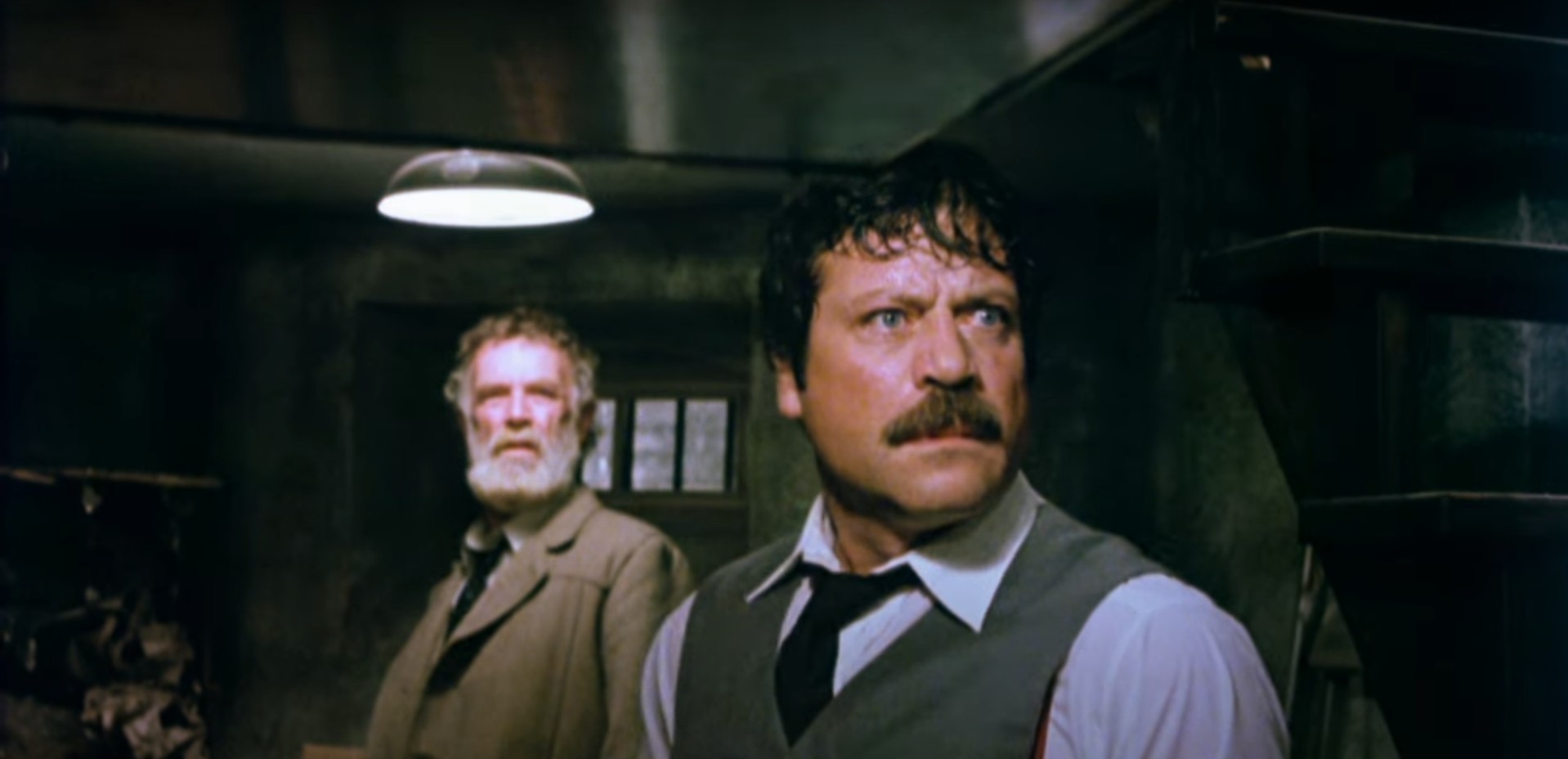
From the pages of Alan Scholefield’s novel to the big screen, “Venom” has a slithery way about slipping into between the crosshairs of a crime-thriller and a venomous creature feature.  Leading “Venom’s” charge is an undoubtedly great, if not iconic, cast giving their all to a farfetched plot of bad luck Ophidiophobia.  While the snake seems to have heat vision eyes only for the Klaus Kinski, Oliver Reed, and Susan George trio of kidnap-for-ransom criminals, who amongst themselves are in a deceitful love triangle that’s doesn’t quite come to a head as one would expect, there’s no animal kingdom peril to the other victimized threesome who, on a physical, first glance surface, are less equipped to handle a dangerous snake with a young, asthmatic-plagued boy, an elderly grandfather, and a nerve-bitten woman but, in reality, Phillip Hopkins, Howard Anderson, and Dr. Marion Stowe are respectively the best equipped to handle the black mamba as an small animal atrium hobbyist, a former African safari survivalist and animal expert, and a venomous snake toxicologist.  Perhaps, this is why the Black Mamba avoids these three at all costs and never interacts with them on a perilous level.  The fantastical mist that’s sprays us lightly with a crimefighting snake has comical properties that standout against what is a palpable thriller involving an international criminal, cop killing, child abduction, and the mutilation of a corpse. 

Blue Underground continues to update their catalogue with a 2-disc, 4K UHD and Blu-ray combo set of ‘Venom.” The UHD is HVEC encoded, 2160p ultra-high-definition, BD66 and the Blu-ray is AVC encoded, 1080p high-definition, BD50. In regard to picture quality, both formats are nearly identical transfer that’s stems from an all new 4K 16-bit restoration from the original 35mm internegative, with the UHD receiving Dolby Vision HDR. UHD is slightly sharper around delineation when gliding between dark and light, which is often inside a merge of a half-lit house to draw more tension toward the potential presence of a deadly snake. The 1080p presentation also provides a pleasing clarity that offers little to negatively note. Color grading and saturation between the two formats show signs of varying quality by a thread with the 4K saturating that much more intently across the board with a better control over the grain levels with the Blu-ray appearing a touch thicker for the pixels to flare optically. The native 4K and 1080p come with an English Dolby Atmos as well as options for either an English DTS-HD 5.1 or a DTS-HD 2.0 stereo. Speaking only to the Atmos, the all-encompassing mix shepherds in a clean, discernible quality without any audible seams. Skirmishes, dialogues, and all the commotions in between find isolated channels of distinction that can put you immerse you into the action. And there’s plenty of action to be had coupled with a Michael Kamen’s brass horn and string score that’s both memorably building with excitement and thrilling that preludes Kamen’s orchestrated composition work of “Die Hard,” starring Bruce Willis. Despite the circumference of sound spaced mostly in interiors with a hodgepodge medley of a street full of police, reporters, and gawkers, the dialogue is equally distinct, discernible, clean, and clear without signs of hissing and crackling strains. Subtitles included are in English, French, and Spanish. The 4K special features include a new audio commentary with Film Historians and Blue Underground commenting regulars Troy Howarth, Nathniel Thompson, and Eugenio Ercolani, an archived commentary with director Piers Haggard, and film trailers. The Blu-ray disc contains the same commentaries and trailers but extends further with new exclusives in an interview with editor-second unit director Michael Bradsell Fangs For the Memories, an interview with makeup artist Nick Dudman A Slithery Story, a film historian point of view interview with British critic and author Kim Newman, and an interview with The Dark Side’s Allan Bryce providing his in-depth two cents and historical surveying. TV Spots are finish out the encoded extras. “Venom” 4K and Blu-ray combo set is physical appeasing to hold and behold with a muted black slipcover with tactile elements on both sides of embossed letters and stark coloring that’s striking in its simple snake fang design arraignment. The black, thick Amaray case has the original “Venom” artwork with the optional reverse cover art. I’m not a fan of the inside design that houses a disc on both sides as there is no room place for 18-page collectible, color picture booklet which just floats inside. The booklet features an essay by Michael Gingold, cast and crew acknowledgements, and chapter selection on the back. The discs are pressed with one or the other cover arts. This gorgeous-looking release, on the outside and inside, comes region free, has a runtime of 92 minutes, and is Rated R.

Last Rites: “Venom” might have been snakebitten back when selling book adaptations of crime capers stopped by a single snake might have seemed farfetched but, today, the 1981 film remains a cult classic of the ophidian nature being one of the earliest serpentine creature features with an imposing, impressive cast. Blue Underground proudly presents the film with a new, and improved, ultra high-definition release.
Slither into “Venom” on 4K UHD and Blu-ray Combo Set!

Interrogating EVIL Mounts to Hundreds of Deaths. “Confessions of a Serial Killer” reviewed! (Unearthed Films / Blu-ray)

An Unearthed Classic Now Available on Blu-ray! “Confessions of a Serial Killer”

Daniel Ray Hawkins drives an unsettling, nomadic lifestyle as he travels across different parts of the country.  With no money, no place to call home, and little friends, Hawkins lives a life of mostly solitude, odd jobs, and equally as strange as him acquaintances spurred from his childhood, shaped by his promiscuously prostitute mother and a war veteran disabled father who gruesomely took his own life, both of which displaying their iniquities right in front of him.  Hawkins also lives a life of torture and murder, being one of the most prolific American serial killers ever of mostly young women.  When caught by authorities, Hawkins is willing to confess to everything and help unearth bodies from over decades on the road to ensure families he’s stolen from receive some sliver of solace.  His anecdotal accounts of individual disappearances and murders shock authorities to the core, so much so that Hawkins may just be unstable and not telling the truth.  That is until he informs them of and leads them to the cached polaroids and decaying corpses. 

Based on the American serial killer Henry Lee Lucas, who notoriously claims killing over 200 people has earned him a trio of film adaptations, at least, with “Henry:  Portrait of a Serial Killer,” directed by John McNaughton and starring Michael Rooker in the titular role, the subsequent lesser part II, and the more obscurely known Mark Blair written and directed production, “Confession of a Serial Killer.”  Much like “Armageddon” and “Deep Impact,” or “End of Days” and “Stigmata,” both movies fall into the paradoxical twin film phenomena of sharing the same them and having both been released approx. within a year of each other.  While “Henry:  Portrait of a Serial Killer” may have taken the top spot with a bigger budget played in more widespread venues, Blair’s rendition was released prior and closer to Lucas’s active killing spree that saw an end in 1983, just didn’t get released in America until a few years later to not duel with McNaughton’s film and thus didn’t succeed as much.  The Cedarwood Productions film was produced by Cecyle Osgood Rexrode, distributed by Roger Corman and his company, Concorde Pictures. 

While he was not the first choice for the titular character of Daniel Ray Hawkins, production designer, the late Robert A. Burns, filled in the sociopathic shoes with great monotonic conviction.  Burns, who has ties as Art Director and makeup effects on some of the most iconic and seminal genre films, such as “The Texas Chain Saw Massacre,” “The Hills Have Eyes,” and “Tourist Trap,” matches the makings of an unempathetic, unsympathetic, natural born killer with a glazed deadpan austere and matter-a-fact knowledge and every evil committed.  “Confessions of a Serial Killer” would not be as laced with depravity if Burns didn’t push the demented drugs to keep audiences hooked on overdosed deviancy.  Not a tall or broadly muscular stature, curly outstretched and receding hair, scruffily unshaven with a consistent 5 o’clock shadow, and wide rimmed glasses, Daniel Ray Hawkins epitomizes the very essence of a creep and accentuates the behavior even further with his leisurely composure and straight-faced simplicity.  Other side characters exist around Hawkins’ maniacal run with the bisexual Moon Lewton (Dennis Hill) and his sister Molly (Sidney Brammer), who marries the pansexual Hawkins out of necessity rather than sexual desire, and while Moon and Molly share Hawkins deranged apathy, they are completely overshadowed by the more controlling and interesting lead principal character due to half the murderous anecdotes are solo ran and all of the perception in the stories is through Hawkins’ recollection, giving him more power in the trio in perceptional self-interest, if Hawkins is capable of such consciousness.  The cast fleshes out with lawmen and victims in Berkley Garrett, Ollie Handley, DeeDee Norton, Demp Toney, Eleese Lester, Colom L. Keating, and Lainie Frasier in the opening stranded motorist scene that sets up Hawkins diabolical reach in turning a car into a trap. 

Bathed in realism, “Confessions of a Serial Killer” does not embellish with surrealistic temperament.  The story never dives into Hawkins’ head to show any indication or any kind of visual mental degradation or reality breakage toward being a coldblooded killer.  His violence is spartan, acidic, and raw to the bone, leaving a gritty taste in your mouth, with only a bleak childhood to blame for his adult obsessions to kill that he describes as necessary as breathing.  Blair distills the story to a “Mindhunter’” episode in trying to understand the killer and recover skeletons from his past, literally, through rational and respect ways rather than boiler room beatings and power-tripping threats.   Blair’s concept humanizes the inhuman and having Hawkins’s reminiscence each account is like recalling childhood memories with a smirk and fond remembrance splayed across his face adds another layer of iciness.  Grounded by pedestrian scenarios, “Confessions of a Serial Killer” disrupts the routine, the familiar, and the unscripted ways we live our lives unconsciously to the fiends living among us that look like you or me.  It’s a very palpable fear Blair conveys under the semi-biopic film.  The director does eventually let loose the reigns in the final third act with a finale account of Hawkins, Moon, and Molly shacking up with an amiable doctor, his suspicious assistant, and his shapely young daughter that boils to a head when one bad decision leas to another. 

For the first time on Blu-ray anywhere as a part of Unearthed Films’ Unearthed Classics sub-banner, “Confessions of a Serial Killer” receives a high-definition, 1080p release on an AVC encoded, single ring BD25.  Higher contrast and a lesser diffusion to create a harsher, flatter color scheme, the intention is to fully base the story in reality as much as possible, to structure an abrasive look of grain and low lighting that parallels the seediness the tale touts. inspired from the facts of an American serial killer without having to fully give recognition to the actual killer.  Shadows are key to Hawkins nightly runs, adding back-alley value to his viciousness, and the more lighter scenes, such as brighter-by-color interiors or day exteriors, are ample with natural grain that cut into the details but don’t necessarily knock them out entirely.  With the lesser capacity disc, compression doesn’t appear to be an issue with no sign of macroblocking, banding, or posterization. The English language LCPM 2.0 mono possesses lo-fi aspects kept true to the original audio master. The dual-channel conduit amasses the layers mostly in the forefront without ascendancy in the environment, creating a flat approach, rendering the audio mostly fixed and depthless with the action creeping onto the dialogue, but this also adds the realism of a real world chaos where cacophony reigns. William Penn’s effectively, inlaid soundtrack has hallmarks of Wayne Bell and Tobe Hooper’s “Texas Chain Saw Massacre in the minor key with added notes of an otherworldly tune fork keyboard and lingering bass elements that’s just infests with the sounds of deceit and death, reminding me also a lot of a George A. Romero’s “Night of the Living Dead’s” atmospheric arrangement. English SDH are an available option. The collector’s edition contents include a commentary with director Mark Blair, aka John Dwyer, director of photography Layton Blacklock, and actor Sidney Brammer (Molly), The Henry Lee Lucas Story by author and former TV news reporter James Moore, and a full-lengthy documentary Rondo and Bob examines Robert Burns being the foremost expert on uniquely deformed actor Rondo Hatton as well as examines Burns’ own career, a polaroid gallery, promotional gallery, and the trailer. Displaying the iconic poster, a profit from rip of Hannibal Lector with a devilishly masked killer behind bars, Unearthed Films’ releases the stark image onto a planar cardboard slipcover. Same image is used from the standard Blu-ray Amaray case with no reverse side. Disc is pressed with a memorable and anxiety-filled chase scenes. There are no inserts material included. The region A encoded Blu-ray has a runtime of 107 minutes and is unrated.

Last Rites: One of the better biopics on U.S. serial killers even if a little bit of speculation and sensationalism increases the already verbose notoriety of one Henry Lee Lucas. Scary and bleak, “Confessions of a Serial Killer” continues to remind us that no one is safe from the everyday sociopath.

An Unearthed Classic Now Available on Blu-ray! “Confessions of a Serial Killer”

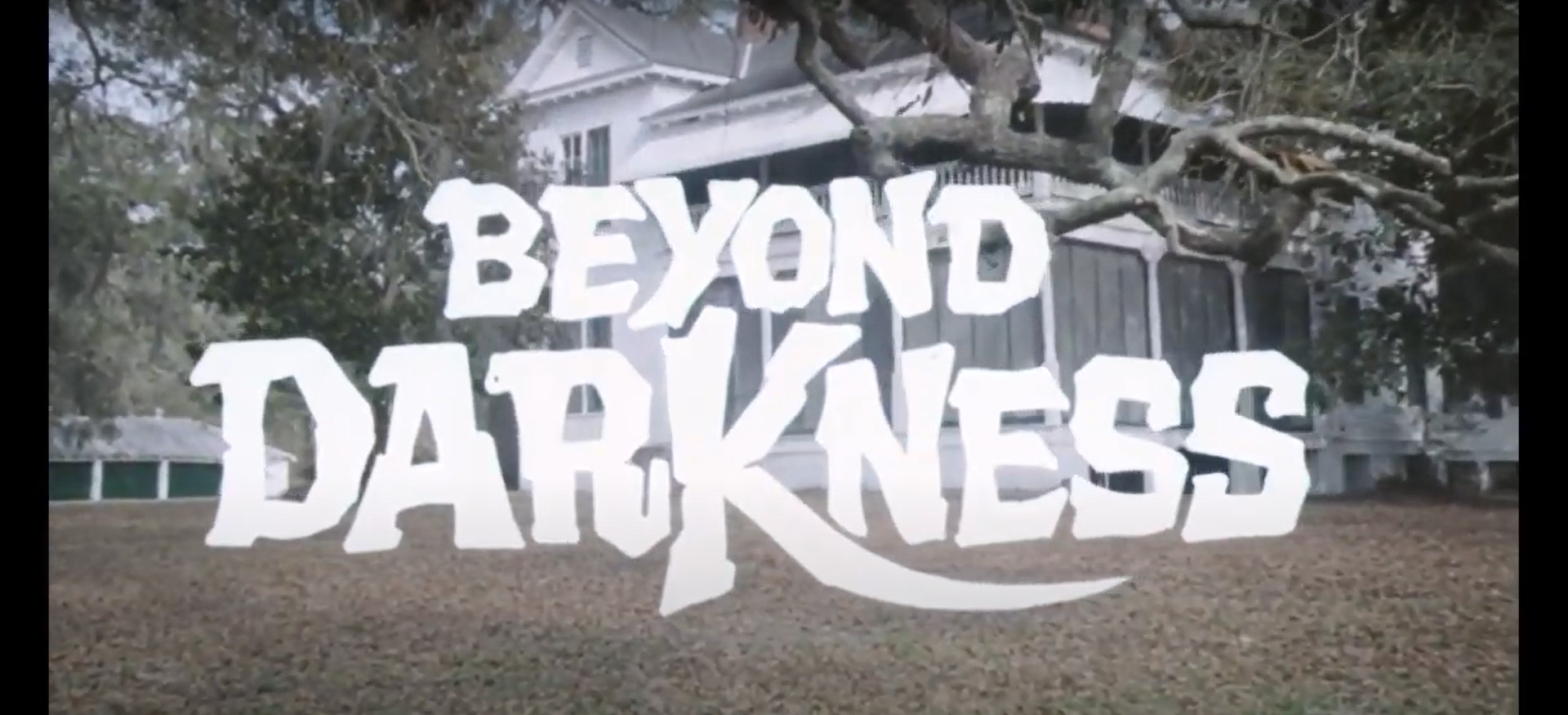
Don’t Mind the Glowing, Ominous Hole in the Wall. That’s Just a Gateway to Evil. “Beyond Darkness” reviewed! (Severin / Blu-ray)

A witch acolyte of Ameth, an underworld demon, is executed on multiple counts of child murder.  The priest who oversaw the witch’s last rites came in with a doubtful heart and upon researching Ameth through an unholy book, disavowed his own religion only to fall into a near drunken stupor of atheism.  Months later, a new priest and his family move into a home arranged by the archdiocese, but soon after settling into the old house, a series of disturbances point to a closed in wall behind a door that’s uncovered to be a gateway to another plane of existence; an existence where the child killing witch is granted access to seek the souls of the priest’s young children.  Fighting with his own struggles of faith, the ex-Jesuit assists the priest and his family in an attempt to cast out evil once and for all. 

Perhaps common knowledge amongst diehard horror fans, but not so much among the casual curiosities of an oblique coursed moviegoer is the fact that “Beyond Darkness” and Sam Raimi’s “The Evil Dead” share a cinematic series connection.  Well, not one in any official capacity one at least.  Drained from the same bloody vain that unofficially corrals Lucio Fulci’s “Zombi 2” as a sequel to George Romero’s “Day of the Dead,” retitled in Italy as “Zombi,” the American-made, Italian-orchestrated “Beyond Darkness” too fell upon the slew of Italian title changes sword with a rechristening into the “La Casa” series.  With the success of “The Evil Dead” in the U.S., Raimi’s video nasty was renamed to “La Case” and “Beyond Darkness” became the fifth “sequel” in the series as “La Casa 5.”  Since Italy has no copywrite laws, a light breeze can easily change any filmic title.  Even the director, Clyde Anderson, dons a false pretense as the Americanized alter ego of Italian director Claudio Fragasso.  The “Scalps” and “Troll 2” Fragasso pens “Beyond Darkness” with longtime script confederate Rossella Drudi, under the Sarah Asproon pseudonym.  “Beyond Darkness” is shot in the deep American South of Louisiana under the Joe D’Amato (aka Aristide Massaccesi) founded Filmirage (“Anthropophagus: The Grim Reaper,” “Deep Blood”), produced by D’Amato, as the Filmirage Production Group.

While behind the camera is mostly an Italian production team, in front of the camera is a cast of American and English actors with an opening Louisiana penitentiary pre-execution theology debate between Bette the witch, played by Mary Coulson, and Father George, a priest having a crisis of faith, played by one of D’Amato’s regulars in English actor David Brandon (“StageFright,” “The Emperor Caligula:  The Untold Story”).  Coulson’s role may be punitively small as the “Beyond Darkness’” lead witch and predominant face of the core evil, but the actress puts all into the Bette character comprised of a maniacal laugh and a lots of very European skin-tag makeup effects whereas the classically trained David Brandon has an array of lively emotions and facial expressions sized to fit Father George’s clerical shirt and white tab collar when he’s not sloshed with doubt.  Both characters interweave into the life of a new-to-the-area priest, his wife, and two kids who move into an old house, built on unholy ground, to start his new chapter in priesthood.  Days later, as the kids become instantly okay with a giant black swam rocking horse in the middle of their bedroom, the family is terrorized by flying kitchenware, flooded with a bayou mist, and frightened by figures in black, tattered shrouds seeking to steal their children’s souls.  Christopher Reeve’s lookalike Gene LeBrock (“Night of the Beast”) fails at double father duty in his poorly lit excuse of a worried father with his children being lured to the realm of the spirit side and as a grounded in faith Father combating the forces of evil without a solid sense of what to do.  Both parents are equally written off as incompetents who continue to stay in the house despite on the continuous threat of Baba Yaga wannabes knocking at every door in the house.  As the mother, Barbara Bingham felt as if she had a little more skin the game.  Perhaps having just come off the legacy success of a “Friday the 13th” sequel (“Jason Takes Manhatten”) she felt the responsibility of maintaining a more diligent approach toward being a mother coursing through occult’s dire straits.   Michael Paul Stephenson (“Trolls 2) and Theresa Walker excel much better in their roles as the two kids, Martin and Carole, who’ve become the centerpiece of Bette’s maliceful desires. 

“Beyond Darkness” will come across as very familiar amongst both horror fans and fans of movies in general with a story pulling inspiration from films like William Friedkin’s “The Exorcist” and Tobe Hooper’s “Poltergeist.”  Fragasso picks and chooses a blanket of trope elements to rework with great malleably in order to not be a total copy.  However, for those who know anything about low-budget Italian horror, Fragasso’s rousing similarities to major and independent hits should come as no surprise.  Notoriously renowned schlock horror directors Joe D’Amato and Bruno Mattei, amongst a sea of others, use to fabricate out of fame at every opportunity by gobbling up successful films, chewing them up, and spitting out their Italian produced counterparts without a second thought just to cash in on just a fraction of the original narrative’s success.  The way I see it, the method was (and still is) an honorable form of flattery. Yet, flattery doesn’t cure sloppiness and “Beyond Darkness” is about as sloppy as sloppy joes. Plot hole after plot hole stack up on Fragasso’s inability to amalgamate elements in an entirely coherent way. There are underwhelming revelations to anticipating character build ups that fizzle; such as a thick-tension mystery behind the local archdiocese and their involvement to place a good Christian family in a house built on evil land or what precisely convinced Father George of Ameth’s power to sink him into an alcoholic pit of despair? I already mentioned Martin and Carole’s inept parents on not fleeing the house at first sign of poltergeist activity or any activity since then so don’t get me started. The story needs some fine tuning but not after is amiss. The acting is not entirely a humdrum of monotony, Carlo M. Cordio’s eclectic synthesizer riff and haunting keynotes score is on another level akin to a composition pulled right out of a survival horror video game, and Larry J. Fraser, another one of Joe D’Amato’s pseudonyms, has an honesty about his scenes unlike we’ve ever seen before in a D’Amato production as the cinematographer captures the fog luminously and effervescently surrounding and chasing the family from out to in.

“Beyond Darkness” is no “The Evil Dead” but is a solid demon and ghost dog and pony show from 1990. Now, the Claudio Fragasso (or is it, Clyde Anderson?) classic is heading straight to your level room television set with a new 2-disc Blu-ray. The hardcoded Region A is presented in widescreen 1.66:1 aspect ratio in a full high definition and 1080p resolution. With only a possible color touch up here or there, I would venture to say the transfer used is the most pristine copy with hardly any damage or any age deterioration. The grain looks amply checked and no cropping or edge enhancing at work in an attempt to correct any issues, if any ever existed. Severin offers two audio options: an English language DTS-HD master audio 2.0 and an Italian dub of the same spec. With dual channels, there retains an always room for growth inkling and with the film’s broad range in sounds, a difficult to swallow lossy audio pill plays the aftertaste tune of, man, this could have been way better. Yet, the track is solid enough, if not more so, with virtually zilch damage. Dialogue comes across clean and clear, but there tails some minor hissing. Like with many Severin releases, new interviews are the star of the special feature show with one-side, talking head interviews with writer-director Claudio Fragrasso Beyond Possession, co-writer Rossella Drudi The Devil in Mrs. Drudi, and actor David Brandon Sign of the Cross. Though the theatrical trailer rounds out the first disc special features, Severin also includes Carlo M. Cordio’s superb soundtrack as disc number two along with a two-page booklet with an introduction to the ingredients of a horror score and to Cordio himself as well as a listing of all 17 tracks. “Beyond Darkness” is Claudio Fragrasso’s unbridled mutt, a motley of motion picture royalties rolled up into an adulating and piggybacking horror beyond comparison.

“Beyond Darkness” 2-disc Special Edition Blu-ray Available on Amazon

War Brings All Sorts of EVIL. “Under the Shadow” reviewed! (Second Sight / Blu-ray)


Set in conflict of the Iran-Iraq war, the young and educated Shideh living in war-frightened Tehran becomes forced to succumb to patriarchal dogma after participating in a revolution against Iran’s standing principals. Her husband’s conscription sends his medical experience to the battle front while she settles into her role as a stay at-home mother to their young daughter and despite pleas from her husband, the stubborn Shideh will not vacate her apartment building home even when the threat of an Iraqi attack is imminent. When a dud ballistic missile crashes into the apartment about them, nearly breaking through their ceiling, the fear of a sinister presence circulates amongst the tenants that drives them one-by-one from the building with the prospect of an Iraqi attack to further motivate as a logical decider. An unsuperstitious Shideh remains until her daughter’s imagery whims and unwavering fever begin to form a more terrorizing atmosphere that even has her questioning the shadowy company of evil.

Not many horror films scare nowadays. “Under the Shadow” is not one of those films. The debut feature film of writer-director Babak Anvari posses a rare commodity of grueling fear set inside an already tense backdrop of the 1980’s Iran-Iraqi war. Anvari, the Tehran born Iranian nationality who was engulfed religiously in the culture, borrowed and rendered his from his family’s stories of supernatural pre-Islamic demons whisking through the wind toward those swimming in sorrow and fear; those demons were also labeled djinns. As a child born in the 80’s, Anvari had to rely and family to obtain a sense of the anxious air suffocating those taut by potential missle strikes as well as political and social punitive measures going against the grain. The UK based independent production company, Wigwam Films, financed the BAFTA winner for an Outstanding Debut by a British Writer, Director or Producer as well as receiving other nomination nods in other categories, serving as one of young production company’s shining stars early in the tenure.

Wrought by the explosive squabbles of two sovereign nations and incepted with archaic folklore, Shideh’s bound and torn between reality and the prospect of superstition, a role dutifully played by another Iranian born, Narges Rashidi, whose family moved to Berlin and she studied acting, scoring a minor role in the motion picture adaptation of the science fiction television series, “Aeon Flux,” and in the 2009 comedy-horror “Must Love Death.” Rashidi courts Sheideh approvingly with sincere strife over how women serving beneath men in 1980’s Iran as well as struggling to overcome that internal conflict as the mirror image of herself, meaning her daughter, when a phantom prowler is afoot. Portraying Shideah’s daughter, Dorsa, and the frequent link between the Djinn’s world and her own is Avin Manshadi in her debut performance. Manshadi’s round cheeks and doughy eyes set upon a physique stilling lingering some ounces of baby fat has little range, but most creepy kids and in creepy kid horror films rarely do. Rashidi and Manshadi fend well for themselves as the sole two characters cornered by war and Shideh’s personal vendetta against her country, her husband, and even her daughter to prove she isn’t useless as the motif lets on. “Under the Shadow” rounds out with Bobby Naderi (“Bright”), Aram Ghasemy, Soussan Farroknia, Behi Djanati Atai, and Ray Haratian (“A Girl Walks Home Alone At Night”).

“Under the Shadow” finds itself in a subgenre nearly all it’s own as the variety of djinn-horror anemically pops up every so often as an unpopular and uncoiled viper, unlike the antagonist powerhouses of zombies and ghosts that’ve reigned supreme over the last two decades, and though Anvari’s film shares little with Robert Kurtzman’s demonic djinn of 1997’s “Wishmaster,” “Under the Shadow” has more in common with the late Tobe Hooper’s last film, entitled simply Djinn, before his death. Both are built on the substructure of an Arabic/Muslin mythology, set on an apartment building locale, and exhibit the malevolency side of the djinn, but Babak Anvari accomplishes a great feat on his very first attempt – a stiffly frightening air of a phenomenally harrowing horror story. Anvari patiently stacks blocks of tension, one on top of another, without a hint of quivering throughout the acts and what’s more astonishing is that all the acts deliver different notes prosed to detail that secures a simmering, shivering plot. To praise Anvari more, the young filmmaker leaves nothing to chance by closing with an open ending for the mind to assemble information and interpret the events; a classic directorial tool used by some of the greats.

Shuttering in the dark has never been so delectable with “Under the Shadow” inside a packed, limited edition Blu-ray from Second Sight Films. The LE runs with only 2000 copies sheathed inside a rigid slipcover with covert art by science fiction artist, Christopher Shy. Global horror aficionados will rejoice to learn that the UK BD disc is region free and presented in a widescreen, 2.39:1 aspect ratio, that’ll be available February 10th. Unfortunately, Second Sight Films provided a DVD-R Blu-ray screener so I’m unable to speak upon the video and audio aside from what’s already been stated. I will say the subtitles were accurate and timely paced. There were special features on the disc, including segmented interviews with director Babak Anvari, lead actress Narges Rashidi, producers Lucan Toh and Oliver Roskill, cinematographer Kit Fraser along with an audio commentary Babak Anvari and Jamie Graham and Anvari’s short film “Two and Two.” Press release also mentioned the release includes a soft cover book with new essays from Jon Towlson and Daniel Bird plus behind-the-scenes photos and concept illustrations and a poster featuring new artwork. “Under the Shadow” must be watched in the dark, alone, and with the volume up, maximizing the crawling chill down the spine and raising all the micro hairs on every square inch of skin.

The Myth. The Legend. The Evil…. “Leatherface” review!


Texas 1955 – the pride of the Sawyer family was not their tattered farm, but a bloodline taste for something else – callous murder and a penchant for human flesh. Verna Sawyer sought to instill that pride into her children, especially her youngest, Jed, but when Hal Hartman, hard nose local Sheriff, learns that his daughter becomes victim of the Sawyer’s suspect nefarious carnage, he executes the law to his advantage, deeming the Sawyer house unfit for children and removes Jed from his labeled degenerate mother Verna. Ten years later, a group of teenage patients escape a mental hospital, kidnap a young nurse, and reek bloody havoc in their voyage to Mexico in an attempt to elude the very same lawman who put them away, but this time, Hartman isn’t adhering to the law, straying off his moral compass to pursue a vengeance mission against unprincipled youth that’s personally driven by Jed and the Sawyer family. Once the embattled Hartman catches up with his prey, a series of gruesome events lead to the creation and the construction of one of the most notorious killers Texas will ever see.

I love a good origin story. There’s something to be said about understanding the commencement of character, to be in the shoes of a long running icon, and to be able to sympathize with their story no matter how atrocious. Directors Alexandre Bustillo and Julien Maury’s 2017 “Leatherface” does just that with the film’s own origin enlightenment on how the chainsaw wielding, human skin mask wearing psychopath came to fruition inside a home of unspeakable brutality and influenced externally by a unforgiving society. From a script penned by Seth M. Sherwood, “Leatherface,” serving as a direct prequel to Tobe Hooper’s “The Texas Chain Saw Massacre,” briefly touches upon the preteen years to setup the catalytic road trip from hell, birthing a monster in a time of adolescence and if part of a legacy spanning over forty decades inspired by Ed Gein, the real life human skin wearing and notorious serial killer, then you damn well know “Leatherface” has to be genetically predisposed to be ultra-violent drenched in blood splatter. The French filmmaking duo, who’ve helmed 2007’s “Inside” and had directed the “Xylophone” segment in “The ABCs of Death 2,” nail the dark and gritty tone that not only breathes a gassy and exhaust fumed life into a massive flesh-ripping chainsaw, but also inflicts heartlessness across the story board into a heartfelt homage to the characters and to the story fathered by Kim Henkel and the late Tobe Hooper, both of whom were attached as executive producers.

Over the years, many actors have held the mammoth power-drive cutting tool in their hand that’s ready to chip away at flesh such as Andrew Bryniarski (“The Texas Chainsaw Massacre” 2003 remake), Bill Johnson (“The Texas Chainsaw Massacre 2”) and, most famously, Gunnar Hansen, the original Leatherface. However, I’m not going to divulge who the pubescent Leatherface is in the story because the film plays out as a who out of the group of degenerate teens is the son of Verna Sawyer, even though you can easily obtain the information in a simple click and search on Google. Instead, Sam Strike, James Bloor, and Sam Coleman portray the three escapees who are accompanied by an equally insane sociopath in Jessica Madsen and an eagerly novice kidnapped nurse by Vanessa Grasse. Amongst a sea of English actors are a pair of vets to shepherd the young cast and be the embattled bookends to the dawn of an icon. Lili Taylor (“The Haunting”) and Stephen Dorff (“Blade”) face off as Leatherface’s mother, Verna Sawyer, who butts horns with a longstanding sheriff, Hal Hartman, with a steadfast vendetta against the Sawyer family. Christopher Adamson (“Razor Blade Smile”), Nathan Cooper (“Day of the Dead: Bloodline”), and Finn Jones (“Wrong Turn 5: Bloodlines”) co-star.

Usually with a pair of directors, two different styles spawn to an end result. With Bustillo and Maury, styles merge into a seamless effort of elegant wonders. Each shot emerges a purpose to the story whether it’s painting an image of the Sawyer’s death house to pulling a one-eighty with characters, the filmmakers ability to combine each element into a single story, that has such a close knit cult following, and still manage to cinematically pull off the atmosphere, the grit, and the gory carnage of a Texas Chain Saw Massacre film is impressive. Cinematographer Antoine Sainer, whose worked previously with the directing duo on the “The ABCs of Death 2’s” segment “X,” has the ever so poised eye that’s able to well-round and solidify Leatherface’s terror tenor, particular exampled in a foot chase scene through a moonlit forest, smoke bellowing out of a growling chainsaw, and a tattered young girl bawling, screaming, and fleeing for her life from a deranged masked killer whose huffing, snarling, and growling during the pursuit.

Lionsgate Home Entertainment presents the Millennium Films produced “Leatherface” onto Blu-ray + Ultra-violet combo disc, a MPEG-4 AVC encoded disc with a 1080p resolution and presented in a widescreen, 2.38:1, aspect ratio that displays the Bulgaria landscape in a yellowish-brown, Texas-like backdrop. Details are noticeably fine that exquisitely reveal the death and destruction of the Sawyers and those who unfortunately surround the family. The English DTS-HD Master Audio 5.1 track evenly distributes and consistently a range of engrossing fidelity, ambient, and dialogue layers. Bonus material includes a play feature with an alternate ending that’s less superior in contrast to the final product, deleted scenes, and a behind-the-scenes making of that includes brief interviews with directors Alexandre Bustillo and Julien Maury, actors Sam Strike, Stephen Dorff, Lili Taylor, and others, and goes behind the scenes in creating the tone and style of “The Texas Chain Saw Massacre” while implementing their own vision. “Leatherface” forces the unsavory and unpleasant down the throats of TCM fans, jamming an attempt to exposition a futile chance to a destined maniac of cannibalistic proportions and manages to mix up the Tobe Hooper’s weathered franchise with a barbaric bruiser of a tale.

“Leatherface” on Blu-ray! Buy it here, today!