

An ambitious physics professor Hiram Otis obtains a research grant that requires him to study in England, pulling his wife, daughter, and two young boys from their Indiana home into a strange new world. In an age of obsolete aristocracy, the Otis family is able to afford rent at the grand Canterville Hall, a legendary castle with an infamous tale of death and suspicion that also might have resulted in being an affordable estate for the American family. Legend records have it that the lord of the castle, Sir Simon de Canterville, had subsequently killed his wife due to his obsessions and became the victim of his wife’s family spiteful vengeance by being chained to a dungeon cell. For 400 years, Sir Simon remained in that cell and his ghost haunts Canterville Hall, but despite their beliefs in the supernatural, the physics professor and his wife can’t see the ghost and only their teenage daughter and two young boys are able to witness him roam the halls, haunting those who live within the castle walls.

Every once and awhile, we’ll thoroughly review a light-hearted fantasy, horror, or sci-fi film and since we’re hot off the heels of the review for Wes Craven’s “Summer of Fear,” the made-for-television train might as well keep chug-chug-chugging alone with the 1996 TV movie adaptation of the Oscar Wilde novella, “The Canterville Ghost.” Distributed by ABC, the Sydney Macartney (as Syd Macartney) directed and Robert Benedetti teleplay written installment tries to differentiate itself and standout amongst a plethora of adaptations that span across the globe, but the American Broadcast Company, a subsidiary of the great and powerful Disney, aimed to separate from the masses by adding star studded power and the result brought a rejuvenation to the ye old tale over two decades ago.

The big name headliner is none other than Captain Jean-Luc Picard himself, Patrick Stewart, two years after his 7-year stint on Star Trek: The Next Generation. Stewart, who co-produced the film, adds his theatrical flair and is absolutely brilliant shaping drama monologues into dense thickets that define Sir Simon de Canterville’s ghost, but there’s an issue; the problem doesn’t lie with Patrick Stewart, but with how Benedetti’s teleplay expos from the story as a continuous, if not slightly jumbled, stream of old English that just feels like rambling. To alleviate that strain is Stewart’s co-star Neve Campbell to add a softer, glassy-eyed touch to the story with a pinch of plain jane American girl insecurities, characterized in Wilde’s story as Virginia Otis. Perhaps in the beginning portion of the height of her career, Campbell finds herself between “Party of Five” and hitting scream queen status as Sydney Prescott in “Scream,” but the “Wild Things” actress wasn’t that sultry or that chased in “The Canterville Ghost” who only took upon an annoyed teenage girl persona, wishing her life was back in America up until the mysterious spirit of Sir Simon de Canterville allured a spark into her dull life. Alongside Stewart and Campbell, Daniel Betts, Ciarán Fitzgerald, Raymond Pickard, Cherie Lunghi, Donald Sinden, Joan Sims, and the late Edward Wiley, who died shortly before the film’s premiere, costar.

Going into “The Canterville Ghost” was nothing short of knowing nothing other than the fact the Patrick Stewart and Neve Campbell were in the lead roles of a Disney backed, family film and to be completely honest, Macartney’s vision completely underwhelms. Along with the verbose nature of the script-to-teleplay alterations, the magical supernatural portions are inarguably cheap, even for television. The simple superimposing of Sir Simon de Canterville offered no stimulation as the the two scenes just didn’t splice together well to seamlessly make the grade. Firecracker explosions and party store cobwebs dilute even thinner the already slim pickings of special effects that top when Virginia Otis crosses over into a dense fogged ghostly realm thats chopped, cropped, and edited with such disorganization, the entire scene feels more lost than Virginia trying to escape the other side back to the living.

Sydney Macartney’s “The Canterville Ghost” is presented for the first time ever on Blu-ray courtesy of the U.K. distributor Second Sight Films. The Blu-ray is presented in the Academy ratio of 1.33:1 with 1080p resolution on a MPEG-4 AVC BD 25. Second Sight’s release will have the best looking version of this film, if the quality is anything like the screener sent to me, with a strong color palette, minor digital noise, and rich in great detail; so detailed in fact that the blemishes on Neve Campbell and Daniel Betts can be seen. The English DTS-HD audio track is lively, but not entirely boastful with more thematic and dramatic elements. Dialogue track is clean and clear and the score by “Dead Heat” and “Tremors” composer Ernest Troost augments his fairy tale rendition into the mix. Bonus material includes new interviews with director Sydney Macartney and producer-writer Robert Benedetti. Second Sight’s presentation of Hallmark Entertainment’s “The Canterville Ghost” has strong Blu-ray technical potential, but despite the big names of that time period and a visually stimulating setting, the fantastic adventure through a cursed ghost’s melodrama and a bored young girl’s tenure of self discovery unfortunately didn’t rivet with excitement or wonder, losing steam with it’s important message that life is more than being in a bubble of stagnant disappointment and guilt.
Category Archives: Remakes / Re-envisions
Get Jacked! Get Evil! “Bloody Muscle Body Builder In Hell” review!

Living free from job responsibilities and able to workout whenever he wants, body builder Naoto is living the high life. His daily workout is interrupted by his former photojournalist ex-girlfriend in search of the next haunted house for her latest article and she calls Naoto to inquire his father’s old, creepy home that’s now in Naoto’s possession. Accompanied by a professional psychic, the three conduct a house call to get a presence reading and take pictures of the rundown, abandoned home. They find themselves trapped inside with Naoto’s father’s darkest secret malevolently toying with them and holding them hostage with her cursed power bestowed upon her death, 30 years ago, forsaken to her by the hands of Naoto’s fahter.

In 2014, first time director Shinichi Fukazawa’s endearment for Sam Raimi’s “The Evil Dead” has encouraged the filmmaker to tribute a film that has dubbed “The Japanese Evil Dead.” With all the depictions of Raimi’s film, including from a shotgun, an axe, and even a severed sarcastic-spewing mangled demon head, “Bloody Muscle Body Builder in Hell” views just as good as the sounds. Taking his film to the next level by going back in a time warp, Fukazawa de-amplifies the image quality with a lo-fi flare that adds chaotic charm bathed in retro-VHS vision as every desaturated hue and blanket of coarse grain is a step back in time. Fukazawa implements his own sturdy brand of macabre to branch his version of “The Evil Dead.” For instance, Fukazawa removes the Necronomicon, the book of the dead, all together. Instead, the director doesn’t forth put an outright explanation behind the cause of the cursed’s murderous revenge other than holding a jealous grudge and the lack of motivation is okay because “Bloody Muscle Body Builder in Hell” is a modern day video nasty.

Shinichi Fukazawa, himself, stars as Naoto, suffering every ding, boink, and bop as our hapless hero that’s aims to strike similarities to Ashley “Ash” Williams and his gift of being the king of Three Stooges foolishness. Fukazawa plays a more conservative character in comparison, but does manage spit out memorable one-liners made genre famous by Bruce Campbell, like “groovy.” THe lead actress, Asako Nosaka, holds her own as a lovely damsel in distress who can double on a dime as a Mike Tyson speed bag puncher. The trapped pair make a convincingly distressed protagonists, especially in such a small Japanese home that’s the equivalent to a cabin in the woods. Last on the roster is Masaaki Kai filling in the psychic’s shoes and conjures an performance that’s could fit right in with the Kandarian Cheryl, Scott, Linda, and Shelley demons.
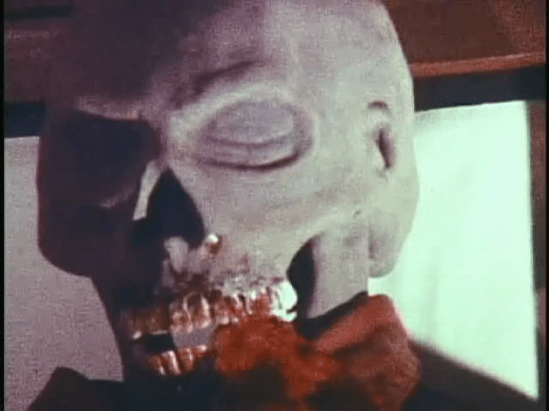
“Bloody Muscle Body Builder in Hell” is a 2014 effects driven, blood hungry roller coaster of pure mayhem entertainment. The ingeniously creative special effects, on a shoe string budget, are made of eye-popping, skull-crushing, and limb-parting goodness that every horror fan can appreciate and love. The lo-fi cinema and melancholy horror fixes to not impress those who have a taste for the CGI eye candy and won’t knock your socks off with the latest and greatest technological, animated advances in effects that attempts to mock real life, but accomplishes the opposite in the fabricated grindhouse reel with overexposures and rough edges that are more fitting for the subject matter. Fukazawa does embody Raimi’s creative editing and angle vision that makes Fukazawa’s film feel very attached to “The Evil Dead” franchise.
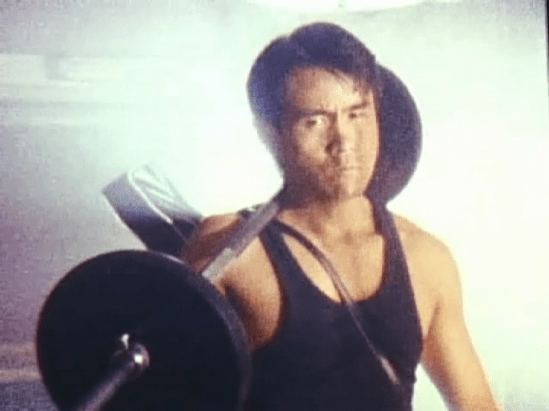
The well-meshed video nasty mingles Japanese culture with a loving tribute to Raimi’s “The Evil Dead” franchise and kicks off Shinichi Fukazawa’s most interesting silver screen career. Terracotta Distribution’s “Bloody Muscle Body Builder in Hell” is a tightly packed 62-minute joyride with squirrelly, demented demons with heavy emphasis on the blood and the gore. Image quality is poor and that’s a good thing! The low-tech fullscreen and unrefined quality are a tall-tell sign of a SOV gruesomeness surrounded by a fuzzy Japanese dual channel stereo. Extras includes a Graham Humprey time lapsed video of him creating his DVD artwork, a behind-the-scenes gallery, a dismemberment of scene clips, and Japanese and Terracotta trailers bringing up the tail end. “Bloody Muscle Body Builder in Hell” packs a punch, delivers the death, and gorges itself in the gore in this UK DVD from Terracotta Distribution! and is a lovely blend of comedy, horror, and praise that’s powerfully short and sweet from a freshman director who aims to make a statement while giving appreciation in his own culturally established way.
Evil Is Only Skin Deep. “The Wax Mask” review!

Set in Rome of 1912, a newly constructed wax museum, under a mysterious alchemy artist known as Boris Volkoff, stirs controversy with the showcasing of the world’s most grisly and notorious murder scenes. Two brothel customers’ debate result in the one challenging the other to spend the night at the curated museum of horror without having an ounce of fleeting fear. The next morning, the man has been found, apparently keeling over in fright, and the police are baffled, but something more sinister is afoot when Sonia, a young costume designer with a horrific past as the sole witness in the gruesome death of her mother and father in Paris 1900, becomes employed at the museum to costume the wax figures and faints when the scene of her parents’ brutal death is recreated as the museum’s new showpiece. Sonia and a reporter closely examine the museum when more people begin disappearing off the street, people who have ties with the beautiful costume designer, and learn the waxed creations are much more underneath their plastic-lifelike skin.

Before his untimely death, the Godfather of (Italian) Gore, Lucio Fulci, had been cooperating on a semi-quasi remake of Vincent Price’s 1953 thriller “House of Wax,” based on the Gaston Leroux’s novel, alongside fellow iconic Italian horror director Dario Argento (“Suspiria”) in a comeback collaboration for Fulci, but the entitled “The Wax Mask” film was evidently delayed partly in because of Fulci’s death. “The Wax Mask” was handed over by Argento, who was producing, to special effects guru Sergio Stivaletti (“Cemetery Man,” “The Church”) and months after Fulci’s death, a finished product shared very similar traits to the Godfather of Gore’s style craftily blended with more modern approaches to filmmaking was released to the public. Though tailored more toward the interests of gory special effects, Stivaletti’s 1997 film is dedicated to Fulci with the implementation of many of the director’s popular trademarks, including closeups on various eye expressions and zoom-ins on gore and the weapons before their fateful strikes, while also basking in strong bright colors in the midst of shadowy cinematography that’s typical of the giallo genre.

In such a crimson world, an elegant performance by Romina Mondello, who stars as the orphaned Sonia, has the Rome born actress bring beauty, innocence, and charm to the macabre that harbors contrasting arguments against undermining marred antagonists and she provides a breath of aesthetic liveliness amongst a narrative that surrounds itself in capturing beauty in inanimate wax figures. “Cemetery Without Crosses'” Robert Hossein embraces the enigmatic museum curator, Boris Volkoff, with struggling internal black aspirations that involve his recently acquired employee, Sonia, and Houssein is able to turn off and on that switch of longing and menacing, playing the hand of the character superbly to keep audiences guessing his true intent. Volkoff’s faithful assistant and exhibit creator, Alex, embodies creepy and morbid attributes wonderfully contributed by a relatively unknown Umberto Balli. The trifecta cast sells the ghastly science fiction that slowly builds toward the transformation of “The Wax Mask” from classic giallo to sensational mad science Gothicism with a boost of euro trashiness that’s more relative to the work of Jesús Franco or Joe D’Amato. Riccardo Serventi Longhi (“Symphony in Blood Red”), Valery Valmond, Gabriella Giorgelli (“The Grim Reaper”), and Gianni Franco (Dario Argento’s “The Phantom of the Opera”) round out the cast.

Stivaletti’s toolbox of special effects celebrate in the practicality that escalates when the cloaked killer’s metal claw literally rips terror through the hearts and souls of characters, but the glossy composite imagery thwarts realism and cheapens the already cheesy Euro horror with a laughable fire set ablaze and a slew of lampoon electricity while half naked women are strapped to a barbaric mechanized chair. The cut-rate composite won’t ruin a guilty pleasure viewing and won’t blast apart an arguably respectable adaptation of Gaston Leroux’s novel, but the script, co-written between Argento, Fulci, and “The House of Clocks'” penning collaborator Daniele Stroppa, does pull from other, interestingly enough, inspirations that one wouldn’t think would be genre compatible. The action-packed finale of James Cameron’s 1984 pre-apocalyptic, time-traveling cyborg blockbuster, “The Terminator,” makes an unexpected appearance with an endoskeleton villain donning some familiar and memorable moments from one of the greatest sci-fi films of all time.

“The Wax Mask” greatly resembles Italian horror cinema from the 1970s and 1980s spawned in the late 90s, a superb feat for a director more aligned in vocational special effects, but the jaded historical background accompanying the film places a stain on whether Lucio Fulci had much to do with the project at all. Much is speculated that Argento and Stroppa re-wrote Fulci’s original script after his death, removing much of Fulci’s atmospheric flair and adding more gore, but in the end, “The Wax Mask” instabilities are overshadowed by great practical effects, an engaging storyline, and a roster of flavorful characters. The One 7 Movies and CAV Distributing Blu-ray release is presented in 1080p. The widescreen 1.78:1 aspect ratio is the not the original 1.85:1 aspect ratio, but doesn’t constrain the image. The MPEG-4 AVC codec emits a bit of shakiness under the compression, suggesting a lower bitrate, but the One 7 Movies’ release is the best, sharpest looking transfer of the original source material with natural coloring on skin tones, vibrant shades of various colors, and shadows being exquisitely black. Four audio options are available from the English and Italian Surround 5.1 tracks to the English and Italian Stereo tracks with no accessible English or Italian subtitles in the static setup menu. Extras are slim with a handheld camera behind-the-scenes that’s solely in Italian. “The Wax MasK” is an ambitious Gothic hybrid horror that cements the memory of Lucio Fulci, pleases the gore of Dario Argento, and showcases the talents of debut director Sergio Stivaletti.

Purchasing One 7 Movies’ “The Wax Mask” at Amazon!

Welcome to the Family. Resident Evil 7: Biohazard Review
I want you all to try to go back to 1996. You just got your Playstation and you picked up the newest game called Resident Evil. You know nothing about it and when you start playing you have a wave of emotions hit you. You feel fear, excitement, and anxiety; but yet you keep playing. You were just introduced to the world of Survival Horror. Now it’s 2017 and we are now into seventh main installment of the Resident Evil franchise and sort of a moment of truth for Capcom. Last few years have been rough for Resident Evil so lets see how the latest installment stands.
Resident Evil 7: Biohazard is a survival horror video game developed and published by Capcom. It is the seventh main installment in the Resident Evil series and was released on the Playstation 4, Xbox One, and PC.

The game takes place in the fictional town of Dulvey, Louisiana. You play as Ethan Winters who goes searching for his wife 3 years after her disappearance. The only information you have of her location is at the Baker estate, this is where your nightmare begins.
There is no denying that the RE engine is amazing. Resident Evil 7 passes with flying colors when it comes to visuals, the game is absolutely gorgeous. Realistic graphics with so much attention to detail really makes the atmosphere. Paired up with its excellent sound design which really puts you on edge, hearing random foot steps and loud bangs some where in the house can quickly make you stop what you’re doing and check behind you. Unlike older Resident Evil games, there really isn’t much background music. The only time i’ll hear music is either in the save rooms or during cut scenes, which is fine. No music really does build the tension and makes you listen to your environment.

The most controversial aspect of the game is its change to game play. Resident Evil 7 now puts the player in first person view, which this isn’t the first time they’ve experimented with this. Resident Evil: Survivor being the first one that was in first person, so I was quite interested when they said they were trying it again. As a big Resident Evil fan I can tell the skeptical fans that the first person view works. Resident Evil now feels even more immersive with it. The game still has its slow and sluggish movement, puzzle solving, save rooms , and combat just like the previous titles and the first person view fits perfectly. I haven’t played the game in VR because I’m broke but I have heard that game is even better with it, so now I guess I’ll have start saving up for one.

I feel I have to talk more about combat since I still see people complain how the game is like other non combat horror games, like Amnesia or Outlast. The combat feels just like an older Resident Evil, except Resident Evil 5 and 6. Thank god Capcom abandon the combat from the previous two and went right back to how Resident Evil 1 through 3 combat worked. Ammo and healing items are extremely scarce and you must manage your inventory to survive in certain situations. Enemies will move unpredictably and you must control your shots and keep your distance if you want to take down your foe. When it comes to difficulty, the game on normal is pretty easy, some parts can be a little challenging but if you’re careful and know where to go, then the game is a breeze.
Now Resident Evil 7 isn’t a long game. It took me about 7 to 8 hours to beat on normal difficulty my first time. It can easily be finished faster when you know where to go and what to do, There have been people who finished it in under 2 hours. But if you’re like me and like to explore then it will take you a while to finish. The story is where this game made me fall in love with it. This is by far my favorite Resident Evil story. The team they have behind this game is solid, the director behind the Revelation games is directing it and the writer behind the F.E.A.R 2 expansions made this a memorable experience and I hope Capcom keeps this team for future installments. Everything about the story is great, every character was interesting, and every location was awesome. The story to Resident Evil 7 is definitely more competent compared to the previous games.
As much as I love Resident Evil 7, I do have some minor gripes with the game. First one isn’t a big deal but I was a bit disappointed. Resident Evil has a tradition, when a player presses start on the main menu, they will hear a loud, deep voice reading the title of the game. Example:
Like I said this isn’t a big deal or a turn off for me but I was a bit bummed they broke tradition. Another gripe I had was the lack of variety with enemies. Before you always fought zombies, mutant dogs, and big hulking monsters. But now the only enemy you fight besides the Baker family are the ”Molded” which look very similar to Resident Evil 4 ”Regeneradors”. Yes these enemies are creepy and hard to take down but after a while you just get tired of fighting them and want something else. Hopefully in Resident Evil 8 we get a bigger cast of monsters.

In conclusion, Resident Evil 7: Biohazard is a great game. I’m so happy that Capcom put the brakes on the franchise and went back to how it originally was. Unlike other companies that have completely abandon their horror franchises. I’m glad that I stuck with Capcom all these years and going through many disappointments to finally see my favorite horror series come back on top. Resident Evil veterans would love this and for new people I highly recommend it. It is a great starting point for newcomers to get invested into world of survival horror.
My final score for Resident Evil 7: Biohazard is a 9/10
Evil Scores Big by Burning Rubber! “Death Race 2050” review!

In the dystopian America of 2050, commercialism presides over the middle and lower classes in the constructed wasteland that is United Corporation of States led by an impeccable and blood thirsty Chairman. A popular, carnage-laden sport known as the high octane Death Race has become beloved by all Americans, giving them an escape from their mundane and pitiful existence. The Death Race is simple: war-modified cars trek across the United Corporation of States in a 3-day race to score points by running down citizens of an overpopulated nation as an encouraged way of resetting the out of control producing rate and racers can also seek glory to reach the finish line with best time. Four-time champion, Frankenstein, is the returning crowd favorite and seeks to win a fifth crown, unless the powerful and conniving Chairman decides otherwise.

Under Universal Studio’s filmic sequel and reboot sublabel, Universal 1440 Entertainment’s “Death Race 2050” is a rip-roaring start toward 2017’s best intense action cinema and despite being pre-labeled as just another diluted and benign remake of the Roger Corman produced, Paul Bartel directed “Death Race 2000” from 1975, the modern day G.J. Echternkamp directed and co-directed film with Matt Tamashita honorably doesn’t lose the rich, yet full of cheap thrills, heritage that makes the original “Death Race” so fun, so entertaining, and so campy keeping the pandemonium on four high-performance, face-shearing tires. Even though Death Race has been quiet for over thirty years since 1975, the last decade has been riddled with Death Race films produced by the legendary low-budget filmmaker Roger Corman and all have been complimentary exclusive in their charm, mayhem, and versions of the lead character Frankenstein to thrill audiences, but it’s “Death Race 2050” that revs in true remake fashion of similar plot structure that changes all but one character.

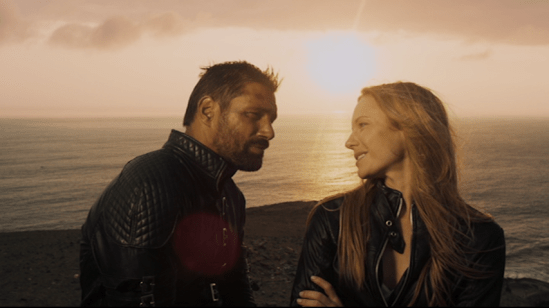
New Zealander Manu Bennet carries the torch in portraying the original character Frankenstein, a four time champion with a leather covered body that’s been ravaged and cybernetically repaired from previous race crashes. Manu’s charisma and rugged image will win over audiences as he perfectly embodies a conflicted champion on the brink of doing what’s right; a tone very similar in all “Death Race” films. Manu is paired with actress Marci Miller, as Frankenstein’s passenger proxy, who dishes out the good girl sex appeal with a self-reliant rind. Beyond these two characters, even with a moniker like Frankenstein, the remaining characters make Mike Judge’s “Idiocracy” a college course of rocket science! Deliveries were timely, actions were precise, and performances couldn’t have been more meticulous in scenes with Jed Perfectus, the genetically engineered and ambiguous pretty boy played by Burt Grinstead, Minerva Jefferson, the wealthy ghetto rapper forged to life by Folake Olowofoyeku, and with Tammy the Terrorist, a cult leader with a celebrity high power portrayed by 2007’s “The Signal’s” Anessa Ramsey. The relatively unknown cast is whole-heartedly glued together by the flamboyant performance of “Clockwork Orange’s” and “31’s” Malcolm McDowell as the Chairman.

One could take a good stab in the dark on what the quality of the effects would be like for any Roger Corman produced film. In this instance, “Death Race 2050” channels much of Corman’s style with Echternkamp and his visual effects supervisor Anthony J. Rickert-Epstein (“Sharktopus vs. Whalewolf”) supplying rotoscope blood and dismemberments that pin-pricks a visual stimulate into the vein of the snobbiest of film aficionados and can be on an everlasting high. The simple, but effect, gasoline based pyrotechnics attest to the dedication of the crew and to the stunt work to know that if they miss their spot, they’re literally toast. However, the sometimes choppy, rapid editing drains some of the juice from the kills that attempt to piece coherent death sequences with humor and action. In fact, “Death Race 2050” redlines just like the modified, manslaughter vehicles used to rundown babies and the elderly to score points by quickly jumping to the next segment in order to sustain all the gory story’s girth.

“Death Race 2050” is adrenaline flowing wildly adjacent with gasoline, exploding with gore, and is terrifically enjoyable. Echternkamp’s script bares no sense with the sensitivities, secreting American wealth, greed, and stupidity in an environmentally degraded America filled with large high fructose corn syrup soda, an addictive cheese whiz byproduct, and borders that are named after corporate conglomerate of brands such as Walmart or Texaco. Universal’s R rated Blu-ray, DVD, and Digital HD release of the New Horizon film is an 1080p of the 1.78:1 widescreen presentation that makes the film look cheap due it’s hi-def attributes. The image quality is sleek and vibrant with a wide range of rainbow hues and the definition doesn’t ever thrown in the towel. The three option audio selection that consists of an English DTS-HD Master Audio has a lossless appetite that delectable distinguishes the channels where explosions are bombastically LFE and the gory parts are viscerally squishy. The dialogue is surprisingly clear through the amount of chaos. Bonus features include “The Making of Roger Corman’s Death Race 2050,” “The Look of 2050″ featurette,” a closer look at the cars in a segment entitled “Cars! Cars! Cars!,” a cast car tour, and deleted scenes. Even if the story’s timing is a spastic, “Death Race 2050’s” a guilty pleasure from start to finish line under the caustic cinematic eye of Roger Corman!

Buy it today on Bluray/DVD/Digital HD!


