An EVIL Alien Blob Storms Earth in Search for Space Feline! “The Cat” reviewed! (88 Films / Limited Edition Blu-ray)

If you missed the Blu-ray, “The Cat” Standard Edition is Available!

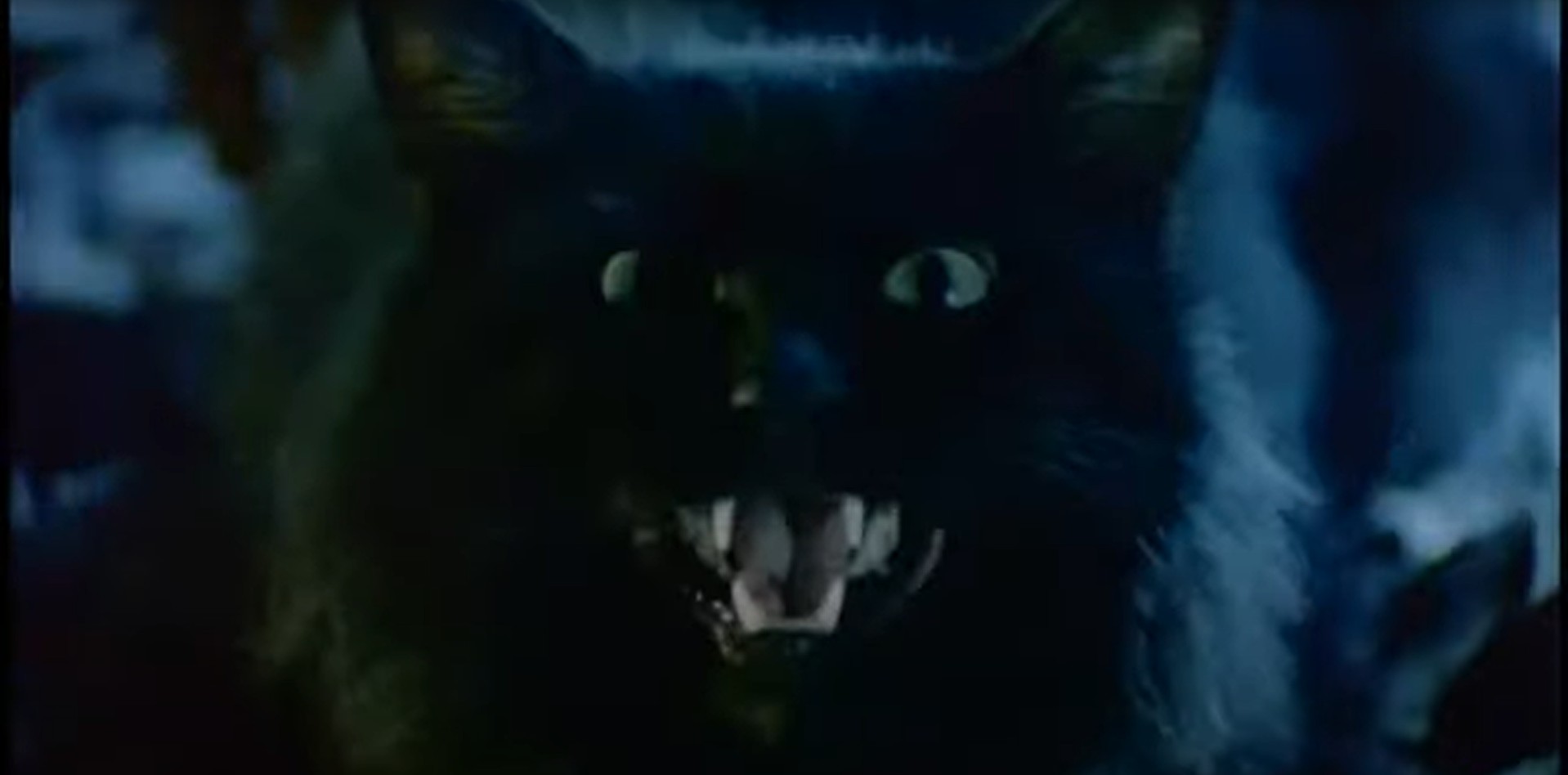
Storytelling author Wisely recounts one of his more fantastical pieces originating from more truth than fiction.  The writer reminisces investigating the mysterious occurrences surrounding a black cat and a young woman involved in a museum heist of an ancient, unknown artifact and, previously, in a strange encountering with Wisely’s friend Li Tung involving strange hammering noises and strewn about cat guts in an adjacent apartment.  Wisely soon discovers he’s bitten off more than he can chew becoming mixed up in extraterrestrial battle between the gentile but fierce fighting space cat and the young woman from another world versus a vicious and imposing orange alien blob that can inhabit dead humans and slip through tight confining spaces, leaving a burn trail of electrified bodies in its wake.  Wisely and his girlfriend, Pai so, decide to help the girl retrieve a second piece of the artifact that be used as a weapon against the relentless alien aggressor before the cat and girl can return to their home planet.

A strange science fiction thriller hailing from Hong Kong, “The Cat,” or “Lo mau,” is the 1991 filmic adaptation of author Ni Kuang’s “Old Cat” from a part of the Wisely adventure series of novels.  Written by frequent collaborating screenwriters Hing-Ka Chan and Gordon Chan (“Cat and Mouse,” “Behind the Yellow Line”) as well as numerous team-ups of Hing-Ka penning Gordon director helmed works (“Beast Cops,” “Thunderbolt”) and directed by “Riki-Oh:  The Story of Ricky” director Ngai Choi Lam, “The Cat’s” bizarrely unraveled as it is unrivaled but evokes a commingling of Hong Kong mysticism, science fiction, horror, and creature personification that’s hard to find not entertaining in its converging Daoism with creature feature movies!  Golden Harvest and Paragon Films, in association with Japan’s Nippon Television Network as a Hong Kong-Japanese alliance, are the companies behind the picture production with Chan Tung Chow (“Riki-Oh:  The Story of Ricky”) and Seiji Okuda (“Pulse”) as producers.
Hong Kong beauty Gloria Yip (“Riki-Oh:  The Story of Ricky,” “The Blue Jean Monster”) took Hong Kong cinema by storm in the early 90s before quietly taking a step back from acting to focus on building a family when newly married in 1995.  Since her divorce, Yip has been active in the last decade and half but to experience her best, early work, “The Cat” is a good start to behold her natural girl-next-door charisma and attractive attributes as an alien inside a human body.  Where she obtains this human form is unknown and her species social status, her name or how she became trapped on Earth is also vague, but Yip’s character can float waltz and is seemingly the caretaker of the Cat, who is a general of sorts in the alien race.  Her alien sidekick, Errol (Siu-Ming Lau, “Shaolin vs Evil Dead:  Ultimate Power,” “A Chinese Ghost Story”), too has an equivocal backstory as they search for weaponry relics and evade the caustic and electrically charged blob monster that threatens their world.  The story falls in more in tune with the three friends buried by the extraterrestrial struggle for survival and dominance with “A Chinse Ghost Story II and III’s” Waise Lee as principal lead character Wisely, a humble story writer living off the riches of girlfriend Pai So (Christine Ng, “Crime Story”), at least based on their dialogue of her owning a big house, playing tennis, and providing.  It’s an oddly laid out relationship that shows no quarrel or being tested when up against alien beings.  Li Tung (Lawrence Lau, “3-D Sex and Zen:  Extreme Ecstasy”) is Wisely’s first friend to encounter the girl and cat as noisy above neighbors but it’s their cop friend, Wang Chieh-Mei (Philip Kwok, “Hard Boiled”) who takes the unfortunate brunt being inhabited by the alien blob and becoming a Rambo-arsenal assassin.  The last piece to “The Cat’s” cast is actually the “Old Cat” author Ni Kuang having a cameo appearance as a warrior dog handler, Processor Yu.

Did I mention already that “The Cat” is beyond bizarre?  The campy story suffers from connective tissue deficiency syndrome, meaning there’s not enough exposition or explanation in the subdued, mild-manner interactions to really bring together and segue the really cool action and creature sequences that involve, but not limited to, pyrotechnics, forced perception effects, stop-motion, blood squibs, prosthetics and makeup, and high-flying wire acts involving not only people but cats and dogs!  The cat versus dog fight is a rough-and-tumble showstopper.  The special effects and choreographic teams of Hong Kong’s special makeup effects artist Chi-Wai Cheung (“Riki-Oh:  The Story of Ricky”) and stunt coordinator Philip Kwok taking their cogs and working into the grand effects design along with Japan’s f/x crew from visual effects artist Takashi Kawabata (“Dark Water”) and special effects Shinji Higuchi (“Gamera, the Guardian of the Universe”) is a masterful amalgamation of two cultures and two styles into one, blending high-flying acrobatics with the strange, bold stop-motion and visual effects that incorporate puppets and molds is optical buffet aimed stimulate and confound.  Nearly experimental in its narrative and effects while bordering being derivative, such as from the 1988 “The Blob” remake, “The Cat’ prowls, growls, and meows as a welcoming hot mess of feline phantasmagoria. 

On a new limited-edition Blu-ray set with exclusive, new artwork by graphic artist Sean Langmore, “The Cat” purrs with a fully-loaded, out of this world high definition release from UK label 88 Films and distributed by MVDVisual in the North American market.  A new 2K restoration of the original 35mm negative is encoded on a AVC encoded BD50 with a 1080p resolution in an aspect ratio of 1.85:1 widescreen.  Image presentation has the stellar glow of regular Hong Kong film stock, a stock that doesn’t dilute the defining particulars but only softens them slight.  The original negative has withstood the test of time and any improper handling providing the restoration effort with a focus-driven goal of grading and detail. The other side of that coin is that all the rubbery and irregular textures are now more in the spotlight instead of being lost in the lower resolution and more opaque video qualities.  Brilliant gel lighting and a comprehensive range of primary reds and blues coupled with an electric orange and blood red of the antagonistic monster seduces contrastingly inside a dark atmosphere with a story mostly told during the nighttime hours.  Remastered with a Cantonese DTS-HD mono track, the compositional track is about as good as it’s going to get but that’s not saying the audio is bad at all.  Clean and clear in ADR dialogue and distinct in the ambience and action, “The Cat’s” remastering is mighty without being punchy with broad-range, consistent audio that doesn’t have any holes poked into it and has an epic, original score by Phillip Chan (“Her Vengeance”).  Newly translated English subtitles are burned onto the only video file feature.  The encoded special features include an audio commentary by Asian film expert Frank Djeng of the NY Asian Film Festivial, a new interview with writer Gordon Chan in Cantonese with an English introduction, the Japanese cut of the film in standard definition, an image gallery, and theatrical trailer.  All of the encoded features will be available on the limited-edition and standard release sets.  Langmore’s artwork graces the LE O-ring slipcover and rigid slipbox with a crazy illustrative arrangement that details how bonkers “The Cat” gets.  Inside the slipbox, a full-bodied colored and detailed booklet with more original Langmore artwork, one sheets, stills, and other contents that include cast and crew acknowledgements, a Paul Bramhall retrospective essay on director Ngai Choi Lam That Cat is Dangerous, a second essay in regard to Nai-Choi’s niche cinematic credits by Matthew Edwards entitled Body Horror, and a special thanks roundup and more acknowledgements in the making of the Blu-ray release.  There’s also a collectible art card stuffed in between the clear Amaray case and the booklet.  The reversible cover art’s secondary slip-shell is of an original poster art, a good alternative to an already overused Langmore illustration that’s on the O-Ring and slipbox.  While not a numbered limited-edition release, news of the set already being or nearly sold out at most retailers is circulating, but there will be a standard edition slated for release late November ICYMI!  The not rated release has a 89-minute runtime and is encoded region A and B for playback.

Last Rites: Ngai Choi Lam’s science fiction, body horror, and creature feature inundated “The Cat” has all the weirdness and practical prosthetics, including deeply bizarre force perception visuals, that’s beyond our galaxy and capacity for understanding, landing with great precision onto a well-deserved, highly anticipated, and must own 88 Films’ limited-edition boxset!

If you missed the Blu-ray, “The Cat” Standard Edition is Available!

Sometimes It Takes EVIL To Bring Out the EVIL In Us All. “Jacob” reviewed! (Crazed House and MVDVisual / Unrated, Director’s Cut Blu-ray)

“Jacob’s” EVIL is Coming to Blu-ray! Order Here!

In the Texas smalltown of Melvin Falls, a dark history engulfs the Kell family.  Edith Kell and her two children have lived in ostracized notoriety for years amongst their neighbors as Edith’s husband, obsessed with restoring a suddently inherited house immersed in haunted opine, walked into the town crowded bar and started violently killing patrons before being shot dead by the local sheriff.  Years later, Edith’s son Jacob is now a quiet, large, and lumbering young man with a death stare that’s akin to looking into the abyss, but Jacob’s underlining rage and psychopathic tendencies are comforted by his younger sister, Sissy, when tensions rise between his mother and her boyfriend, the abusive town drunk Otis.  When Otis inadvertently kills Sissy, Jacob’s bloody rampage is unleashed and the townspeople, led by a capital punitive sheriff, form a posse to bring down the vengeful Jacob, if they even can, in another Kell family massacre.

IMDB.com

Larry Wade Carrell writes-and-directs the dysfunction family and rural community horror “Jacob,” released over a decade ago in 2012.  The film is Carrell’s debut solo directorial that earned the filmmaker best Indie Fantasy-Horror, Best Young Actress, and Best Music Score at the WorldFest Houston before embarking into more recent horror of the last decade with “She Rises,” “Girl Next,” and “The Quantum Devil” that run the subgenre gamut with supernatural terror, trafficking abductions, and evil on a whole other plane of existence.  Carrell’s humble backwoods basket case thriller has broad stroke inklings of a supernatural catalyst.  Filmed in and around Richmond, Texas, “Jacob” is the last feature from Odyssee Pictures and the first for Javaline 98 Productions, produced on a low budget by Carrell, Odyssee Picture’s Stacy Davidson and Jeremy Sumrall (“Domain of the Damned,” “Sweatshop”), William B. Davis, Catherine and Frederick Rushford, James Martinelli, and Chuck Norfolk (“Conjoined”).

IMDB.com

Like most indie features, multiple hats are being worn in front of and behind the camera.  Not only does director Larry Wade Carrell write the script, he also dons the twin brother roles of drunkard abuser Otis and the gentile deputy Billy.  Edited so the two characters are never fully faced in a scene together, Carrell manages to pull off contrast personalities by portraying, essentially, the epitome of bad versus good with the no-good delinquent and intoxicated aggressor Otis up against the mild-mannered solicitous nature of Billy, a deputy.  While Carrell may be the core of the story playing two characters, he’s written a narrative that has to battle out against the titular character Jacob, played by Dylan Horne, and the venerated genre name of Michael Biehn (“Terminator”), in what can be considered as the worst impersonation of a whoopie-exclaiming Podunk, literally with the character yelling whoopie when learning of inheriting a house.  Aside from Biehn’s cringy performance, the acting is generally positive and compelling.  Carrell goes beyond the bar in melodramatics but manages to keep grounded by much of dynamic interactions supplied by scrupulous actors with Krystn Caldwell (“Psychic Experiment”) as Edith Kell, the staying in victim of abuse, Leo D. Wheeler (“Domain of the Damned”) as the manbun sheriff with a firm but gentle approach, and Grace Powell (“Hell of a Night”) as Jacob’s soothing little sister Sissy.  Horne, in the Jacob role, is voiceless throughout but imparts Jacob’s ogre-esque killer from inside out but is still overshadowed by Carrell’s double-edge role that takes away from his menancing run through the simpleminded townsfolk.   Dustin Lane (“The Darq’), Travis Hester, Sandy Ray (“Hairmetal Shotgun Zombie Massacre: The Movie”), Shane Stewart, Karen Schlag (“Domain of the Dead”), Nick W. Nicholson (“Pickaxe”), and Deke Garner (“The Void”) rounds out the “Jacob” cast.

IMDB.com

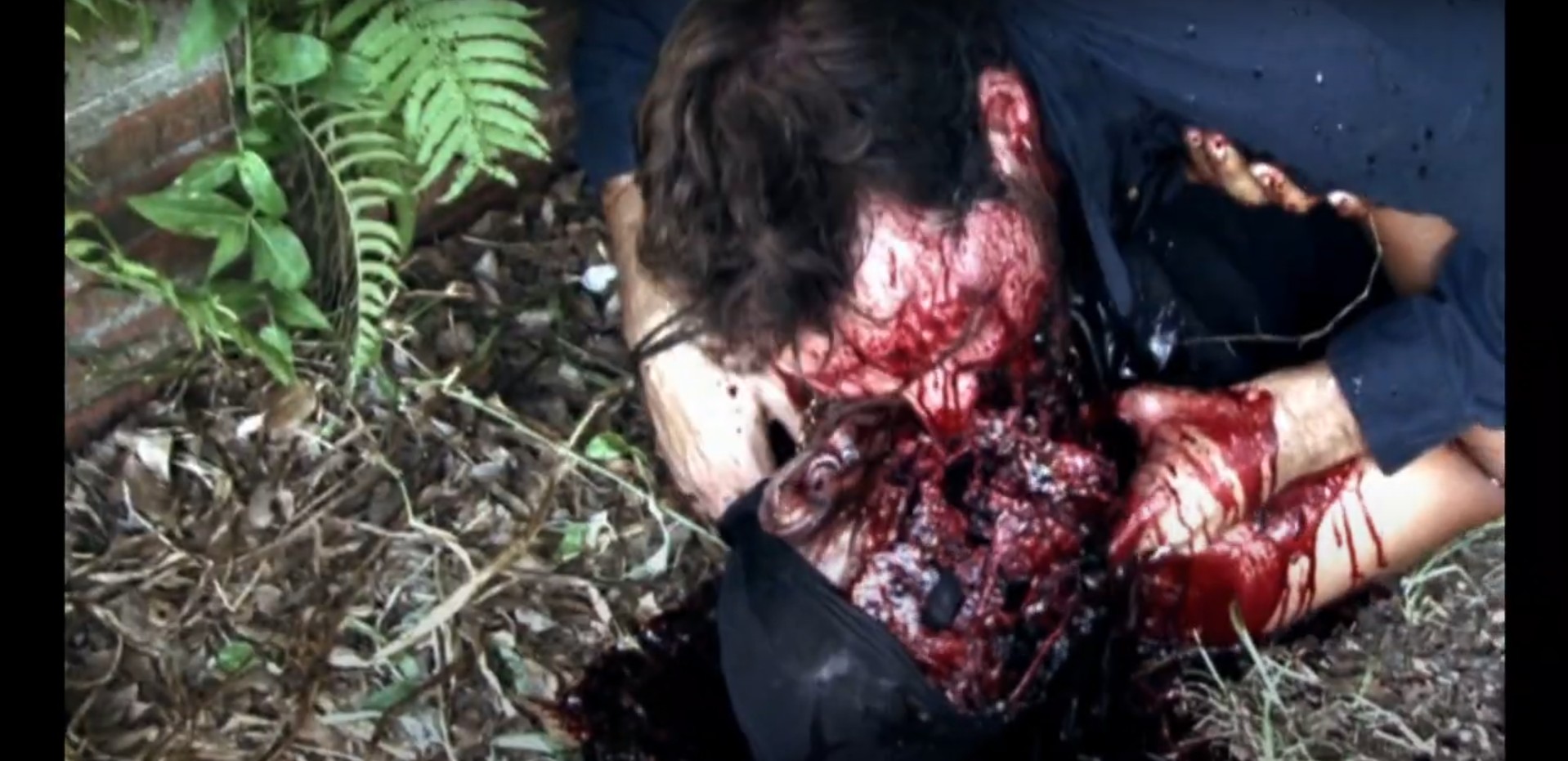
“Jacob” is one of those horror-thrillers that wears the trope suit of a large, quiet, countryside hulk with little intelligence but makes up for with strength and goes on a killing spree when a cataclysmic moment, usually spurred by external elements like peer bullying or the death of significant person, in this case the death of his sister, Sissy, breaks Jacob’s dammed violent tendencies and what ensues is a deluge of body mangling carnage in a big ole heap of misunderstanding as the Melvin Falls residents believe, with prior judgement and without a doubt, Jacob finally snapped and murdered his sweet baby sister, though far from the truth.  However, the reason for Jacob’s turn to madness is a little more complex than just dead sister vindictiveness.  In this case, less is more would have suited Carrell’s film more aptly as Carrell adds in a supernatural element with Jacob’s father inheriting a supposed haunted house.  As the father attends to the house rehab, a montage of him finding a book and able to read and be beguiled by the demon scripture inside causes him to slowly become obsessed and insane while fixing their newfound home which then leads to the bar massacre Jacob witnesses.  Jacob also comes in contact with his father’s spilled blood that night and that presumably passes whatever supernatural forces the father was affected by to his son, an evident metaphorical theme of hereditary genes gone wild through blood lineage that’s also demonstrated within Sissy who mentions hearing the house’s callings to her but she was not tainted by the touch of her father’s blood with her being inside mother’s womb. There’s a lot to digest and decipher but not properly arranged or the demonic mainspring is sorely underplayed to really nail the occult supernaturality on its head.

The Unrated, Director’s Cut of Larry Wade Carrell’s “Jacob” lands onto Blu-ray from Carrell’s current release company Crazed House and distributor MVDVisual.  The AVC encoded, 1080p, BD50 and presented in a widescreen 1.78:1 aspect ratio.  Picture quality is a bit all over the place and its likely not from the compression codec but rather stylistic choices for flashbacks for a narrative that goes into a flashback while already inside a flashback, creating multiple tonal layers to distinguish the vying eras.    Carrell really gets his hands into a sepia and desaturated grading that sucks the color out in a fit leaning toward overexposure taking with it much of the finer detail points.  Combined with digital stock, the gritty tone Carrell goes for often loses the battle to an ultra-sheen effect.  The English LPCM 5.1 surround sound plays to the rigors of the dialogue.  The loquacious script, delivered on point by the actors, goes unobstructed with a prominent dialogue layer underscored by its Iain Kelso score that evokes a slightly better grittier tone Carrell attempts to achieve with the film’s appearance.  Range is limited to just what’s in frame and within the nucleus bubble and that often goes together with eliminating much of the depth when all the centered focus objects are making all the noise in the room and scene, diegetic speaking.  English subtitles are available.  The director’s cut has special features that include two commentaries with one including writer-director Larry Wade Carrell and the other including Stacy Davidson, a behind-the-scenes documentary The Journey of Jacob that has retrospective cast and crew interviews as well as raw footage and film footage of the film’s from alpha to omega, an interview at the “Jacob” Canadian premiere hosted by Yell Magazine, actors screen test, extended and deleted scenes with Carrell commentary, a storyboard comparison with Carrell commentary, and the theatrical trailer.  There is no stinger scene post credit.  The cover art screams low-budget and photoshop but is an adequate shoe that fits the rural horror and lumbering maniac concept.  “Jacob” comes in a standard Blu-ray Amaray for its region free, 92-minute feature presentation.

Last Rites: “Jacob’s” a good first effort in the big chair for filmmaker Larry Wade Carrell with solid acting, interesting characters, and palpable bloodshed. Where the weaknesses lie is with the story’s inability to connect the demonic, haunted house, ghost story, or whatever supernatural force may be to the essence of backwater calamity and dysfunctional family lineage.

“Jacob’s” EVIL is Coming to Blu-ray! Order Here!

White Space Men are the EVIL Captains of the Zombie-inducing Slave Trade and Intergalactic Fast-Food Industry! “Race War: The Remake” reviewed! (Wild Eye Releasing: Raw & Extreme / DVD)

Get Caught Up in the Middle of a “Race War: The Rmeake” on DVD

Drug dealer Baking Soda is feeling the peddling pangs of dropped traffic for his crystal pure PCP.  With no one buying his smack, he and his friend G.E.D. reside back home to drink with their close fish-headed friend Kreech and sleep off the day’s failure to try again tomorrow.  Their persistence to sell puts them on the radar of a white supremacy group vending a new drug on the street, the cause for Baking Soda’s drop in sales, but their product isn’t just going to get users high, it will turn them into flesh-eating zombie slaves.  When G.E.D. is kidnapped by the group, Baking Soda and Krrech have to run through the list of suspects – Jews, Hispanics, Chinese, and others – for the source of his sale woes and to rescue his friend, guns blazing if necessary or if unnecessary, but there may be more extraterrestrial motives that haven’t yet been unearthed. 

“Race War: The Remake” is a 2012 politically incorrect, ultra-offensive spoof comedy and blaxploitation horror from writer-director Tom Martino.  A Tom Savini school graduate, te special effects artist Martino (“Dead of Knight,” “Return to Nuke ‘Em High Volume 1,” “Doll Factory”) takes helm in the director’s chair for his debut in indie feature productions with one of the wildest, crudest, and tactlessly funny comedy-horrors I’ve seen since Troma’s “The Taint.”  Set in and around Houston, Texas and the greater surrounding area with guerrilla filming in locations such as the Houston Space Center and shooting with permission at the Darke Institute’s Phobia Haunted House, “Race War:  The Remake” doesn’t have an originating film despite the title in what is considered a spoof sequel – think of examples “Dude Bro Massacre III” and it’s standalone release or the non-existent second sequel between  “Thankskilling” and “Thankskilling III.”  Martino produces his own work under his outside of Houston-based company DWN Productions that doubles in making horror theme masks, busts, and props.

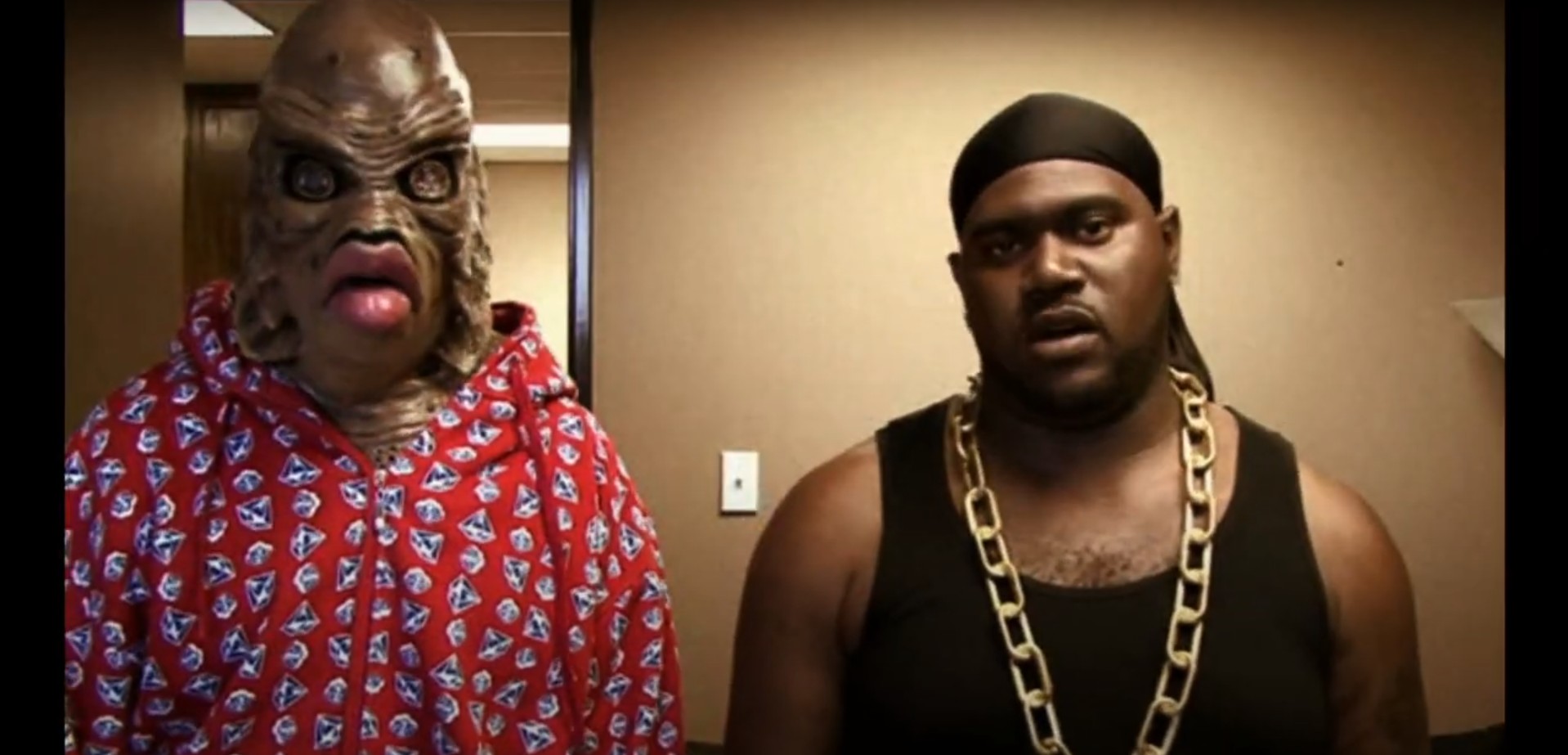
Thick-skinned actors comfortable with the narrative’s uncomfortable themes begin with Howard Calvert and Jamelle Kent as Baking Soda and G.E.D.  Calbert and Kent have become regulars in the Tom Martino catalogue of cast members for his more recent films and their humble beginnings in “Race War:  The Remake” proved their longevity to stay with the director, who is white, who wrote extensive race, gender, sexuality, and fart jokes in the context of a comedy-horror with cringy stereotypes and genuine tributes.  Calvert and Kent have great comedic timing to pull off all the zany editing, sound bites, and practical effects distaste Martino has flaming axe tosses at them to achieve his vision.  The two are joined by Danny McCarty, who would become another regular and be the visual effects supervisor for the film, dressed head-to-toe in loose-fitting urban attire to match the theme of Calvert and Kent’s black A-shirt and do-rags but his hands and face are masked to become the Creature from the Black Lagoon, aka Kreech.  Martino’s “Race War:  The Remake” isn’t just about the terrestrial races but intergalactic ones as well and we soon see that later on with the intentions of neo-Nazi white drug suppliers, led by Matt Rogers’ vulgarity in the horseshoe mustached Tex.  There are various other encountered gross stereotypes in the trio’s urban quest, such as a large nosed, greedy Jewish lawyer, Mexican luchador bodyguards, and a Pai Mei-esque Shifu speaking gibberish har har sounds and listing off popular Americanized Chinese dishes in attempt to be derogatorily funny.  With a film titled as “Race Wars:  The Remake,” the cast is mostly white and black actors poking uncouth fun with a big unconcerned and insensitive stick with Corey Fuller, Kerryn Ledet, Sam Rivas, and Coady Allen listed in the cast.

“Race Wars:  The Remake” isn’t funny, it’s stupid funny!  Having grown up in the 1980-2000s, consciously I might add, Martino’s politically incorrect and his brand of juvenile humor resonates with me, reminding me how cinema has become numb to the spoof humor.  Granted, Martino’s humor is over the top cutting, gross, and full of jest bigotry, traits that would trigger many in today’s sensitive awareness, and while cringy after a tasteless joke may result, there’ll likely be some a side of the mouth chuckle to go along with it.  On the opposite side of the spectrum, Martino tributes to references of certain popular culture icons, though slightly bastardizing some for laughs.  From Peter Jackson’s “Bad Taste,” to “Creature from the Black Lagoon,” to even “Mortal Kombat,” “Race Wars: The Remake” integrates the best parts of each these staples of pop culture and that gives his film a leg up on other offensive spoofs of the same crass caliber.  Th one negative story structure item to  highlight is the act one narrative takes a while to work the gears and get going as it attempts to setup the 40oz-drinking chumminess of Baking Soda, G.E.D., and Kreech but lags to a stagnant stall for hot second while still surround with the here-and-there gags, themed with G.E.D. homosexual tendencies and Baking Soda’s drug peddling woes on and off the streets, but once the antics pickup, there’s no stopping Martino and his filmic entourage from raining down an assault of insults. 

If you’re easily offended or put off by off-color race comedy, then Wild Eye Releasing’s “Race War:  The Remake” DVD is not for you!  For me, and those like me, unaffected by the type of uncouth spoof, Tom Martino’s debut is for you!  The Raw & Extreme sublabel’s DVD is MPEG2 encoded, 720p resolution, on a DVD5.  Presented in widescreen 1.78:1 aspect ratio, there is a breadth of visual presentation not confined within’ pillar and letterboxing but is stretched vertically that affects the already par level resolution.  Guerilla filmmaking also involves no production lighting and natural lighting is more than used here in Martino’s run around the Houston area, but one thing good about Martino’s naturally lit cinematography is its neutral set, avoiding under and overexposure.  The lesser used interiors have some tint lighting and key lighting to avoid total flat, dark outcomes but give the image a haze of hue, especially inside Baking Soda’s living room scene in the first act that sees a thin layer of red and green.  The English PCM Stereo has inconsistencies in volume.  Some scenes discern quieter than others because of the guerilla filmmaking constraints as well as just using commercial recording equipment.  However, the dialogue does land well enough for the jokes to hit and overlayed sound effects greatly lift the sound design where needed, such as with the Mortal Kombat video game sequence or with the array-spray of gunshots throughout and soundboard gag effects.  There are no subtitles with this release.  Included in the special features is Tom Martino director’s commentary, a gag/blooper reel, a behind-the-scenes reel of the gory moments, and Wild Eye Releasing trailers that include “Race War:  The Remake.”    The clear, ECO-Light Amaray DVD case houses stellar covert art illustration work by Belgium graphic artist, Stemo, with the inlaid narrative intensity and characters in collage.  The reverse side includes a gory still from one of the scenes.  The disc is pressed with the same front cover image but there are no other physical materials.  The unrated DVD runs for 95 minutes and is region free.

Last Rites:  Wild Eye Releasing re-unleashes another outrageous title on their Raw & Extreme label and the Tom Martino film is every ounce of the sentiment in it’s indie underground hokum of gore, racism, homosexuality, and aliens! 

Get Caught Up in the Middle of a “Race War: The Rmeake” on DVD

EVIL’s Beauty is in Her Catwalk Madness! “Nothing Underneath” reviewed! (Rustblade / Blu-ray)

“Nothing Underneath” 40th Anniversary Blu-ray Available Here!

Bob Crane, a Wyoming park ranger, suddenly sees visions of gloved hands wielding long, sharp shears entering his supermodel, twin sister’s hotel room in Milan, Italy.  His  psychic experience with his sister sends him packing frantically to Italy, specifically to the Hotel Scala, where his sister, amongst many other gorgeous supermodels, reside when working in Milan.  Unable to locate her and without a sign of disturbance in her hotel room, her disappearance is seemingly nothing more than that – a disappearance – but an aging police detective, Commissario Danesi, is willing to investigate the disappearance which will be his very last case before retirement.  Without any leads, Crane and Danesi don’t have much evidence to go off of until another supermodel is brutally murdered in the same hotel and a pair of scissors is the forensically determined cause of death.  The once case of disappearance now turns into a murder investigation and goes deeper into the ugliness of the fashion world with a deranged killer targeting supermodels. 

Considered to be a prominent gem of the giallo genre but not entirely considered to be a full-fledged horror by the filmmakers is Carlo Vanzina’s “Nothing Underneath.”  Known natively as  “Sotto il vestito niente,” inspired by the title only written by Marco Parma, a pseudonym for journalist Paolo Pietroni, Vanzina cowrote the novel extraneous story alongside brother Enrico Vanzina (“Call Girl”), who are siblings more suited in the measures of comedic premises initially, and the prolific horror writer Franco Ferrini’s, whose screenplays of Dario Argento’s “Phenomena,” “Opera,” “The Card Player,” and amongst others, as well as Lamberta Bava’s “Demons”, gave the writer formidable cult status and creditability amongst the international horror fan base, not to forget to mention regular work and collaboration with a master of horror, Dario Argento.  “Nothing Underneath” is shot on location in Milan under the Faso Film productions with executive producer Raffaello Saragò (“The Witches’ Sabbath”) and producer Achille Manzotti (“Beyond Darkness”).

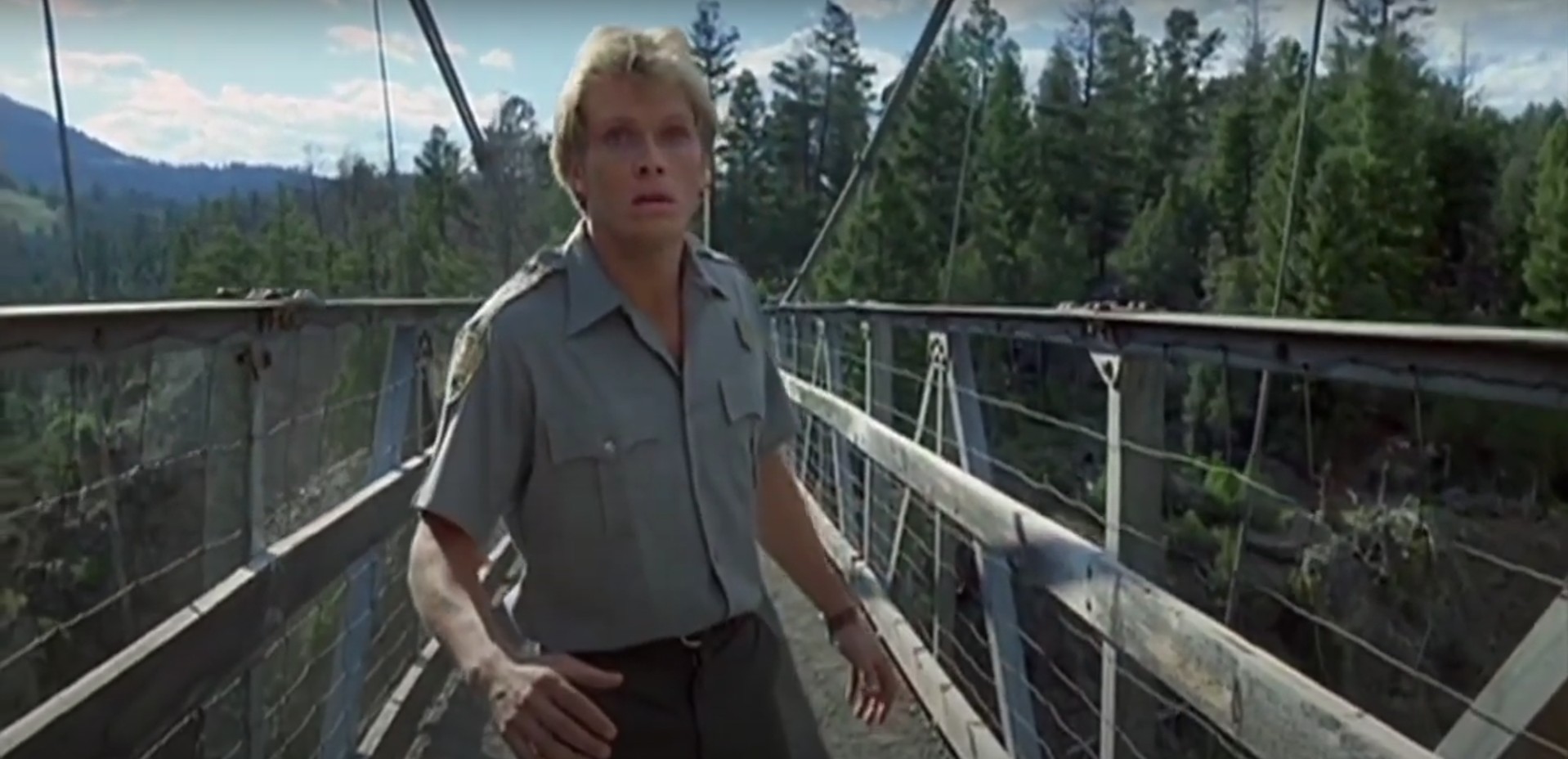
What’s interesting and more infrequent for this Italian production is that it’s entirely shot in English and not dubbed in post-production ADR.  Reason for this was for “Nothing Underneath” to be a synch-sound production with the image and to market it better internationally because of the main cast comprised of American and English actors.  The American actor, starring in his debut feature film, is Tom Schanley (“Savage”) as Wyomning park ranger Bob Crane and the way the story is structure really homes in Crane as the principal lead with a complete credit setup and character follow-through of the Yellowstone National Park.  Schanley’s blonde hair and muscular toned good looks embodies a likeness to his on-screen supermodel sister, played by Nicola Perring, who, as the story displays her, is not in the business of acting with very little dialogue and is only used for her short platinum blonde hair and thin figure for narrative form fitting.   The other native English speaker in a cooperative lead role is “Halloween’s” Donald Pleasence as an investigator on the verge of retirement.  Pleasence is no stranger to Italian cinema, seeing his fair share in the 1980’s psychotronic pictures, including Dario Argento’s “Phenomena” released prior.  The prolific British actor still manages to produce mountains of charm even in his most rubbish Italian accent as the long in the tooth comminssario eager to solve one more exciting, mysterious case and buddying up with young, handsome, and outdoorsy Bob Crane with twintuition.   The love interest falls upon real life model and Denmark native, then 19-year-old Renée Simonsen who is absolutely stunning with her looks and with her debut into acting in what is a significant role that involves a lot of screentime, a lot of dynamic and interactive dialogue, and does show some brief nudity with intimate sexual situations with Schanley.  “Nothing Underneath” has a roster that fills out with Catherine Noyes and Maria McDonald as Milan models, Paolo Tomei as a coke-head jeweler and model philanderer, Cyrus Elias as Comminssario’s Danesi’s assistant, and Phillip Wong as the peculiar fashion photographer Keno Masayuki.

“Nothing Underneath” isn’t a skimpy, loose garment with nothing going for it.  Instead, Carlo Vanzina offers more with his giallo by making it less giallo in terms of its cinematic style and with Pino Donaggio’s score which is in the style of, much like the rest of the filmed and narrative structure, a Brian De Palma erotic thriller.  With plenty of sexy sashaying from beautiful models, a balance between sex and sadism teeters as the alluring aspects of a promiscuously titled are dissected and interspersed with a long sheer psycho engrossed by a theme rarely explored and depicted, but certainly skimmed, during those times of 1980’s Europe and completely disconnected from Paolo Pietroni’s story with keeping only the fashion world and the murder mystery as core elements and adding a supernatural flavoring with the brother and sister telepathy.  Donaggio’s suspenseful brass orchestration and conduit synth-infusion score separate itself others in the subcategory that deploy synth-rock, haunting discord, and, perhaps, even a late 70’s swanky cop thriller piece typically layered alongside.  The composition, coinciding with the temporary expat cast as most giallo’s permit, often feels more westernized while still striking notes of unnerving tension and having collaborated with De Palma on “Dressed to Kill” and “Body Double” years prior, Donaggio imports those arrangement qualities for the Italian market and reaping success amongst the rest of the frayed giallo conventions. 

Italian boutique label Rustblade extends their release of “Sotto il Vestito Niente,” aka “Nothing Underneath” to the North American market with a new region free, 40th anniversary special edition Blu-ray release as well as releasing deluxe releases that come with accompanying limited edition lobby cards postcards, a polaroid, a poster, a colored vinyl, a book, CD soundtrack, a tote bag, and even, yes you’re going to read this correctly, underwear.  The standard release isn’t that supplementally sexy but does have great standalone supplementals in its AVC encoded, 1080p full hi-def, BD50.  The newly restored version stems from the original 35mm negative and presented in 1.85:1 widescreen aspect ratio.  The negative print looks to have been in pristine condition that rendered an impeccable transfer that fully provides depth and detail accentuated by well-adjusted and put together color grading that elevates the pop of the natural hues.  No signs of compression issues or smoothing over with sharp detail textures on skin and fabrics alike as well as the metallic shears having reflective qualities as it sheens and shines in mirrored property.  Two audio options are available, an Italian DTS Master Audio 2.0 Mono and an English DTS Master Audio 2.0 Stereo, the latter comes from the English living synch recording mixed in Dolby Stereo.  The English track is preferred here as its natural with innate reflections and tones of the actors on screen.  I noticed brief moments of Italian actors being English dubbed as a mismatch in the A/V synchronization as well as a disturbance in the aural consistency.  The dialogue track has prominence but has intermittent hissing and crackling, likely from the video-synch recording.  English, Italian, Spanish, and German subtitle are available.  Special features include interviews with co-writer Enrico Vanzina and composer Pino Donaggio, plus a film analysis by Francesco Lomuscio, the theatrical trailer, and a still image gallery.  For the standard packaging, the clear Amaray encasement has the supermodel in sheer and blood artwork used in previous DVD and Blu-ray versions and the reverse side as a still image with the opposite a black and red silhouette of shears and blood drop splatters.  The disc is pressed with the same cover art image.  Rustblade’s release is not rated and has a total runtime of 94 minutes.

Last Rites: Rustblade’s 40th Anniversary Edition Blu-ray of Carlo Vanzina’s “Nothing Underneath” is a great leap toward a go-to less giallo that’s tragically overlooked and underappreciated but ranks high above the bar and near the top sure to please in seduction and in murder.

“Nothing Underneath” 40th Anniversary Blu-ray Available Here!

Rash Decisions Permeate EVIL’s Presence. “When Evil Lurks” reviewed! (Second Sight Films / 4K UHD Blu-ray)

“When Evil Lurks” 4K UHD Blu-ray for Purchase!

Two brothers in a small, remote community discover a neighboring man infested and rotting with a demon inside the body.  Fearing evil will spread once the birthed demon is free from the bloated and pus-oozing human host, they move the body miles out of town with the help of an impatient and bellicose farmer, but when they lose the body, a dark violent force spreads across their rural outlook, beginning with the horrendous death of the farmer and his pregnant wife.  Escaping to the city, the two brothers hightail out of town, picking up family along the way, only to unintentionally spread evil from contamination by the rotting body.  Local folklore has a set of established rules, seven rules in fact, when face-to-face with a demon and they enlist a reclusive woman, a proper cleaner of the rotten, to help them against the clinging evil determined to never let their family go unscathed. 

The 2023 released, heavy demonic and folkloric horror from Argentina, entitled “When Evil Lurks,” tells the whole story of a family’s past regrets, the road-splitting life choices they make, and the consequences that follow using graphic, unabashed violence and a campiness that’s corrosive to the soul.  Demián Rugna writes-and-directs “When Evil Lurks,” aka “Cuando acecha la maldad,” after his breakout hit “Terrified” from 2017.  The Buenos Aires filmmaker continues to push a singular amalgamate of wide-range tradition and horror to the extent the world has never seen, and he continues to shoot on location from his own country, mostly in or around his home municipality.  Fernando Díaz of Machaco Films alongside Roxana Ramos under her founded production company Aramos Cine with the support of the national cinema institute, the Instituto Nacional de Cine y Artes Audiovisuales or the INCAA, and the streaming horror service and productions, Shudder.

“When Evil Lurks” primarily follows Pedro and Jimi, two brothers living on the outs of their own lives stagnantly inside their rural family home.  Ezequiel Rodríguez (“Legions”) sports a grizzly beard as the lead, older brother Pedro who frantically and desperately needs to get his family away from the spreading evil while returning to collaborate with Rugna “Terrified” actor Demián Salomón tracks as a more youthful footloose, Jimi, not tied down by a family or even a girlfriend but rather is dialogued as free lover amongst women.  Every character they encounter exposes them to the evils that lie ahead, or generally around the vicinity, as the this rotten, as they label the formless rotten presence that is solely an inhabitant of people and animals alike, can jump to another host if the rules are not followed, with the most common rule being broken is using gun powder to kill the possessed rotten.  Up for to be demonic fodder is Pedro’s estranged family who have alienated him because of his ambiguities’ surrounding possible unforgivable crimes and family abandonment.  The latter speaks more specifically to his severely autistic son Jair (“Emilio Vodanovich, “Fever Dream”) Pedro once hated himself for spawning, per his ex-wife and restraining order enacting Sabrina (Virginia Garófalo, “La Vagancia”), but his Pedro’s pre-narrative occurred change of heart sends him frantically into the fire to save his children Jair and younger brother Santino (Marcelo Michinaux, “Fever Dream”).  Also demonically targeted is Jimi’s once city affair now turned socially isolated former cowwoman-turned-rotten cleaner Mirta (“Silvina Sabater, “The Wrath of God”).  Mirta pivotally provides audiences insight by solidifying what other characters only know by hearsay or try to understand intuitively about the rottens, or the possessed, and how it spreads and what rules to follow.  Without Mirta, a lot of the supernatural circumstances involving children, the insidiousness, and the mindset of evil.  Other cast members interlocked with the gruesome violence and gut-wrenched storytelling is Luis Ziembrowski (“The Rotten Link”), Paul Rubinstesztein (“Portraits of the Apocalypse”), Isabel Quinteros (“High Heels”), Lucrecia Nirón Talazac, Ricardo Velázquez, Desirée Salgueiro (“Luciferina”), Federico Liss (“Portraits of the Apocalypse”), and Berta Muñiz (“Plaga Zombie”) as the voice of the bloated rotten Uriel.

“When Evil Lurks” accompanies with it a strong theme of children replacing their parents or adults in a metaphorical, supernatural demon enriched context.  Children are drawn to the demon as the demon is drawn to children, a verbatim more-or-less statement said by Mirta about the rotten, or demon, that shows children as it’s bewitched devoted servants and protectors, like little underage Renfields, who try and trick adults off the rotten’s hidden location or carry out for more sinister acts.  One of those acts is literally devouring adults which becomes a regular theme throughout seen with Jair and Eduardo, and even in anecdote told by Mirta about a previous witness to a rotten’s case of regurgitation.  In a way, the demon is a child itself being birthed into the world under a swelling and oozing Uriel’s sinew and viscera and indulges in childish acts of fibbing, mischievous tricks, and playful portents that happen right under our noses and can be shocking to the system as we want to believe what our children, our flesh and blood, have to say but there’s always that inkling of untruthfulness in our minds. Rugna couples the manipulation with bold, visceral violence, even some on children, and a grotesque folklore inflamed by poor and naïve choices by those who don’t understand or are unwilling to fully comprehend the extent of consequences that follow because of their hastiness to act, solve, and be rid of a threat.  “When Evil Lurks” clearly points out our innate flawed existence and makes abundantly clear our mortality with our progeny to dominate the world. 

Second Sight Films emerges “When Evil Lurks” onto a 4K UHD Blu-ray.  The BD66 is HVEC encoded with an ultra high-definition, 2160p resolution and presented in the original widescreen aspect ratio 2.39:1.  Second Sight Films produce the high dynamic range with Dolby Vision, approved by director Demián Rugna.  The result is immense image immersion that inarguably has the wherewithal for a fluently stable color timing, a range of depth, and phenomenal detail.  Every aspect of what is on screen is crisp to the bone and Rugna’s violence, under Mariano Suárez’s eclectic cinematographer eye that builds toward suspense, benefits from the grisly faced display.   Audio fidelity through a Spanish DTS-HD 5.1 Master Audio holds and delivers exact reproduction.  Plenty of back and side channel clinks and clunks to establish a presence created coincidingly with the image.  Dialogue is unobstructed, confidently paced, and above the layers whenever appropriate with Pablo Fuu’s score sneaking int folkloric tones and a despairing timbre and tempo there in the mix but subconsciously eats away the soul of the viewer.  Optional English subtitles are available and accurate but in moments of great hasty dialogue, the rhythm of display can be quick.  Special features include a new audio commentary by cinematic academic Gabriel Eljaick-Rodriguez, four new interviews with director Demián Rugna It Was Always There, actor Ezequiel Rodríguez Tragedy is Inevitable, actor Demián Salomón We Made a Movie, and actress Virginia Garófalo Stripped to the Bone, and a video essay by UK film podcaster Mike Muncer Terror and the Unknown in When Evil Lurks.  There are no during or after credit scenes.  The 4K UHD Blu-ray release comes in a black UHD Amaray with a new monochromatic art rendition of young Vicky holding the leach of the French Mastiff, same as the pre-release promo still for the film.  There are no internal supplements with the region free release that has a runtime of 100 minutes and is UK certified 15 for Strong Horror, Bloody Violence, Gore, and Language.

Last Rites: There’s no stopping death. Our children will replace us no matter how hard we try. A seemingly evil accursed death will come for us all and the choices that are made will be the design to our destruction. Director Demián Rugna sees the path and knows “When Evil Lurks” it has us completely encircled with no escape, no hope, and no compassion. How soon we choose to parish depends on how rash and unwise our decisions are in the grand scheme of life.

“When Evil Lurks” 4K UHD Blu-ray for Purchase!