On the space shuttle Nautilus, three astronauts are returning home after one year in deep space. Their outbound transmissions to Earth are not being returned nor are they being received and as their ship draws closer to Earth, the only option for reentry is to take a risky crash landing into the Pacific Ocean, just off the coast of California, hoping someone, anyone, would see their shuttle coursing downward from the sky. Only two survive the crash and swim to shore where no boats, no planes, nor onlookers were around to receive them. They soon find out why. World War III had engulfed much of the Earth during their time in space, reaping the land of the urban jungles and making food and living conditions scare. Germ warfare had mutated much of the population to cannibalistic creatures and when torrentially raining, acid rain pours from the war torn atmosphere from ferociously brilliant and deadly clouds. Only a small band of good people remain and the two astronauts seek to keep them safe from the harsh elements, even against a merciless gang of thugs.

In the early 1980s, an ambitious and visionary filmmaker sought to produce, write, direct, and star in his very own modest budget feature film that would rival Hollywood’s glamourous and expensive effects while still maintaining a down-to-Earth independent production. That filmmaker was none other than Steve Barkett, creating his debut film, the 1982 science fiction post-war catastrophe, “The Aftermath.” “The Aftermath” is like if the “Planet of the Apes” met “The Walking Dead,” a sheer blunt for trauma of returning to your home to discover the world in shambles with different factions of hard nose killers ready to plunder all that you own and all that you will ever have. Barkett, with assistance from the brothers Dennis and Robert Skotak, who’ve went on to work on major studio films such as “Aliens” and did the matte work for John Carpenter’s “Escape from New York,” create a destroyed Los Angeles landscape through the power of some serious movie magic considering the time period and the budget.

Steve Barkett is Newman, one of the three astronauts with no first name, and the tough hombre’s hard disposition comes from his background exposition where he lost his wife and child before going up into space. Newman’s cold, but not heartless, and Barkett taps into that fairly well despite some robotic and formulaic performances. However, Christopher Barkett, Steve’s son, was a complete first generation cyborg, a regular toaster oven with teeth and eyeballs that monotones through all the lines and actions. The most interesting casting here is Lynne Margulies, who at the time of this release, was or was not yet the late Andy Kaufman’s girlfriend. Margulies, who previous worked on an adult film entitled “Young, Hot ‘n Nasty Teenage Cruisers,” continued the racy trend with a shirt-pokey role in Sarah, Newman’s quick-to-sack love interest with a briefly, well-endowed nude scene. Yet, Sig Haig manages to steal the Barkett’s film from right under his nose. The young and ruggedly muscular “The Devil’s Rejects” star sports his trademark shaved head and thick, dark goatee, labeling him the perfect casting choice in gang leader Cutter. Alfie Martin, Forrest J. Ackerman (“Dead Alive”), Larry Latham, Linda Stiegler, and Steve’s young daughter, Laura Anne Barkett costar.

One aspect that’s really appreciated in Barkett’s enterprising venture through post-war commentary and morally righteous themes is the special effects matte work from the Skotak brothers. Detailed paintings, such as exampled in the war-ravaged metropolis that was formerly L.A. embodying the once towering buildings, are now destructively cut short in a mangled heap in a matte effect with live actors. Practical effects work wonders for Barkett’s large scale premise despite the small scale performances, except from Sid Haig. The detail in the violence dawns a newly restored faith in early 1980’s sci-fi films; violence that was more prevalent in the genre later in the decade, in such films as “Aliens” or “Robocop,” making Barkett’s film a trail blazer that paved the way to deliver more sensational savagery and lots of blood of a high body count to a already fantastic genre.

MVDVisual and VCI Entertainment release Steve Barkett’s “The Aftermath” onto a dual format, DVD and Blu-ray, combo pack. Presented in 1080p on a MPEG-4 AVC encoded BD-50, the post apocalypse never looked so good in a widescreen 1.78:1 aspect ratio from a 2K remastered transfer of the original 35mm negative. VCI has bested the rest with colorfully enriched scenes and untouched framing. Slight grain more so over the matte special effects that optically contrasts between the two different layers where a little touchup could have smoothed out the indifferences, but other than that, the details are quite stark. The clean and untarnished English LCPM 2.0 mono track is also vastly well constructed that contains minuscule hissing and the occasion pop, clearly making the dialogue a prevalent force. Composer John Morgan’s traumatically dramatic score is full-bodied and robust that coinciding renders well with the action sequences and tranquil moments. The extras offer the original laserdisc bonus material that provide snippets of interviews from cast and crew, Steve Barkett’s short film “Night Caller,” over an hours’ worth of John Morgan’s soundtrack complete with title information, VCI promo announcement for Barkett’s other director “Empire of the Dark, and the original theatrical trailer. A retrospective journey to the early 1980’s science fiction indie sector is also a visually stunning resurrection of “The Aftermath” courtesy of VCI Entertainment and with impressive effects and a bigger-than-life concept despite an underwhelming performance as an actor, director Steve Barkett’s legacy as a filmmaker remains stronger than ever with this prominent and well-deserved upgrade of the lazer-gun and mutant inhibiting world reckoning.
Tag Archives: the walking dead
Evil Climbs the Cut-Throat Corporate Ladder! “Mayhem” review!

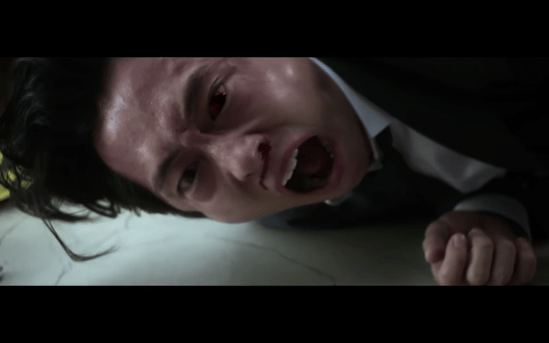
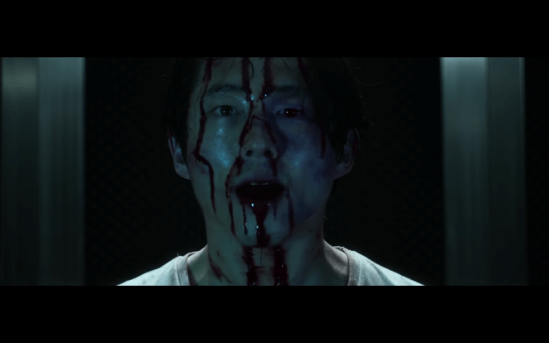
In a world under sieged from a highly contagious virus, known as the ID-7 virus, that blocks the uninhibited and explosive impulses, workaholic Derek Choe attempts to make a footprint at his ruthless, white collar firm, but lands on the receiving end of a frame job that results in a pink slip and being escorted out of the building. Before being able to walk through the exit by security, an ID-7 invasion as quarantined the office and symptoms are seeping to the surface. All hell breaks loose amongst co-workers, exacerbating the already highly caffeinated, extremely strung out, intensely coked up, and amoral aggressive behaviors of a volatile workplace environment, and an infected Choe aims to reach the top floor to violently express to the firm’s board on why they should reconsider his termination, but a drug-fueled, and also infected, boss strives to make that endeavor challenging with the assistance of his lower tiered, corporate suits.

“Mayhem” is a HR nightmare! The Joy Lynch 2017 directed action-horror film is “The Firm” meets “The Raid: Redemption!” Luckily for the viewers, “Mayhem” is a hardcore insight into unlocking all of your deepest, darkest inhibitions to the tun of explicitly telling off your boss with every four letter expletive in the book, giving your rotten colleague a firm piece of your mind, or just knocking everyone’s teeth down their smug throat. Yeah, it’s that kind of movie. Lynch (Wrong Turn 2: Dead End) runs with the first time feature film from screenwriter, Matias Caruso, who designs a virus, called the ID-7, that removes or ceases to function what defines us as human, from compassion to sympathy, in order to frankenstein a demented rendition of Donkey Kong and Caruso’s characters basically all have singular mode – asshole – but that subversive level stems from an infection induced state and the characters, deep down, maintain a slither of their original selves in an extremely dark comedic sense.

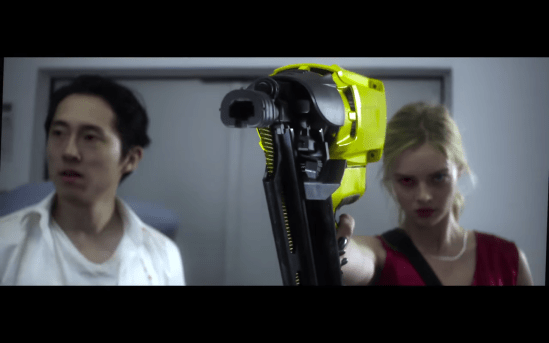
On the coattails of his character’s brutal demise on AMC’s “The Walking Dead,” Steven Yeun remains in an dimension plagued by a different kind of viral infection. Instead of blowing the brains out of walkers, Yeun brilliantly and entertainingly fills the ambitious workaholic shoes of account manager Derek Choe who literally battles his way to the top after being canned by his unscrupulous consulting firm and when the ID-7 overwhelms each and every employee. Choe is a far cry from Glenn on “The Walking Dead,” a pure hearted character with a good moral compass. Yeun’s character’s moral compass is skewed without doubt and double skewed with introduced by the virus. Choe forms an unlikely pact with a desperately disgruntled borrower Melanie Cross fighting against the firm, and the firm’s bank, looming foreclosure and the sassy, blond ass kicker, embraced by “The Babysitter’s” Samara Weaving, can chew gum and kick tail all at the same time. The pair are pitted against the some of the office’s most ruthless suits, such as a sociopathic HR enforcer known as The Reaper (played by “The Walking Dead” vet in Dallas Roberts), a manipulative snake charmer Cara Powell (Caroline Chikezie of “Æon Flux”) and at the top is none of than the big boss played by “Hellraiser: Revelations'” Steven Brand. Not only does “Mayhem” have colorful, well-scribed anchoring characters, but the supporting parts are just as well-quick-e-quipped too with Kerry Fox, Claire Dellamar, André Eriksen, and Mark Frost (“Faust”).

“Mayhem” relishes in the ferocity of that of a Mark Neveldine “Crank” franchise, but lacks a certain coherency untuned to seamlessly sustain the story to the end. Moments of purely poor editing don’t convey the full message intended, leaving much desired when considering the hero and heroine’s plight through the firm’s ruthless hierarchy to the top. These moments don’t make or break the story and are minuscule in portion size but are large enough to thwart going unnoticed. Another annoyance of how the story is told is the off screen violence. With a feature entitled “Mayhem,” by very definition states, “violent or damage disorder, chaos,” one would imagine that any and all violence would be in full display, showcased proudly and exhibited without ambivalence, and the beginning starts off energetic enough with an explosive scene of a conference room brawl involving the attendees in a all out melee, a half naked couple sexing right on the conference table, and ending the scene with a murderous gashing of one’s carotid artery. Narrating why these berserkers are killing and humping each other is Steven Yeun’s Derek Choe, setting up the ID-7 as the uninhibited virus. The violence that pursues goes into a hot or cold state where the latter involves off-screen violence, especially between Chikezie and Clarie Dellamar’s characters in a fight to the death between boss and assistant, but in a heated exchanges that had more girth in the dialogue, their actual bout screens over to Choe and Cross’ blank stare expressions and the determination of who bests who goes into a big question mark status.

RLJ Entertainment releases “Mayhem” onto various formats include a not rated DVD, Blu-ray, and streaming platforms. I am unable to comment or critique on the audio and video qualities of the film as I was provided a streaming link that didn’t include bonus material; instead, I’ll comment on how Lynch and the rest of filmmakers did a remarkable job constructing an ambiguous building structure along with the help of the two Stateside based production companies Royal Viking Entertainment and Circle of Confusion. Though the film was shot in Bulgaria, the location could have been right in downtown of your nearest city and that fairs in “Mayhem’s” success to establish anywhere as a victim to the virus or a workplace go array in the world. The next time you want to take a heavy duty Swingling stapler to you’re supervisor’s noggin for assigning to many TPS reports to you, check out “Mayhem” to instill that visceral courage and audacity to do so all the while being entertained by utter, unadulterated violence and violent thoughts and actions that usually spur underneath the breath of a common office environment.
Sion Sono’s Brings the Evil Back to the Japanese School Girls! “Tag” review!

Life is seemingly pleasant and happy-go-lucky when two fully loaded coach buses of high school girls travel down a forestry passageway toward a lakeside hotel until sudden violence and gore turns Mitsuko’s classmates into minced meat. Overcome with shock and fear, Mitsuko escapes the terror only to find herself in another horrifying scenario. The vicious cycle continues as Mitsuko is thrusted into one chaotic, blood-splattering world after another, quickly losing her identity with each threshold crossing, and with no clue of what’s going on and how she got into this limbo of hell, Mitsuko must stay alive and unearth the truth behind the surreality of her being.

Nothing is more terrifying than being in a heart-pounding situation and not having one single clue why bodies are being sliced in half like corks popping violent out of champagne bottles, why childhood mentors break their professional oath and slaughter students with a ferocity of a mini-gun, or why being chased by a tuxedo-decked out groom with a gnarly pig head is in tow ready to drop kick anything, or anybody, standing in the way. Writer-director Sion Sono manifests that very chaos entrenched world in the 2015 action-horror “Tag” and, once again, the “Suicide Girls” director puts Japanese school girls back into the harrowed ways of gore and death over salted with an existential surrealism based off a novel by Yûsuke Yamada entitled Riaru Onigokko aka Real Game of Tag. Yamada’s story is followed more closely to that of Issei Shibata’s 2008 “The Chasing World” that involves a Government influence and parallel universes, “Tag” serves more as an abstract remake that Sono masters a soft touch of irrational poetry bathed in gore and strung with chaos rectified with a tremendously talented cast of young actresses.

Actresses such as the Vienna born Reina Triendl. Being Japanese doppelgänger to Mary Elizabeth Windstead with soft round eyes and the picturesque of youthfulness, Triendl transcends tranquility and innocence when portraying a content Mitsuko in the midst of many of her classmates boorishly bearing the typical, low-level adolescent anarchy. When Mitsuko’s thrusted into phantasmagorical mayhem, Triendl steps right there with her discombobulated character in an undried eye panicky frenzy whose character then spawns into two other fleshy vessels, a pair of recognizable names of J-Pop fandom in Mariko Shinoda and Erina Mano, when Mitsuko enters another zone in her fictional world. Though different in all aspects of their appearance and in name – Misuko, Kieko, and Izumi, the three women share the same existence and fathom a unbroken entity of character that hacks her way through the brutal truth. The remaining cast, Yuki Sakurai, Aki Hiraoka, and Ami Tomite, sport the high school miniskirt wardrobe and garnish a bubbly-violent J-horror persona very unique to the genre.

“Tag” is a plethora of metaphors and undertones likely to be over-the-head of most audiences, but if paying close enough attention and understanding the subtle rhythmic pattern of Sono’s direction, the gore and the fantastic venues are all part of an intrinsic, underlining message of feminism and sex inequality that’s built inside a “man”-made, video game structure thirty years into the future. Sono points out, in the most graphic and absurd method, how men treat women like objects or playthings. There’s also a message regarding predestination with white pillow feathers being the metaphor for fate and being spontaneous is the key to break that predestined logic and all of this corresponds to how Misuko, the main character, needs to break the mold, to choose her path, and to remember her past in order to free all the women trapped inside a male-driven purgatory of pain, punishment, and pleasure. Supporting Sono’s ability to disclose an epic survival-fantasy horror in such a way comes from multiple production companies, one of them being NBCUniversal Entertainment, providing the cash flow that allows Sono to flesh out the gore, to acquire massive amount of extras, and to scout out and obtain various locations.

Eureka Entertainment presents a dual format, Blu-ray-DVD combo, of “Tag” for the first time in the United Kingdom. However, the disc provided was a feature-only screener and a critique on the video, audio, and bonus material will not be conducted, but in itself, “Tag” is a full throttle encephalon teaser warranting a need for no supplementary content aside from conventional curiosity into what makes Sono’s “Tag” tick. When all pistons are firing, from the visual effects of Satoshi Akabane to “The Walking Dead” familiar score, “Tag” is no child’s game with a heavily symbolic, touch-and-go and bloodied pro-feministic essence that would serve as an abrupt and acute wakeup call to all the Harvey Weinsteins in the world that women are not to be simply playthings and that their gender destiny lies solely with them despite the misconstrued male manipulation.
Colleen and Colleen Versus the Evil Bratzis! “Yoga Hosers” review!

Colleen Collette and Colleen McKenzie are best friends. They’re also two superficial 15-year-old girls who are nose deep into their social media campaigning cell phones, jamming in their girl punk band Glamthrax, and living by the unorthodox, yet namaste driven, yoga practices while exasperatingly working at one of girl’s father’s convenient stores called “Eh-2-Zed.” Set in the Great White North of Canada, the Winnipeg, Manitoba sophomores are surprisingly invited to a senior party, a lure by a popular, good-looking senior boy who has a darker, Satanic side to him. The Colleen girls’ run in with a murderous devil worshipping senior inadvertently opens another hidden danger lurking 37 feet beneath their “Eh-2-Zed” soles. A slumbering Nazi mad scientists has been awoken and aims to finish his Third Reich master plan to take over Canada with a cloned army of Bratzis, living Bratwurst sausages who are pint-sizes Nazis, and seeks to unleash evil upon the Manitoba Earth.

Kevin Smith’s latest pop-cultural flick, a comedy-horror feature, entitled “Yoga Hosers” is the second installment, following 2014’s film “Tusk”, in Smith’s horror-inspired trilogy known as The True North Trilogy. Did you noticed I labeled “Yoga Hosers” as a comedy-horror instead of a horror-comedy? The “Mallrats” and “Clerks” director basks more in the familiarity of witty, profane humor in this second of three films, but Kevin Smith has known to dapple, gradually stepping over to the dark side into horror with his radical religious sect piece “Red State” and, like aforementioned, the body-horror “Tusk.” The Jersey native also has an occasional appearance on AMC’s “The Talking Dead,” a talk show about “The Walking Dead’s” post-premier of each episode, and has meddled in the realm of the fantastic. Not only is Smith a strong advocate and sincerely passionate comic book enthusiast, coinciding with his own AMC show “The Comic Book Men,” but “Dogma,” starring the late Alan Rickman, delivers divine revelations and, now, with “Yoga Hosers,” a villainous Nazi clones miniature Bratwurst soldiers. Smith holds, in my opinion, one of the most extremely diverse bodies of work in our lifetime.

Where as “Tusk” goes gritty and gory with R rated horror-comedy, Smith’s intentions for “Yoga Hosers” has always leaned toward that of PG-13 and, maybe, that’s due in part of the two films’ minoring connection. The connection, presumably set in the same whacked out alternate universe, stem from the two Colleens, one played by Smith’s hysterically funny daughter, Harley Quinn Smith, and the other being Harley’s longtime, kindergarden friend Lily-Rose Depp. Yes, the daughter of mega star Johnny Depp and French singer Vanessa Paradis brings her inherited talent and French dialect to one-half of a buddy comedy. The 15-year old girls, who are also 15-year old in character, transfer their natural offscreen relationship into being an entitled millennial pair with every intent on neglecting responsibility until faced with the moment of truth. Teamed up well with Lily-Rose’s father, Johnny Depp, under the heavy makeup of a fictional French manhunter named Guy Lapointe, also from “Tusk,” with scene-to-scene rotating facial mole, the crime fighting, buddy trio awkwardly moves across the plain in an enjoyable double entendre performance of simple wit. Accompanying Depp, Smith, and Depp are an eclectic roster of Kevin Smith’s usuals such as Justin Long (“Tusk,” “Jeepers Creepers”) as a reality-severed Yoga instructor named Yogi Bayer, Jason Mewes (“Jay and Silent Bob Strike Back”) in a bit part, and, of course, Kevin Smith himself as the devilish Bratzis. New faces also make the scene with an unrecognizable Haley Joel Osment (“Sixth Sense”) as a young Canadian Nazi and “Orange is the New Black” Natasha Lyonne portraying a slutty Eh-2-Zed manager who sleeps her way to the top with Colleen C’s father, “Veep’s” Tony Hale.

“Yoga Hosers” explodes with Canadian farce that’s laced heavily with jokes on ‘aboots,’ hockey jersey-wearing patrons, an alternate version of Lucky Charms called Pucky Charms, and many more stereotypical references that satirically poke a good humored finger at Canadian culture and pop-culture. To top this satire sundae, the smug Colleens define the very title of the film with their dimwitted sludge and white girl yoga written into every storyboard moment. “Yoga Hosers'” buddy film concept gives an opportunity to two young and clueless teen girls who genre pirate the story with a jalopy of unsystematic plot humor, sucking away and discarding like garbage the sole ounce of blended “Gremlins” and “Puppet Master” cavalier subgenre horror that’s comfortably pleasant and inarguable right for a fun film of this triviality. Though I think the Colleens’ have had their story told, I’m intrigued to see what the pair of aloof teens offer in Smith’s third film of the trilogy, “Moose Jaws.”

MVDVisual distributes a dual format Blu-ray, DVD, and Digital HD release of the various production companies’, including main investor, Invincible Pictures, and Kevin Smith’s founded SModcast Pictures, “Yoga Hosers.” The Blu-ray disc is a MPEG-2 encoded 1080p transfer with a 2.38:1 presentation and, rarely, flutters under a mediocre bitrate. Image brightens with a glossy coating that revels in brighter hues of blue, pink, orange, and yellow while starker bolds such as red and purple pop with vividness. Yet, sharp details are thin, less defined to bring high definition to present technological age. The English Dolby Digital 5.1 track slightly elevates the ambient noise, especially during the girls’ punk rock practice that muffles out portions of their vocals, yet still manages to vary and balance. The only bonus feature available is a behind-the-scenes featurette that includes some insightful interviews. “Yoga Hosers” oppresses a melancholy reminder that the old Kevin Smith is no more and dawns a Kevin Smith 2.0 who transforms his satirical trademarks and his witty banter into strange misadventures, involving, in this case, two teenage fools flighting from one sub-narrative to another in a mixed bag of comedy and inferior minion horror.

Evil Joins the Mile High Club! “Flight 7500” review!

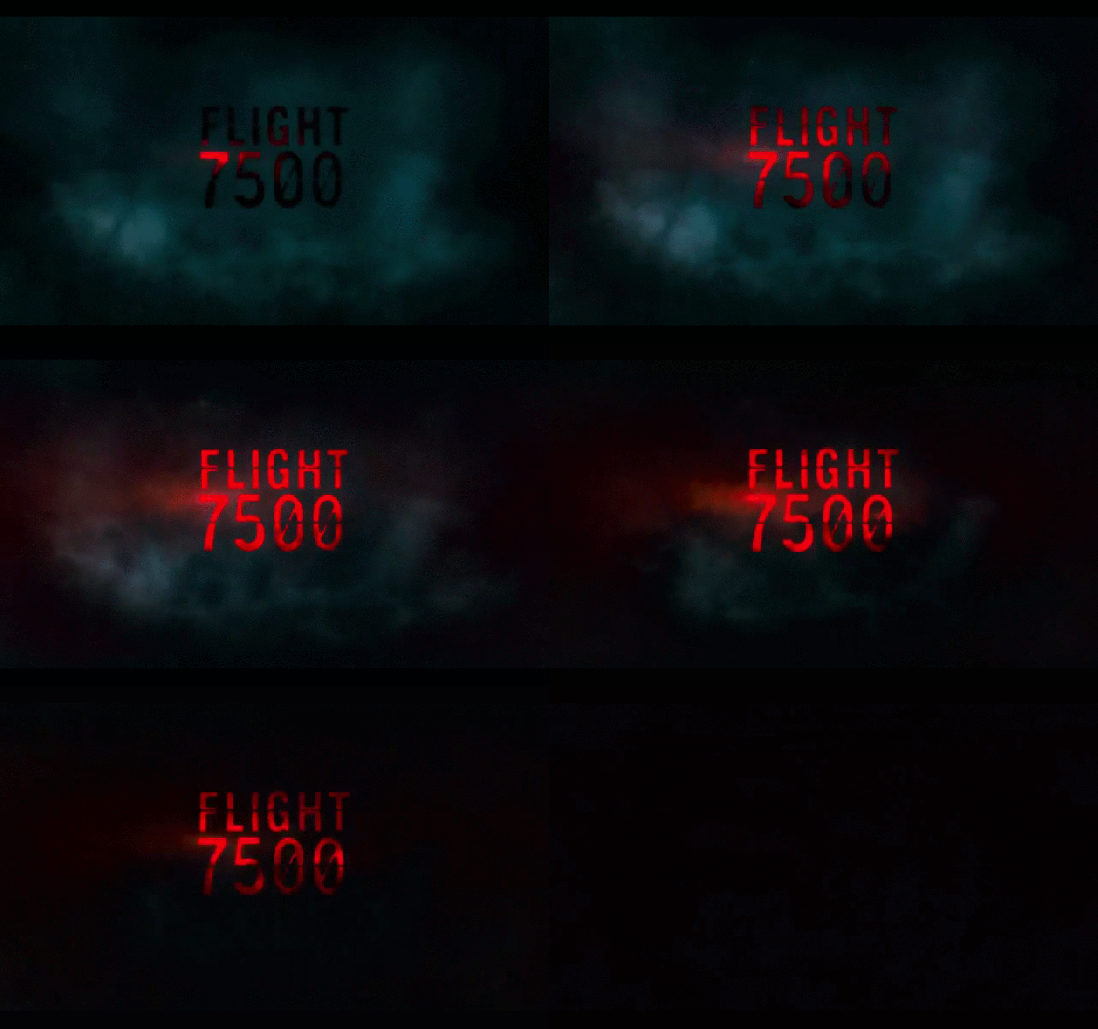
The transpacific Vista Pacific Flight 7500 from Los Angeles to Tokyo should have been a long, but relaxing overnight ten hour flight for many of the traveling passengers. After experiencing heart-stopping turbulence, the flight’s most mysterious passenger dies suddenly and violently over the pacific ocean. His death releases a string of strange apparition encounters with rest of the passengers and the crew that literally grapple at their internal fears. As the supernatural force slowly engulfs every inch of the plane, passengers disappear one-by-one and the key to possibly stopping the remorseless evil that has betaken them is to investigate into the unexpected death of the mysterious passenger and into his on-flight baggage.
Ju-on: The Grudge director Takashi Shimizu terrorizes the skies with his trademark macabre of supernatural entities. Shimizu’s “Fightly 7500” mixes Japanese culture with Hollywood cinematic values while also, literally, connecting L.A. with Tokyo with a flight over the pacific. Nothing is scarier than being trapped with no where to run from a menacing force on a pressurized plane that could fail on any given moment. The plane becomes a synonym for death. Shimizu exemplifies the given unforeseen horrors of a plane by adding in the exterior motive of a trembling, and extremely creepy, Shinigami death doll, which allows suddenly dispatched spirits to spook and terrorize. Sinister spirits are unable let go of their robbed mortality. Shimizu couldn’t help but include numerously his trademarks of limbs jutting out suddenly, reaching to grab a surprised victim to face their fate or slowly overcoming an obstacle such as in this film a hand reaching over the edge of a suitcase or springing out of a small airplane trash receptacle.

The cast is made up of relatively recognizable and more modern day horror vets with Amy Smart (“Mirrors”), Scout-Taylor Compton (“Halloween I & II” remakes), “True Blood’s” Ryan Kwanten, Leslie Bibb (The Midnight Meat Train), Rosita Espinosa herself from “The Walking Dead” Christian Serratos, and Jamie Chung (“Sorority Row” remake). Nicky Whelan, Jerry Ferrera, Alex Frost, Rick Kelly, and Johnathon Schaech round out the rest of the cast. The under the radar, non-mainstream cast play their roles respectively and accordingly to the script written by the serial B-horror writer Craig Rosenberg, building up their conflicting outer lives before they’re all crammed into a single jumbo jet liner. However, the instance of too many characters cause each of character’s development to fall flatlined due in part to the measly 80 minute runtime.

Like previous Shimizu ghost features, nothing is what it seems and “Flight 7500” is no exception to that fact, but in trying to build a monumental case to deliver a shock in the finale, various mishaps raise questions that don’t add up the surprising reveal. A couple brain scratching questions rise to the surface, stemming from the following: There were two different midair turbulent events in which both were significant, but the one the film specifies isn’t the one referenced back to the catalyst turn of events in dooming the passengers to a remaining ride of rampaging terror. Also, when the phantasmal mystery becomes resolved and the characters’ realize the understanding behind their strife, the plane’s onboard television transmit a newscast explaining the events that happened to “Flight 7500,” but the divulging is ridiculously forced and a road less traveled trick. The newscast exposition comes as if there isn’t any other means of communicating the characters’ situation, putting in the ground, six-feet under, the mood of the ah-ha moment.

The Lionsgate and CBS Films collaboration presents the 2014 PG-13 feature on DVD in a 16×9 widescreen format with a crisp, LFE heavy English 5.1 Dolby Digital audio. The experienced director of photography David Tattersall uses a vibrant, almost neon-like, dark blue tone that sets appropriately the coldness of thrilling spirits and the lifelessness of mechanical plane setting. The Tyler Bates soundtrack feels as inexpensive as the film’s modest budget which is disappointing from Bates whose had solids scores for Zack Snyder’s epic-extravaganza “300” and superhero-melodrama “Watchmen” while also doing John Carpenter justice in re-imagining the “Halloween” theme. “Flight 7500’s” “The Grudge” like effects stay the plotted course given by this director and embodies the airplane as a haunted house in the sky, soaring through living fog, jutting grey hands, and a presence that can’t be shaken. The overall experience doesn’t have a perfect touchdown landing on the runway, but at least the Takashi Shimizu airplane horror doesn’t crash and burn either, leaving viewers walking away safe and satisfied at their journey’s final destination.